
Poets' Corner at Westminster Abbey: Commemoration of British Writers
Poets' Corner at Westminster Abbey: history of commemorations, burials and memorials honoring British poets, playwrights and writers, plus selection practices and modern additions
Overview
Poets' Corner is the informal name given to a part of the south transept in Westminster Abbey where poets, dramatists and other writers have been commemorated over several centuries. The area contains a mixture of actual burials and memorial plaques or monuments that honour individuals for their contributions to British literature and culture.
Image gallery
2 Images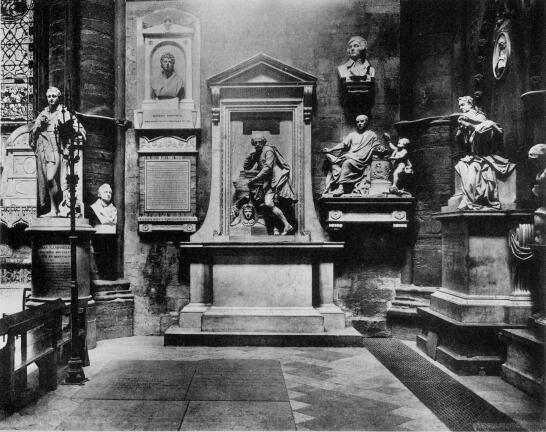

History and development
The site's literary associations date back to the medieval period. Geoffrey Chaucer was buried in Westminster Abbey at the beginning of the 15th century, and a prominent tomb and memorial connected with him was in place by the mid-16th century. Later burials nearby, most notably that of Edmund Spenser at the end of the 16th century, helped cement the area’s reputation as a place to mark the lives of distinguished literary figures.
Commemoration practice
Commemoration in Poets' Corner is selective rather than automatic. Proposals for new monuments or inscriptions are considered and approved by the Abbey’s authorities, and both the form of the tribute and whether remains are interred are decided on a case-by-case basis. As a result, some celebrated writers were not honoured there immediately after their deaths. For example, Lord Byron, who died in 1824, did not receive a memorial in the corner until 1969.
Recent examples
- The Poet Laureate Ted Hughes was given a memorial in Poets' Corner on 6 December 2011.
- C. S. Lewis was commemorated there on 22 November 2013, the fiftieth anniversary of his death.
Significance
Poets' Corner functions as a symbolic centre for the remembrance of writers who have had a lasting impact on British letters. It continues to attract public interest and ceremonial attention whenever a new name is added, reflecting changing attitudes about literary reputation and national memory.
Questions and answers
Q: What is Poets' Corner?
A: Poets' Corner is an area in the south transept of Westminster Abbey where many people have been buried in recognition of their contributions to British culture, mostly poets, playwrights, and writers.
Q: Who was the first person buried in Poets' Corner?
A: Geoffrey Chaucer was the first person buried in Poets' Corner in 1556.
Q: When was the tradition of burying literary notables in Poets' Corner established?
A: The tradition of burying literary notables in Poets' Corner was established when Edmund Spenser was buried nearby.
Q: Who was the most recently commemorated person in Poets' Corner?
A: Poet Laureate Ted Hughes was the most recently commemorated person in Poets' Corner on 6 December 2011.
Q: Who will be the next person to be commemorated in Poets' Corner and when?
A: Writer C. S. Lewis will be the next person to be commemorated in Poets' Corner on 22 November 2013, the fiftieth anniversary of his death.
Q: Is burial in Poets' Corner automatic following death?
A: No, burial in Poets' Corner is not automatic following death. Lord Byron died in 1824, for example, but a memorial in the corner was not raised to him until 1969.
Q: Who qualifies to be buried in Poets' Corner?
A: Those who have made significant contributions to British culture, mostly poets, playwrights, and writers, qualify to be buried or commemorated in Poets' Corner.
Related articles
Author
AlegsaOnline.com Poets' Corner at Westminster Abbey: Commemoration of British Writers Leandro Alegsa
URL: https://en.alegsaonline.com/art/77595