
Poblet Monastery — Royal Abbey of Santa Maria de Poblet
A major Cistercian abbey in Catalonia founded in 1150. Poblet served as a royal pantheon for the Crown of Aragon and is notable for its Gothic architecture, history, and UNESCO recognition.
Overview
The Royal Abbey of Santa Maria de Poblet, commonly called Poblet Monastery, is a Cistercian house founded in 1150 at the foot of the Prades Mountains in the comarca of Conca de Barberà. Its Catalan name is often given as Reial Monestir de Santa Maria de Poblet. The complex sits in Catalonia, a region of Spain, and is one of the most complete and best-preserved medieval monastic ensembles in Europe. It belongs to the Cistercian tradition (Cistercians) and historically formed the so-called "Cistercian triangle" together with Santes Creus and Vallbona de les Monges.
Image gallery
10 Images


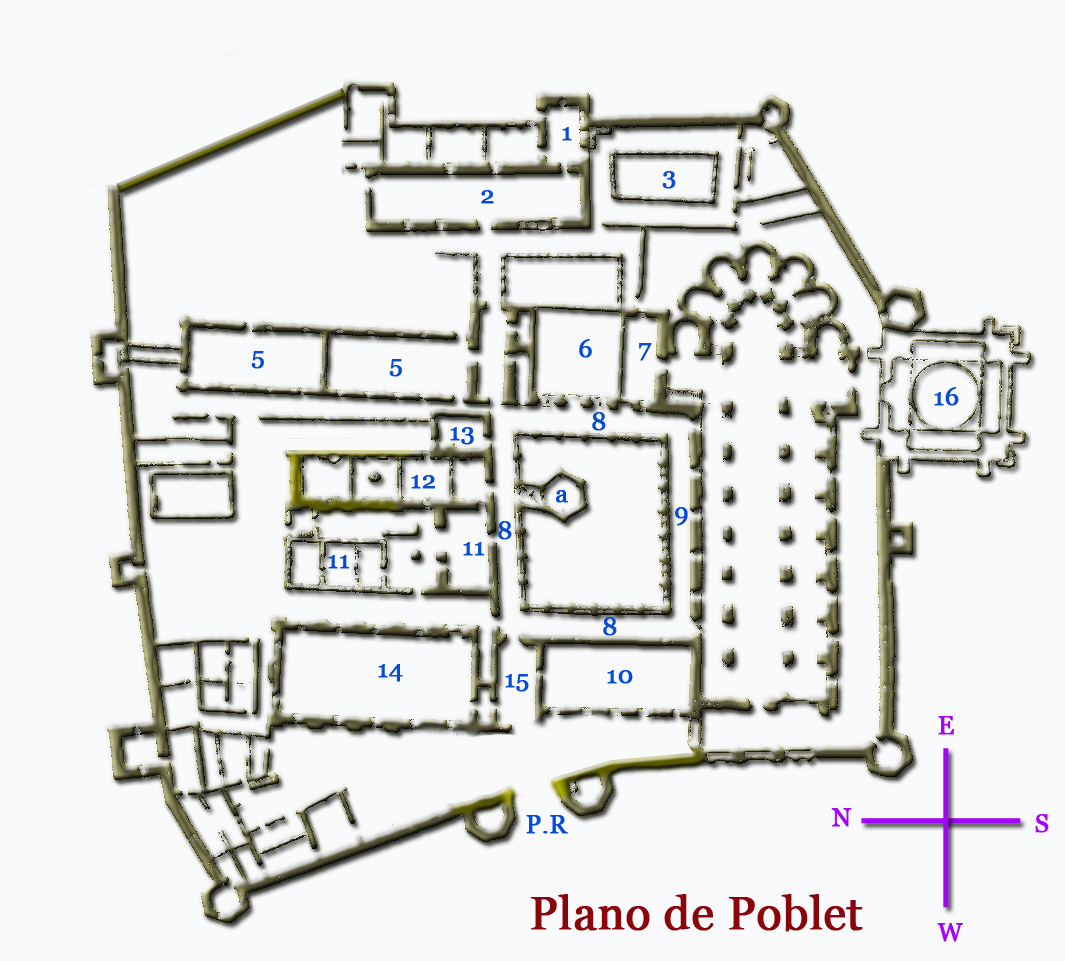


Architecture and principal parts
Poblet's plan follows the Cistercian model adapted over centuries. The ensemble includes the abbey church, cloister, chapter house, dormitory, refectory and ancillary buildings. Architectural styles range from Romanesque beginnings to Catalan Gothic refinements introduced in later medieval phases. Notable artistic features include sculpted capitals, vaulted interiors, a monumental west front and a royal pantheon where members of the Crown of Aragon were interred. The later medieval master-builder Arnau Bargués contributed to some of the Gothic work and restorations.
History and development
Founded by Ramon Berenguer IV, Count of Barcelona, Poblet became a major religious and political center in medieval Catalonia. It was endowed by the counts and later kings of Aragon, who used the abbey as a dynastic burial place. Over the centuries the community grew in wealth and influence, commissioning extensions and artistic programs. Like many Spanish monasteries, Poblet suffered decline and partial abandonment during 19th-century secularization policies, and it underwent significant restoration and monastic reoccupation in the 20th century.
Importance and uses
Beyond its religious function, Poblet served as a cultural repository, a site for royal ceremonies and a symbol of dynastic legitimacy. Today it continues as a living monastery while also functioning as a historical monument, museum and destination for pilgrims and visitors. The abbey was recognized for its outstanding universal value and protection when it entered the list of World Heritage Sites; it remains a focus for research into medieval monasticism, Catalan art and Gothic architecture.
Visiting, conservation and notable facts
- Visitors can explore the church, cloister and royal tombs and learn about monastic life through guided tours.
- The site has been the subject of careful conservation to preserve original masonry, sculptures and painted elements.
- Poblet forms part of wider cultural itineraries in Catalonia and attracts international interest for its architecture and history.
- As an institutional link to broader Cistercian history, information and comparative studies are often referenced through resources about the Cistercians and other monastic houses like Santes Creus.
- For general national context about the site's location and heritage policies see resources on Spain.
Poblet remains both a place of worship and a protected cultural landmark, notable for the continuity of monastic presence, the quality of its medieval architecture and its role in the historical narrative of the Crown of Aragon.
Questions and answers
Q: What is the Poblet Monastery?
A: The Poblet Monastery is a Cistercian monastery located in Catalonia, Spain.
Q: Who founded the Poblet Monastery?
A: The Poblet Monastery was founded by Ramon Berenguer IV, Count of Barcelona.
Q: When was the Poblet Monastery founded?
A: The Poblet Monastery was founded in 1150.
Q: Where is the Poblet Monastery located?
A: The Poblet Monastery is located at the feet of the Prades Mountains, in the comarca of Conca de Barberà, in Catalonia (Spain).
Q: What other two monasteries make up the "Cistercian triangle" besides Poblet Monastery?
A: The other two monasteries that make up the "Cistercian triangle" are Vallbona de les Monges and Santes Creus.
Q: Who was the main architect of the Poblet Monastery?
A: The main architect of the Poblet Monastery was Arnau Bargués.
Q: What type of monastery is the Poblet Monastery?
A: The Poblet Monastery is a Cistercian monastery.
Related articles
Author
AlegsaOnline.com Poblet Monastery — Royal Abbey of Santa Maria de Poblet Leandro Alegsa
URL: https://en.alegsaonline.com/art/77560
Sources
- mcu.es : "Monasterio de Poblet"
- poblet.cat : Tombes reials