
Pledge of Allegiance (United States)
A civic oath expressing loyalty to the U.S. flag and republic, its origins, wording changes, legal history, public uses, and recurring debates over religion and compulsory recitation.
The Pledge of Allegiance is a short oath of loyalty traditionally recited in the United States to express allegiance to the nation and its symbol, the flag. It is commonly spoken at civic events, school gatherings, and before government meetings. The Pledge links patriotic language to the visual emblem of the country and is one of several rituals—alongside the national anthem—used to mark national identity.
Image gallery
8 Images


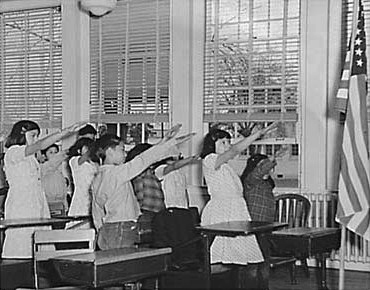
Text and common practice
In public settings participants often stand facing the flag, place the right hand over the heart, and recite the words together. The spoken text has been altered several times since its creation; the current widely recognized wording includes a phrase about being "under God," added in the mid‑20th century. The ritual can be voluntary or customary, and practice varies by institution and state.
History and development
The pledge originated in the late 19th century as a brief expression designed for use in schools and patriotic observances. An early version was written in 1887, and a revised form was published in 1892. Over subsequent decades the wording and associated gestures were modified. Congress formally recognized a standard text in the early 1940s, and an additional phrase invoking a deity was inserted by federal legislation in the 1950s during a period of heightened Cold War symbolism.
Legal status and controversies
The Pledge has been the subject of legal and public debate. Courts have addressed whether public institutions may require students to recite it and whether particular phrases conflict with constitutional protections. A landmark Supreme Court decision in the 1940s protected individual choice by ruling that students cannot be compelled by the state to salute or recite the Pledge. Since then, challenges have focused on the religious wording introduced in the 1950s and on the balance between patriotic ceremony and freedom of conscience.
Uses and notable distinctions
- The Pledge is used routinely in many public schools, though participation is not mandatory under current constitutional interpretation.
- It is often recited at civic meetings, before sporting events, and at commemorations.
- It differs from the national anthem, which is a song; the Pledge is a spoken oath linked specifically to the flag and to allegiance to the republic.
Readers seeking primary sources or official versions may consult government or educational materials; for background on the flag as a symbol see the entry on the flag.
Questions and answers
Q: What is the Pledge of Allegiance?
A: The Pledge of Allegiance is an expression of allegiance to the Flag of the United States and the republic of the United States of America.
Q: Who originally composed the Pledge of Allegiance?
A: Colonel George Balch originally composed the Pledge of Allegiance in 1887.
Q: Who made changes to the original Pledge of Allegiance?
A: Francis Bellamy made changes to the original Pledge of Allegiance in 1892.
Q: Was the Pledge of Allegiance formally adopted by the Congress?
A: Yes, the Pledge of Allegiance was formally adopted by the Congress as the pledge in 1942.
Q: What is the purpose of the Pledge of Allegiance?
A: The purpose of the Pledge of Allegiance is to express allegiance to the Flag of the United States and the republic of the United States of America.
Q: Why was the Pledge of Allegiance created?
A: The Pledge of Allegiance was created to foster patriotism and loyalty among citizens of the United States.
Q: Who is responsible for changing the original Pledge of Allegiance?
A: Francis Bellamy is responsible for changing the original Pledge of Allegiance.
Author
AlegsaOnline.com Pledge of Allegiance (United States) Leandro Alegsa
URL: https://en.alegsaonline.com/art/77445
Sources
- books.google.com : Teachers Magazine for Primary Grades
- wsj.com : "One Nation, Indivisible"
- worldcat.org : 0099-9660
- goordnance.army.mil : "Captain and Brevet Lieutenant Colonel George T. Balch, Ordnance Corps Hall of Fame Inductee 2001, U.S. Army Ordnance Corps"
- pbs.org : "Society & Community. Faith in America: The Legal Dilemma"