
Platypus (Ornithorhynchus anatinus)
The platypus is a distinctive egg-laying, semi-aquatic mammal native to eastern Australia and Tasmania, notable for its bill, electroreception, and mixture of reptilian and mammalian traits.
The platypus (Ornithorhynchus anatinus) is a small, semi-aquatic small mammal native to eastern Australia and Tasmania. It is one of the few surviving egg-laying mammals and has long been the subject of scientific fascination because it combines features found in mammals, birds and reptiles. The singular and the plural are commonly both rendered as platypus.
Image gallery
10 Images




Physical characteristics
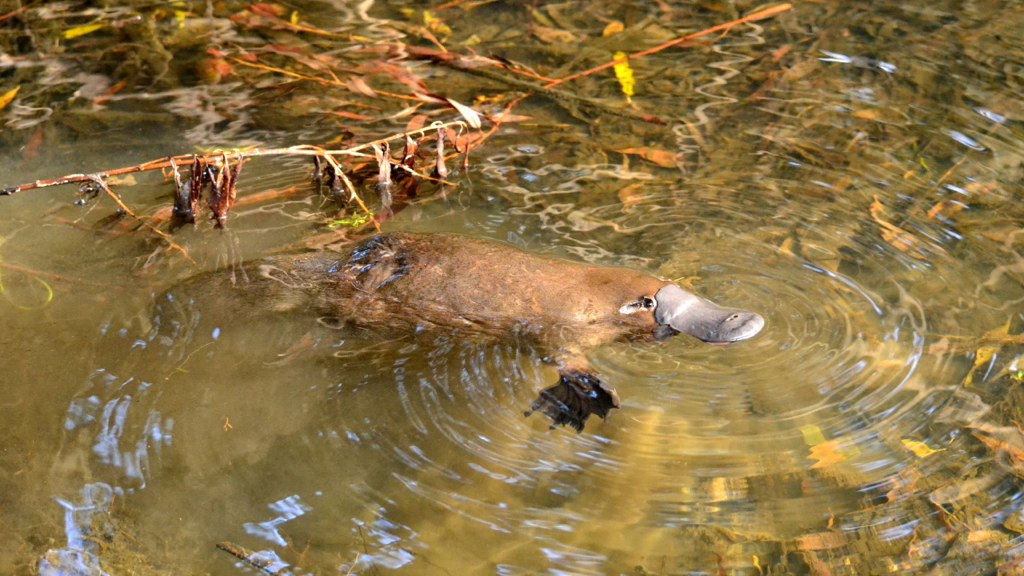
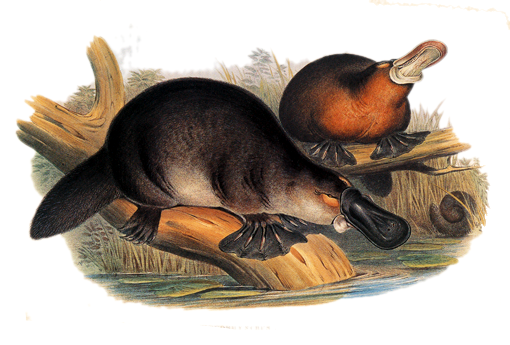
Platypuses are adapted to life in freshwater. Their most conspicuous feature is a broad, flattened bill covered in soft skin that houses hundreds of electroreceptors, enabling them to detect the weak electric fields generated by prey. They have dense, waterproof fur, webbed forefeet for swimming, and a broad tail that stores fat and helps steer underwater. Males carry a sharp spur on each hind leg that can deliver venom strong enough to cause severe pain in humans—an unusual trait among mammals.
Habitat and diet
Platypuses inhabit streams, rivers and freshwater lakes and are most often associated with deep banks where they dig burrows. They forage underwater for aquatic invertebrates, insect larvae and small crustaceans, using their bill to locate food while submerged. Typical habitats include slow-moving waterways and wetlands; see further notes on distribution and riparian dependence at rivers and riverbanks.
Reproduction and lifecycle
Along with the echidna, the platypus is a monotreme, a group of mammals that lay eggs rather than giving birth to live young. The echidna group contains four species and together they illustrate an early branch of mammalian evolution. Female platypuses lay one to a few leathery eggs and incubate them in a burrow. After hatching, the young feed on milk secreted from the mother’s mammary glands; monotremes lack nipples and the milk is absorbed from patches of skin.
Senses, anatomy and classification
Monotremes are distinguished from other mammals by a suite of primitive anatomical features, including a single posterior opening called the cloaca, through which both reproductive products and urine and faeces are expelled. This arrangement is often described as basal within the larger assemblage of vertebrates known as the tetrapods. Modern studies emphasize that platypuses combine ancestral and derived traits—egg-laying and a cloaca alongside fur, milk production and a seven-boned middle ear typical of mammals. Their bill’s electroreception and the male venom spur are particularly notable specializations.
History, research and cultural significance
European naturalists first encountered the platypus in the late 18th and early 19th centuries; initial reports and specimens baffled some scientists who thought the animal might be a hoax. Since then it has become emblematic of Australia’s unique fauna and a subject of research into evolution, sensory biology and mammalian origins. Information on taxonomy, ongoing studies and natural history can be explored via general references and specialist summaries at authoritative sites such as monotremes resources.
Conservation and notable concerns
Although not uniformly rare across its range, the platypus faces threats that include habitat destruction, river regulation, water pollution and climate-driven drying of waterways. Local declines have been reported and conservationists emphasize protecting riparian habitats, maintaining water quality, and monitoring populations. Key aspects to consider when assessing platypus status include habitat connectivity, breeding sites and the impacts of invasive species and land use changes.
- Notable features: electroreceptive bill, venomous spur (males), egg-laying, dense fur.
- Close relatives and taxonomic notes: see echidna and broader monotremes.
- Habitats: freshwater systems—see rivers and riverbanks—and conservation guidance from regional authorities.
For introductory material and species overviews consult general summaries and natural history accounts; for technical literature, specialists provide detailed findings about genetics, physiology and ecology that illuminate how this unusual mammal evolved and persists in modern Australian landscapes.
Questions and answers
Q: What is the duck-billed platypus?
A: The duck-billed platypus is a small mammal and one of only two monotremes that survive today.
Q: Where does the platypus live?
A: The platypus lives in eastern Australia, in rivers and river banks.
Q: What is the plural of platypus?
A: The plural of platypus is just 'platypus'.
Q: How many families of mammals lay eggs?
A: Only two families of mammals lay eggs, and the platypus is one of them. The other is the Echidna, which has four species.
Q: When was the platypus first described in detail?
A: The platypus was first described in detail in the early 19th century.
Q: Why are monotremes called monotremes?
A: Monotremes are called monotremes because they have a common rear opening, the cloaca. Through this opening faeces and urine are voided (put out), and sexual activity takes place.
Q: Which mammals have the system where the rear has two openings?
A: The later ('derived') mammals have the system where the rear has two openings, while monotremes, birds, and reptiles have a common cloaca.
Related articles
Author
AlegsaOnline.com Platypus (Ornithorhynchus anatinus) Leandro Alegsa
URL: https://en.alegsaonline.com/art/77375
Sources
- departments.bucknell.edu : "Order Monotremata"
- google.com : Mammal Species of the World: A Taxonomic and Geographic Reference
- worldcat.org : 62265494
- doi.org : 10.2305/IUCN.UK.2016-1.RLTS.T40488A21964009.en
- dpiw.tas.gov.au : "Platypus"
- books.google.com : Platypus: the extraordinary story of how a curious creature baffled the world
- bbc.co.uk : "Wildlife Finder - Platypus"
- platypus.asn.au : "Venom"
- epa.qld.gov.au : "Platypus"
- abc.net.au : "Kangaroo Island"
- clw.csiro.au : "Impacts of water management in the Murray-Darling Basin on the platypus (Ornithorhynchus anatinus) and the water rat (Hydromus chrysogaster)"
- epa.qld.gov.au : "David Fleay's achievements"
- abc.net.au : "Platypus"