
Planaria — freshwater flatworms noted for simple bodies and regeneration
Planaria are free-living flatworms mostly in freshwater or damp habitats. They possess simple organ systems, are hermaphroditic, and can regenerate lost parts, making them valuable model organisms.
Planaria is a common name applied to a group of small, free-living flatworms within the phylum Platyhelminthes. Many familiar species are included in genera such as Dugesia and related taxa; for an overview of their classification see taxonomic notes and a general flatworm overview. These animals are typically found in freshwater ponds, streams and springs, and in moist terrestrial microhabitats beneath stones or leaf litter. They move by gliding on a carpet of cilia while also using muscular waves, producing a smooth, wave-like locomotion across submerged surfaces.
Image gallery
3 Images

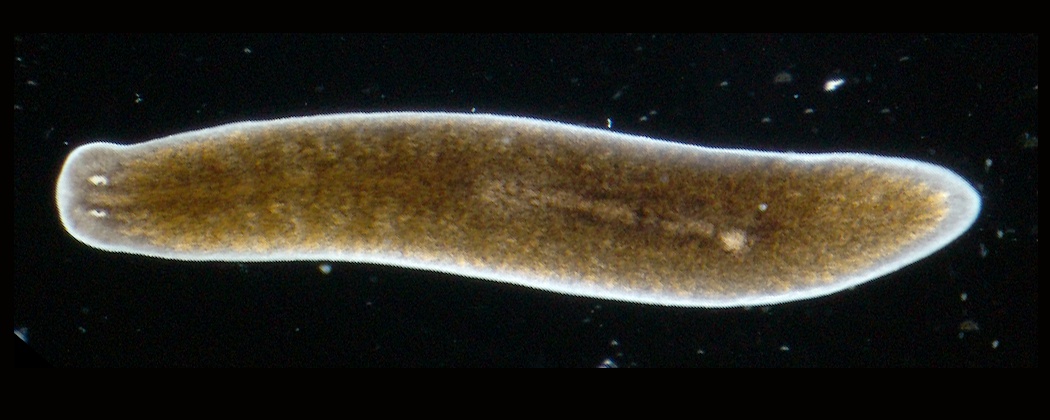
Anatomy and external features
Planarians have a dorsoventrally flattened body that increases the surface area available for diffusion. The anterior region often bears a pair of photoreceptive eyespots and sensory lobes or auricles used in chemoreception; the light-sensitive eyes help them detect the direction and intensity of illumination (light perception and eyespots) so they typically avoid bright surfaces. The epidermis is ciliated on the ventral side, and beneath it are three primary muscle layers — circular, longitudinal and diagonal — that permit crawling, twisting and shape changes. They lack an external skeleton and rely on a hydrostatic and muscular system for support and movement (absence of skeleton).
Internal systems: digestion, respiration and nervous system
The digestive system centres on a ventral mouth, an eversible pharynx and a branching gastrovascular cavity. Food can be externally digested by enzymes secreted from the mouth region and pharynx; partially digested material is then ingested and distributed through the branched gut, where nutrients are taken up by surrounding cells (digestive enzymes) and then spread by diffusion (nutrient distribution). Because planarians lack specialized circulatory or respiratory organs, gases move directly across the body surface by diffusion: oxygen enters and carbon dioxide leaves across the thin epidermis (no circulatory/respiratory system, gas exchange).
The nervous system is relatively simple but organized. A pair of cerebral ganglia located under the eyespots connects to longitudinal nerve cords that run the length of the body, forming a ladder-like arrangement that enables coordinated movement and basic sensory processing. This system supports behavioral responses such as phototaxis, chemotaxis and simple forms of learning and habituation.
Reproduction and regeneration
Most planarians are hermaphroditic and possess both male and female reproductive structures, including testes and ovaries; for anatomical details see gonadal structures. Sexual reproduction involves the exchange of sperm between individuals and internal fertilization, followed by the production of eggs that develop into juveniles (sperm, eggs, sexual reproduction). Many species are also capable of asexual reproduction: transverse fission produces two fragments that regenerate missing parts and become complete animals (asexual reproduction).
A defining biological feature of planarians is their regenerative capacity. When a planarian is cut or fragmented, specialized proliferative cells called neoblasts migrate to wounds, proliferate and differentiate to replace lost tissues, enabling regeneration of entire heads, tails or other structures (regeneration and stem cells). Regeneration has made planarians a central study system in developmental biology and stem cell research.
Ecology, diet and behavior
Planarians are generally opportunistic feeders and may scavenge dead matter or prey on small invertebrates such as insect larvae, crustaceans and other worms. They locate food using chemosensory cues, moving toward attractive signals and away from adverse stimuli. Many species favour shaded, cool microenvironments and will move away from intense light, a behavior linked to survival and predator avoidance. The balance between sexual and asexual reproduction in wild populations depends on species biology and local environmental conditions; asexual fission is frequent in some taxa and rare in others.
Research and practical considerations
Because of their simple, accessible body plan and powerful regenerative ability, planarians are widely used in laboratories to study regeneration, pattern formation, neurobiology and toxicology. They are inexpensive to maintain and amenable to experiments that examine the effects of environmental factors or chemical exposures on behaviour and development. Practical notes for care and handling emphasise clean water, stable temperatures and appropriate food sources to keep cultures healthy.
For further reading on comparative anatomy, ecological roles, and reproductive strategies consult introductory summaries on taxonomy and physiology (flatworm overview), hermaphroditic reproduction (hermaphroditism), and more focused discussions of feeding mechanics (enzyme action in digestion) and regeneration mechanisms (neoblasts and regeneration). Additional resources cover the distribution of nutrients within the gastrovascular cavity (nutrient transport), the lack of circulatory structures (circulatory absence), the anatomy of reproductive organs (ovaries and testes), and comparisons of sexual versus asexual reproduction modes (sexual reproduction, asexual fission).
Planarians remain important both as subjects for fundamental biological research and as accessible examples of how relatively simple animals solve physiological problems such as gas exchange, nutrient distribution and tissue repair. Because many claims about detailed cellular mechanisms continue to be refined by ongoing research, general descriptions here emphasise broadly accepted features and avoid overstatement of unresolved specifics.
Questions and answers
Q: What type of animal is Planaria?
A: Planaria is a small aquatic genus of flatworm. The term is also used for other similar flatworms. They are fresh water animals which move in a smooth wave-like manner.
Q: How do Planaria reproduce?
A: To reproduce, a planarian releases eggs and sperm into the water, where the eggs get fertilized. Planarians can also reproduce through asexual reproduction, which involves splitting and regenerating parts that are missing.
Q: What does the nervous system of Planaria consist of?
A: The nervous system of Planaria consists of ganglia under the eyespots and a cord of nerves that run down the body, under the gut (ventral nerve cord). The three pairs of ganglia under the eyespots make an inverted U shape with nerves sticking out to the outside of the head so that it is more sensitive than other parts of its body.
Q: What does their digestive system consist of?
A: The digestive system of Planaria consists of a mouth, pharynx and gut cavity. Digestive enzymes are released from its mouth onto food to soften it before it gets sucked up into its stomach. From there, nutrients diffuse into the restof its body.
Q: Do they have circulatory or respiratory systems?
A: No, planarians do not have circulatory or respiratory systems; oxygen enters and carbon dioxide leaves their bodies by diffusing through their body wall instead.
Q: Do they have skeletons?
A: No, planarians do not have skeletons; they have an extendable crumpled muscle that allows them to move as well as three layers constructed with circular muscle fibers and longer muscle threads instead.
Q: How many ways can planarians reproduce?
A:Planarians can reproduce both sexually and asexually; sexually by having sex with another planarian and asexually by splitting and regenerating parts that are missing from their bodies
Related articles
Author
AlegsaOnline.com Planaria — freshwater flatworms noted for simple bodies and regeneration Leandro Alegsa
URL: https://en.alegsaonline.com/art/77237
Sources
- bioone.org : bioone.org/doi/pdf/10.2108/zsj.19.1123