
Pizzicato: the plucked technique for bowed string instruments
Pizzicato is the technique of plucking the strings of bowed instruments to produce a short, percussive sound. This article explains methods, notation, history, musical uses and common variants.
Overview
Pizzicato is the musical technique of producing sound on a stringed instrument by plucking the string with a finger rather than using the bow. On orchestral instruments such as the string instrument family this produces a short, struck tone that contrasts with sustained bowed notes. The basic action is to take hold of a string with a fingertip or nail and release it quickly so it vibrates freely; the finger itself is often simply called a finger in instructional references.
Image gallery
2 Images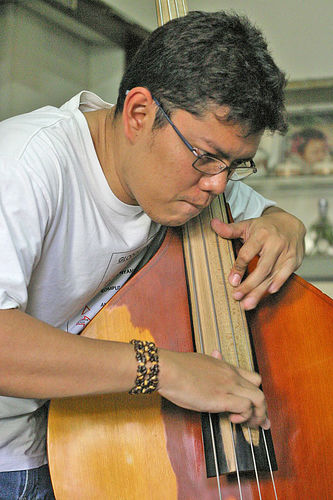

Instruments and common practice
Although instruments like the violin, viola, cello and double bass are primarily played with a bow, composers frequently ask for pizzicato to achieve different tonal colours and rhythmic emphasis. In chamber and solo repertoire, players switch between bowing and plucking to shape phrases or create special effects.
Technique and variants
Basic right‑hand pizzicato is the standard pluck with the dominant hand. Left‑hand pizzicato is executed by plucking a string with a finger of the hand that normally stops notes on the fingerboard; it is useful in rapid passages or when the right hand is occupied. There are several recognizable variants:
- Ordinary pizzicato: a gentle pluck producing a warm, short tone.
- Snap or percussive pizzicato (often called Bartók pizzicato): the string is snapped back onto the fingerboard for an accented, snapping sound.
- Harmonic pizzicato: plucking at or near a nodal point to produce natural harmonics.
Notation and performance
In printed music the instruction to pluck is commonly indicated with the abbreviation "pizz." (short for "pizzicato"). When the composer wants the bow restored, the score will show "arco," the Italian word for "bow." Contemporary scores may also label special effects explicitly (for example "Bartók pizz." or with a specific symbol) to clarify the intended attack or degree of force.
History and musical uses
Pizzicato has been used since the Baroque era as a coloristic device and grew in importance through the Classical, Romantic and modern periods. Composers exploited its dry, rhythmic quality for passages that require clarity, playful textures, or percussive emphasis. It appears in orchestral tutti, string quartets and solo works, and is a standard expressive resource in film music and contemporary ensembles.
Practical considerations and distinctions
Players vary where they pluck along the string to change timbre: closer to the fingerboard yields a softer, rounder sound; nearer the bridge gives a brighter, more metallic tone. Pizzicato differs fundamentally from plucked chordal techniques on guitar or plucked instruments because the bowed strings are primarily designed for sustained bowing; therefore pizzicato is usually shorter and less sustained. For further reading on technique, pedagogy and repertoire see resources linked by composers and instrument specialists such as composer studies and instrument manuals. Additional introductory material is available for string pedagogy at string instrument guides and technique collections (finger placement and exercises), and in practical editions for violin, viola, cello and double bass ensembles. Many modern scores also include special notation instructions alongside the usual "pizz." and "arco" indications (bow and pluck contrasts) to guide the performer and convey the desired sound color (composer intent).
Questions and answers
Q: What is pizzicato?
A: Pizzicato is a method of playing string instruments by plucking the strings.
Q: Which instruments are usually played with a bow?
A: Instruments such as the violin, viola, cello and double bass are usually played with a bow.
Q: How do composers indicate that a player should pluck instead of bow?
A: Composers indicate that a player should pluck instead of bow by writing the word "pizzicato" or "pizz" in the music.
Q: What is the Italian word for bow?
A: The Italian word for bow is "arco".
Q: How is the word "arco" used in music notation?
A: The word "arco" is written in the music to indicate that the player has to play with the bow again.
Q: Can a string instrument be played exclusively using pizzicato?
A: Yes, a string instrument can be played exclusively using pizzicato if the composer indicates this in the music.
Q: What is the difference between playing with a bow and playing pizzicato?
A: Playing with a bow produces a sustained, legato sound, while playing pizzicato produces a short, staccato sound.
Related articles
Author
AlegsaOnline.com Pizzicato: the plucked technique for bowed string instruments Leandro Alegsa
URL: https://en.alegsaonline.com/art/77184