
Pituitary adenoma
A pituitary adenoma is a usually benign tumor of the pituitary gland that can affect hormone production and cause mass effects; management ranges from observation to medication, surgery, or radiotherapy.
Overview
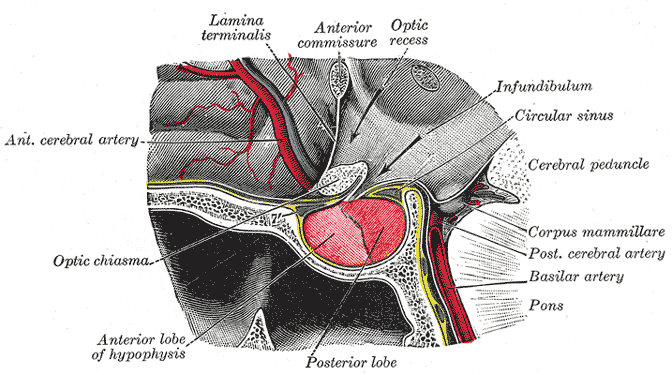
A pituitary adenoma is a neoplasm that arises from cells of the anterior pituitary (adenohypophysis). Most are benign and slow-growing, but their behavior varies: some are small and asymptomatic, others secrete excess hormones, and a minority invade surrounding structures or rarely metastasize. Because the pituitary sits beneath the brain and above the sphenoid sinus, even modest enlargement can produce neurological and endocrine symptoms.
Image gallery
7 Images




Classification and key characteristics
- Size: microadenomas are less than 10 mm in diameter and macroadenomas are 10 mm or larger.
- Function: functioning (hormone-secreting) adenomas produce excess pituitary hormones; nonfunctioning adenomas do not secrete clinically relevant amounts.
- Local behaviour: most are non-invasive, some are invasive (extending into dura, cavernous sinus, or bone), and pituitary carcinomas with distant spread are very rare.
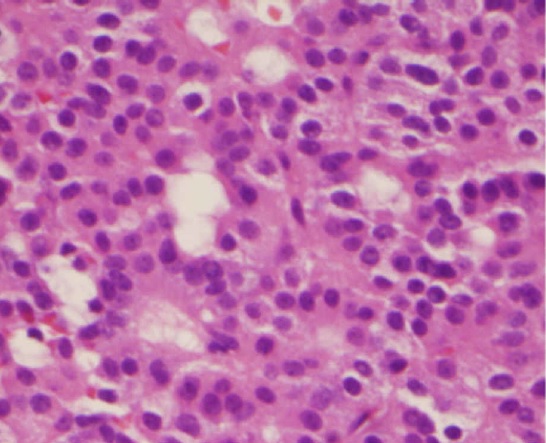
- Cell type: classified by the hormone produced or by lineage (e.g., lactotroph, somatotroph, corticotroph, gonadotroph, thyrotroph) identified with hormone assays and immunohistochemistry.
Clinical presentation and diagnosis
Symptoms reflect two main mechanisms: hormone excess and mass effect. Hormone-related syndromes include hyperprolactinemia (galactorrhea, menstrual disturbance, infertility), growth hormone excess (acromegaly), and corticotropin excess (Cushing disease). Mass effects can produce headaches and visual field defects, classically bitemporal hemianopsia due to optic chiasm compression. Nonfunctioning microadenomas are often discovered incidentally on imaging performed for unrelated reasons and are commonly termed "pituitary incidentalomas." Diagnostic evaluation combines biochemical endocrine testing with high-resolution magnetic resonance imaging (MRI) to image the pituitary and surrounding structures; the pituitary gland is often discussed in general terms at background resources.
When invasive behavior is suspected, imaging assesses extension into the cavernous sinus, bone, or dura. Invasion of adjacent bones such as the sphenoid bone is a recognized pattern; references to the local skull base anatomy and sphenoid sinus may be found at anatomy resources.
Treatment options and follow-up
Treatment is individualized according to tumor type, size, symptoms, and patient factors. Management approaches include:
- Observation with periodic biochemical testing and MRI for small, nonfunctioning lesions without symptoms.
- Medical therapy — for example, dopamine agonists (cabergoline, bromocriptine) are highly effective for prolactin-secreting adenomas; somatostatin analogues and other agents may be used for growth hormone–secreting tumors.
- Surgery — transsphenoidal resection is the most common surgical approach to remove or decompress symptomatic adenomas, particularly macroadenomas compressing the optic apparatus.
- Radiotherapy — conventional or stereotactic radiotherapy can be used for residual, recurrent, or medically resistant tumors.
Long-term follow-up frequently involves both endocrine surveillance and periodic imaging because hormone deficiencies or recurrences can appear years after initial therapy.
Epidemiology, prognosis, and notable points
Pituitary adenomas are among the more common intracranial neoplasms encountered in clinical practice. Many remain clinically silent and are found incidentally on imaging or at autopsy. Functioning adenomas most commonly secrete prolactin, followed by growth hormone and ACTH; nonfunctioning adenomas often present later because symptoms arise mainly from size. While the majority behave in a benign fashion and respond to treatment, invasive adenomas and the very rare pituitary carcinomas require more complex management. Advances in imaging, endocrinology, and surgical techniques over the last century have improved detection and outcomes, but individualized care remains essential to address the tumor's hormonal effects and local consequences.
Questions and answers
Q: What are pituitary adenomas?
A: Pituitary adenomas are tumors that occur in the pituitary gland.
Q: How are pituitary tumors generally divided based on their biological functioning?
A: Pituitary tumors are generally divided into three kinds dependent upon their biological functioning: benign adenoma, invasive adenoma, or carcinomas with carcinomas accounting for 0.1% to 0.2%, approximately 35% being invasive adenomas and most being benign adenomas.
Q: What percentage of brain tumors do pituitary adenomas represent?
A: Pituitary adenomas represent from 10% to 25% of all brain tumors.
Q: What percentage of the general population is thought to be affected by clinically active pituitary adenomas?
A: Recent studies have suggested that clinically active pituitary adenomas may affect about one in 1000 of the general population.
Q: What are the two types of pituitary adenomas based on their size?
A: Adenomas that are bigger than 10 millimetres (0.39 in) are called macroadenomas, and those smaller than 10 mm are called microadenomas.
Q: What are non-invasive and non-secreting pituitary adenomas considered to be?
A: Non-invasive and non-secreting pituitary adenomas are considered to be benign, which means harmless.
Q: Are there any studies that have proven non-invasive and non-secreting pituitary adenomas to be harmless?
A: A recent large study (Fernández-Balsells, et al. 2011) has shown there are few studies to prove if this is true or not.
Related articles
Author
AlegsaOnline.com Pituitary adenoma Leandro Alegsa
URL: https://en.alegsaonline.com/art/77164
Sources
- doi.org : 10.1002/cncr.20412
- pubmed.ncbi.nlm.nih.gov : 15274075
- journals.allenpress.com : "Practical pituitary pathology: what does the pathologist need to know?"
- doi.org : 10.1043/1543-2165(2008)132[1231:PPPWDT]2.0.CO;2
- pubmed.ncbi.nlm.nih.gov : 18684022
- ncbi.nlm.nih.gov : PMID 16968795