
Piston (mechanical component)
A piston is a sliding element that moves within a cylinder to change volume and transfer force in engines, pumps, compressors and hydraulic systems; it includes rings, skirts and pins and requires lubrication.
Overview
A piston is a component that slides tightly within a cylinder to alter the volume of an enclosed chamber, transmit force to or from a working fluid, and open or close ports. In many machines it converts pressure into mechanical motion or vice versa. Common applications include internal combustion engines, steam engines, compressors, pumps and hydraulic or pneumatic cylinders. The moving element is typically described as a lubricated sliding shaft or a closely fitting disc/plug depending on the design.
Image gallery
10 Images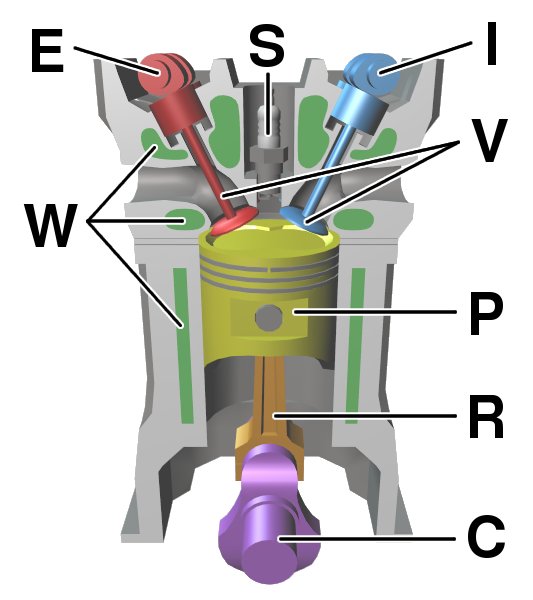


Parts and characteristics
Pistons are built with several basic features that control performance and durability. Typical elements include piston crown (top face exposed to pressure), piston skirt (guides the piston in the bore), piston rings (seal and control oil), and the wrist pin (gudgeon pin) that links the piston to a connecting rod. Materials commonly used are aluminum alloys for lightness and thermal conductivity or steel and cast iron where strength and wear resistance are needed. Surface treatments and precise machining help reduce friction and control wear.
- Sealing rings: prevent gas leakage and meter oil.
- Skirt and skirt coatings: stabilize motion and reduce scuffing.
- Wrist pin: transmits force to the connecting rod.
Types and operation
Pistons appear in reciprocating engines (four-stroke and two-stroke), hydraulic cylinders, pneumatic actuators and positive-displacement pumps. In internal combustion engines the piston moves through intake, compression, power and exhaust strokes; in compressors and pumps it moves to change the enclosed volume. Different designs emphasize light weight, heat resistance, or sliding stability depending on duty.
Maintenance, failures and safety
Effective lubrication and intact sealing elements are essential. Piston rings and rubber or polymer seals control oil retention and prevent cross-contamination between chambers. These seals and rings wear over time and are replaced during servicing; if a seal or ring fails in service it can cause loss of compression, increased wear, oil contamination, and potentially severe engine or machine damage. Regular inspection, correct lubrication, and proper fitting are the primary preventive measures.
History and notable facts
Pistons have been central to reciprocating machinery since early steam engines in the 18th century and evolved with metallurgy and machining techniques. Modern pistons benefit from alloy development, computer-aided design, and coatings that reduce friction and extend life. For more technical background see an engineering reference or a component overview such as the cylinder and studies of lubrication and seal behaviour (volume change, fluid force).
Distinctions: pistons differ from plungers (which often travel without a tight sealing ring) and from diaphragms (which deform rather than slide). Choice of piston type depends on the working fluid, pressure, temperature and desired lifetime.
Questions and answers
Q: What is a piston?
A: A piston is a lubricated sliding shaft that fits tightly inside the opening of a cylinder.
Q: What is the purpose of a piston?
A: The purpose of a piston is to change the volume enclosed by the cylinder, to exert a force on a fluid inside the cylinder, to cover and uncover ports, or some combination of these.
Q: What is a rubber seal used for in a piston?
A: A rubber seal is sometimes used to keep the lubricate within the shaft.
Q: Why should the rubber seal be replaced with every servicing?
A: The rubber seal should be replaced with every servicing because due to the constant motion of the machine this seal wears quickly.
Q: What can happen if the rubber seal breaks during usage?
A: If the rubber seal breaks during usage there can be disastrous long-lasting consequences for the machine.
Q: Can a piston have more than one purpose?
A: Yes, a piston can have more than one purpose such as changing the volume enclosed by the cylinder, exerting a force on a fluid, and covering and uncovering ports.
Q: Is it important to keep the rubber seal in good condition?
A: Yes, it is important to keep the rubber seal in good condition as it helps to keep the lubricant within the shaft and prevent damaging consequences.
Related articles
Author
AlegsaOnline.com Piston (mechanical component) Leandro Alegsa
URL: https://en.alegsaonline.com/art/77108