
Pietro Cavallini: Roman painter and mosaicist of the Late Medieval period
Overview of Pietro Cavallini (c.1259–c.1330), his surviving works in Rome, artistic style, influence on contemporaries and later art, and his place in the shift toward naturalism.
Overview
Pietro Cavallini (c. 1259 – c. 1330) was an Italian painter and mosaicist active in Rome and working within the broader context of medieval Italy. He is usually placed in the Late Medieval period and is often discussed alongside better-known contemporaries such as Giotto. Some documentary evidence and stylistic attribution suggest he may also have worked outside Rome, possibly in Naples, but much about his career remains uncertain. Cavallini is remembered for attempts to render figures with greater solidity and spatial presence than was typical in much Byzantine-influenced art of the era.
Image gallery
9 Images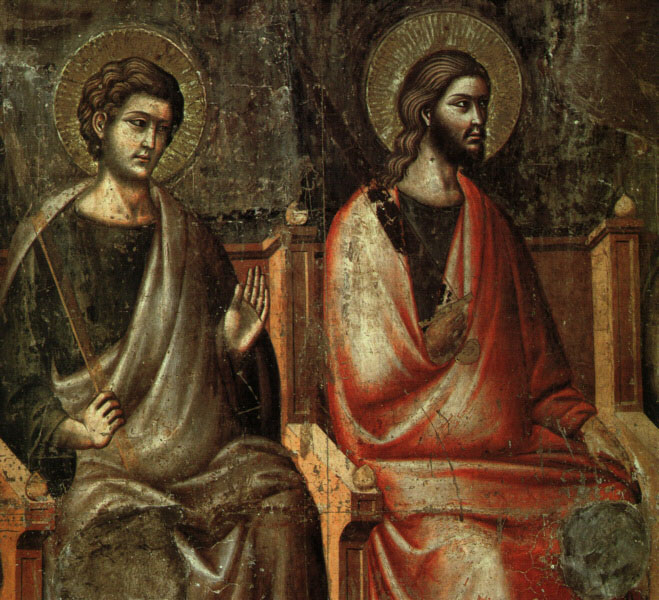


Surviving works and locations
Only a handful of works are widely agreed to be by Cavallini or his workshop, and two important fragments survive in Rome. A celebrated mosaic of the Virgin and Child and accompanying saints is preserved in the apse of Santa Maria in Trastevere; this mosaic shows a careful modelling of faces and drapery that departs from strict flatness and a more decorative approach.
Another significant fragment is a large fresco representing the Last Judgment in the convent of Santa Cecilia in Trastevere. The fresco, partly lost or lowered by later architectural changes, originally displayed Christ in majesty surrounded by rows of saints and a structured arrangement of figures. The scene centers on Jesus as judge and illustrates Cavallini's interest in three-dimensional modelling, likely inspired by both Byzantine techniques and the remains of Ancient Rome.
Style and technical approach
Cavallini worked in both mosaic and fresco media. His style shows a combination of inherited Byzantine iconography and an emerging concern for volume, light, and spatial coherence. Compared with many contemporaries, his figures often read as more corporeal, with attention paid to anatomical suggestion and weight in drapery. These qualities led later historians to credit him with contributing to the gradual move toward naturalism that characterized early Italian Renaissance painting.
Influence, workshop practice, and connections
Although few securely attributed pieces survive, Cavallini's approach influenced artists who worked in and around Rome. Some scholars propose that painters from Rome influenced by Cavallini travelled to the great sculptural and painted programs at the Basilica of St Francis of Assisi, and that elements of his modelling can be seen in works associated with that complex. He may also have run a workshop or taught assistants who disseminated his stylistic ideas. His career overlapped with important developments in other Italian centers, notably Florence and the circle around Giotto, but regional differences and limited surviving material make direct attribution and influence complex subjects for study.
Legacy and scholarly attention
Cavallini's reputation among art historians rests less on a large body of surviving work than on the high quality of the pieces attributed to him and on their place in the story of late medieval Italian art. The fragmentary state of his frescoes and the rarity of intact mosaics mean that assessments of his importance are cautious and often hypothetical. Nonetheless, his name frequently appears in discussions of the transition from Byzantine-influenced icon painting toward a more naturalistic and three-dimensional depiction of the human figure in Italian art. Visitors to Rome who study medieval art often seek out his remaining works in the Trastevere district as examples of this transitional style.
- Key surviving locations: Rome — Santa Maria in Trastevere (mosaic), Santa Cecilia in Trastevere (fresco).
- Contemporaries and contrasts: Giotto of Florence, and anonymous Roman painters linked to the Assisi program.
- Contextual references: the flow of artists and ideas between Rome, Naples, and central Italian religious centers; ties to classical Ancient Rome and medieval devotional practice.
For general introductions and site visits, readers may consult museum guides and scholarly overviews that discuss Cavallini in relation to broader movements in medieval Italian art and the gradual evolution toward Renaissance naturalism. Further research remains active, and assessments of attributions, workshop practice, and regional influence continue to be refined by specialists.
Additional resources and entries about Cavallini and related topics can be found through general art history references and site-specific literature about the churches of Trastevere and the artistic exchange between Roman and other Italian centers (Italy, Late Medieval, Tiber River).
Note: specific documentary details about Cavallini's life and precise chronology remain limited; much of what is stated about his output comes from stylistic analysis and fragmentary archival evidence rather than a continuous biographical record.
Questions and answers
Q: Who was Pietro Cavallini?
A: Pietro Cavallini was a painter who lived and worked in Rome in Italy in the Late Medieval period.
Q: Where did Pietro Cavallini possibly work besides Rome?
A: Pietro Cavallini possibly worked in Naples.
Q: How is Pietro Cavallini thought of in terms of his painting skills?
A: Pietro Cavallini is thought of as one of the greatest painters of his day.
Q: Why is Pietro Cavallini not as well known as Giotto from Florence?
A: Pietro Cavallini is not as well known as Giotto from Florence because only two pictures by Cavallini still exist.
Q: Where can one find the two existing pictures by Pietro Cavallini?
A: One of the two existing pictures by Pietro Cavallini is a mosaic in the Church of Santa Maria in Trastevere, and the other is a fresco in the nearby convent of Santa Cecilia in Trastevere.
Q: What is the fresco in the nearby convent of Santa Cecilia in Trastevere?
A: The fresco in the nearby convent of Santa Cecilia in Trastevere is a large picture of the Last Judgement with Jesus sitting between rows of saints.
Q: What happened to the fresco at Santa Cecilia's?
A: The fresco at Santa Cecilia's is in ruins because a new level was added to the room, partially cutting across the fresco.
Related articles
Author
AlegsaOnline.com Pietro Cavallini: Roman painter and mosaicist of the Late Medieval period Leandro Alegsa
URL: https://en.alegsaonline.com/art/76856