
Phrase (grammar): types, structure, and use
An overview of grammatical phrases: what they are, how they function, main types (noun, verb, adjective, adverb, prepositional), structure and differences from clauses and sentences.
A phrase is a group of words that functions as a single unit within a sentence but does not express a complete clause by itself. A phrase lacks the full subject–predicate structure that characterizes a clause or a sentence, yet it contributes meaning and performs syntactic roles such as naming, modifying, specifying time or place, or completing a verb. For a concise definition see phrase (definition).
Image gallery
2 Images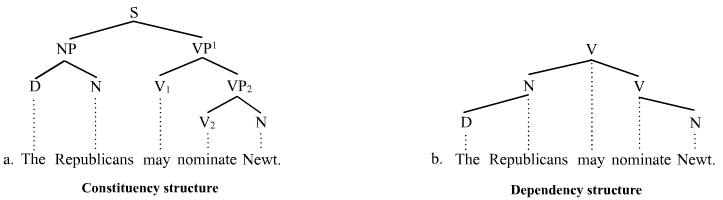

Core idea and internal structure
Every phrase is organized around a central element called the head. The head determines the phrase's category and core meaning: a noun is the head of a noun phrase, an adjective is the head of an adjective phrase, and so on. Other words in the phrase act as modifiers, determiners, complements, or particles that qualify or complete the head. For example, in "the old oak tree," tree is the head and "the old oak" supplies identifying and descriptive material.
Main types with examples
Grammars commonly distinguish phrases according to the category of their head. The most frequently discussed types are:
- Noun phrase (NP) — names people, places, things or ideas. Examples: children in "all my dear children", age in "the information age", lions in "seventeen hungry lions in the rocks". See noun phrase notes.
- Verb phrase (VP) — contains a main verb and any auxiliaries, objects, or complements that belong with it. English verb phrases can include tense and aspect auxiliaries. For further discussion see verb phrase (details).
- Adjective phrase (AdjP) — modifies a noun or functions as a subject/complement: "so very sweet", "very happy with his work".
- Adverb phrase (AdvP) — modifies verbs, adjectives, or other adverbs: "especially softly", "much too quickly to see clearly". See adverb phrase examples.
- Prepositional phrase (PP) — begins with a preposition and supplies information about time, place, manner, or relation: "in the afternoon", "under the table", "with great care". The preposition heads the phrase; more on prepositions is at preposition basics.
Functions and tests
Phrases play roles such as subject, object, complement, modifier, or adjunct. Linguists use simple tests to identify phrases: substitution (replace a phrase with a pronoun or pro-form), movement (relocate the unit while keeping grammaticality), and coordination (join two units of the same kind with "and" or "or"). These constituency tests help distinguish phrases from loose word groups and from clauses that contain an independent verb.
History and theoretical context
The term "phrase" appears in traditional grammar, but modern linguistic theories developed more precise accounts through phrase structure rules and constituency-based analyses. Generative and phrase-structure grammars treat phrases as the building blocks of sentences, allowing recursive composition (a phrase can contain another phrase of the same type). The study of phrases also connects to parsing in computational linguistics and to pedagogical grammar for language learners.
Practical importance and distinctions
Understanding phrases is essential for clear writing, sentence diagramming, second-language instruction, and natural language processing. Important distinctions: a phrase is not a clause (clauses normally require a finite verb and a subject), and a phrase may be reduced (e.g., "to sing" as an infinitival phrase) or expanded with modifiers. For further reference on usage and classification see related notes and adjective phrase guidance.
In short, phrases are flexible, repeatable units that structure meaning inside sentences: recognizing their heads, dependents, and functions clarifies how language conveys relations and detail.
Questions and answers
Q: What is a phrase?
A: A phrase is a group of words that adds meaning to a sentence. It is not a complete idea with a subject, verb and predicate like a sentence.
Q: How many kinds of phrases are there in English?
A: There are five different kinds of phrases in English, one for each of the main parts of speech.
Q: What is the head in a phrase?
A: The head in a phrase is the main word or the word that the phrase is about. It is usually printed in bold.
Q: What kind of information does an Adjective phrase give?
A: An Adjective phrase gives more information about an adjective.
Q: What kind of information does an Adverb phrase give?
A: An Adverb phrase gives more information about an adverb.
Q: What kind of information does a Prepositional phrase give?
A: A Prepositional phrase gives information about time, location, possession or condition and always starts with a preposition.
Author
AlegsaOnline.com Phrase (grammar): types, structure, and use Leandro Alegsa
URL: https://en.alegsaonline.com/art/76621