
Auxin: Plant Growth Regulators and Their Roles in Development
Auxins are plant hormones that coordinate growth, cell elongation, tropisms and organ formation. This article covers chemistry, biosynthesis, transport, signaling, physiological roles, applications and historical background.
Overview
Auxins are a class of plant hormones or growth regulators that play central roles in nearly every aspect of plant development. They are best known for promoting cell elongation in shoots, directing growth responses to environmental cues (tropisms), and coordinating organ initiation and patterning. Because auxin molecules can move directionally through tissues and form concentration gradients, they are often described as having morphogen-like properties that provide positional information during development. For context about hormonal control of growth see plant hormones and for discussion of gradient-based patterning see ideas described as morphogen-like.
Image gallery
7 Images


Chemistry and biosynthesis
The principal naturally occurring auxin in most plants is indole-3-acetic acid (IAA). Plants also contain several related compounds and metabolic derivatives that can have auxin-like activity or serve as storage forms. Biosynthesis of IAA occurs via multiple biochemical pathways starting from the amino acid tryptophan and other precursors; the balance between synthesis, conjugation and degradation helps regulate active levels in tissues. Researchers typically study auxin biology using both the natural molecule and synthetic analogues that mimic or perturb its activity.
Polar transport and cellular transporters
A defining feature of auxin biology is polar auxin transport: a regulated, directional cell-to-cell movement that establishes local concentration maxima and minima. Specialized transporter proteins mediate uptake and efflux across the plasma membrane. Examples include influx carriers of the AUX1/LAX family, efflux carriers of the PIN family, and certain ABCB transporters. The subcellular localization and abundance of these transporters can be dynamically regulated, which allows tissues to redirect auxin flow during organ initiation, wound responses or tropic bending.
Perception and signaling
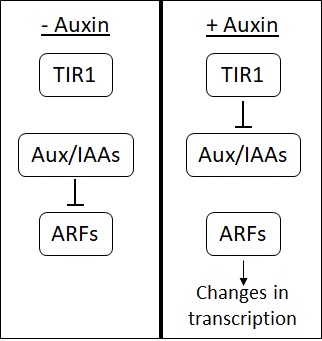
At the molecular level, auxin signaling involves perception by receptor complexes that influence transcriptional regulators. In many plants, auxin promotes interaction between F-box receptor proteins and Aux/IAA repressor proteins, targeting the repressors for degradation and thereby freeing ARF transcription factors to modulate gene expression. This signaling module links short-term responses, such as changes in cell expansion, with longer-term developmental programs by altering expression of downstream genes. Additional non-transcriptional responses and alternative perception mechanisms are also subjects of active research.
Key physiological roles
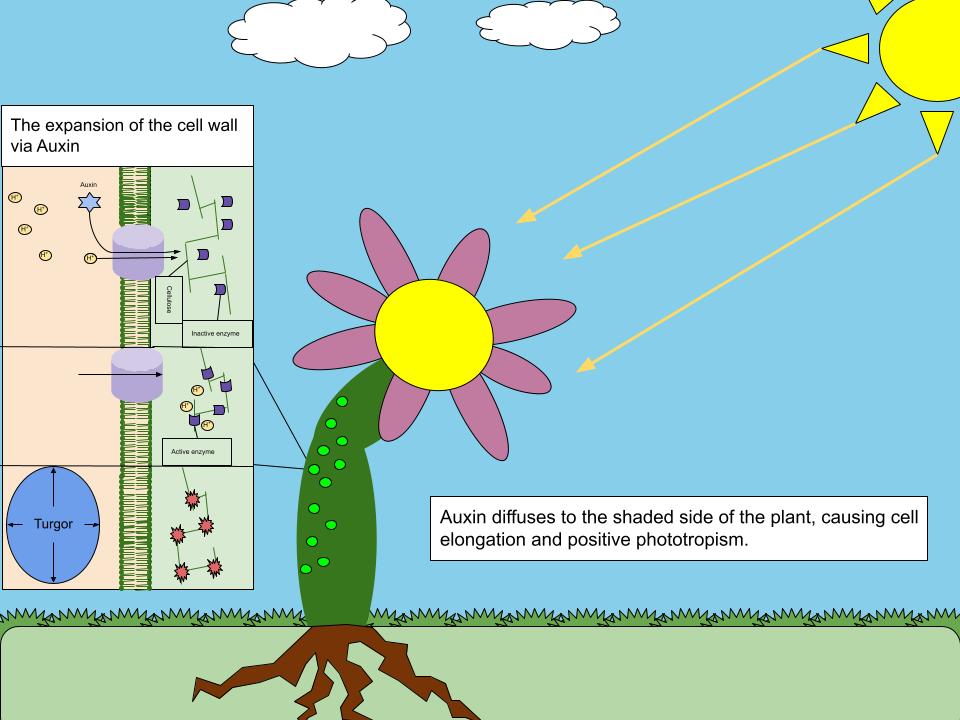
- Cell elongation: Auxin stimulates loosening of the cell wall and expansion in many shoot tissues, contributing to stem elongation and leaf growth.
- Tropisms: Asymmetric auxin distribution mediates bending toward light (phototropism) and responses to gravity (gravitropism) by promoting differential cell expansion.
- Apical dominance: High auxin produced in shoot apices suppresses outgrowth of lateral buds, shaping plant architecture.
- Root formation: Auxin promotes lateral and adventitious root initiation and is widely used in vegetative propagation to induce rooting.
- Organ patterning and vascular differentiation: Auxin maxima mark sites of organ initiation and guide developing vascular strands.
Interactions with other hormones and environment
Auxin acts in concert with other plant regulators such as cytokinins, gibberellins, abscisic acid and ethylene. Developmental outcomes often depend on relative hormone ratios, tissue sensitivity and timing. Environmental factors such as light quality, direction and gravity influence auxin distribution by altering transporter localization or biosynthesis, thereby producing adaptive growth responses.
Applications and practical importance
Auxins are widely used in horticulture and agriculture. They are applied as rooting hormones to promote cuttings, used in tissue culture to control organogenesis, and can be applied to modify fruit set or reduce premature fruit drop. Several synthetic auxins and auxinic herbicides are used to control weeds; common classes include phenoxy and picolinic acid derivatives. These compounds act at high doses to disrupt normal growth, so formulations and application rates are subject to regulation and careful management. For regulatory and agronomic information see resources on herbicides. One historically notable and controversial use of synthetic auxin compounds was in mixtures such as Agent Orange, which combined related chemicals as a defoliant.
Research tools and measurement
Modern studies of auxin employ molecular reporters, genetic mutants and analytical chemistry. Synthetic transcriptional reporters (for example DR5-based constructs) reveal sites of auxin-responsive gene activity, while techniques such as mass spectrometry quantify auxin levels and metabolites. Genetic and pharmacological tools that alter transporter function, receptor activity or biosynthetic enzymes have revealed much of the current mechanistic framework.
History and discovery
Early physiological experiments in the early 20th century showed that detached coleoptile tips produced a mobile substance that promoted curvature toward light; these classical studies are associated with Frits W. Went and others. Later biochemical work by researchers including Kenneth V. Thimann led to the isolation and chemical identification of the principal natural auxin, indole-3-acetic acid, and to synthesis of early overviews of plant growth substances. For broader life-cycle perspectives consult summaries on plant life cycle.
Contemporary questions
Current research addresses how auxin transport and signaling are integrated with mechanical signals, how specificity is achieved among related receptors and transcription factors, and how auxin-mediated pathways evolved across plant lineages. Understanding these aspects remains important for both fundamental plant biology and applications in crop improvement and sustainable management.
For an accessible introduction to hormonal coordination in plants see general resources on plant hormones and, for conceptual material about signaling and pattern formation, see discussions of morphogen-like roles of auxin. Additional regulatory, agronomic and historical context can be found via links on herbicides, studies of the Agent Orange mixtures, and resources describing the plant life cycle.
Questions and answers
Q: What are auxins?
A: Auxins are a class of plant hormones or plant growth substances that coordinate many growth and behavioral processes in the plant's life cycle.
Q: What is the role of auxins in plant growth?
A: Auxins play an important role in the coordination of many growth and behavioral processes in the plant's life cycle, and they are essential for plant body development.
Q: Who first described the role of auxins in plant growth?
A: The Dutch scientist Frits Warmolt Went was the first to describe the role of auxins in plant growth.
Q: Who isolated auxin and found its chemical structure to be indole-3-acetic acid (IAA)?
A: Kenneth V. Thimann isolated auxin and found its chemical structure to be indole-3-acetic acid (IAA).
Q: Did Went and Thimann co-author a book on plant hormones?
A: Yes, Went and Thimann co-authored a book on plant hormones called Phytohormones, in 1937.
Q: Are there synthetic auxins?
A: Yes, there are synthetic auxins.
Q: Can synthetic auxins be used as herbicides?
A: Yes, in big doses, synthetic auxins can be used as herbicides. Agent Orange, for example, is a mixture of synthetic auxins.
Related articles
Author
AlegsaOnline.com Auxin: Plant Growth Regulators and Their Roles in Development Leandro Alegsa
URL: https://en.alegsaonline.com/art/7662
Sources
- sciencedirect.com : sciencedirect.com/science/article/pii/S0168945210003444