
Phototropism: plant growth responses toward light and their mechanisms
Phototropism is the directional growth of organisms, especially plants, toward or away from light. It is driven by light receptors and hormone redistribution and is important for photosynthesis, competition and development.
Phototropism is the oriented growth of an organism in response to a light stimulus. In plants this often appears as stems, leaves or seedling shoots bending toward a light source (positive phototropism) or, less commonly, away from light (negative phototropism). The phenomenon helps plants optimize light capture for photosynthesis, influences seedling emergence, and contributes to a plant's overall architecture. Many organisms besides green plants—such as certain fungi and algae—also display phototropic responses, although the cellular mechanisms can differ.
Image gallery
5 Images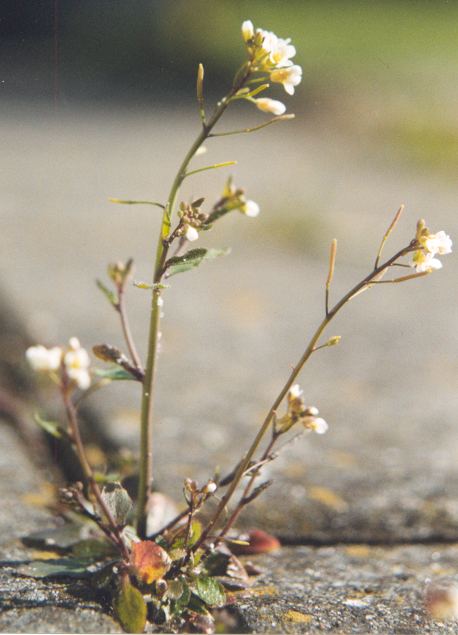


Basic characteristics and types
Phototropic responses are classified by direction: positive phototropism denotes growth toward light and is typical of aerial shoots, while negative phototropism denotes growth away from light and can be seen in some roots and climbing tendrils. Phototropism should be distinguished from phototaxis (movement of whole organisms toward light) and heliotropism (daily tracking of the sun by leaves or flowers). External factors such as light intensity, spectral quality, and the presence of competing stimuli like gravity influence the magnitude and direction of the response. For a concise description of directional growth, see directional growth.
Mechanisms: receptors, hormones and cell behavior
At the cellular level phototropism depends on perception of light by specific photoreceptors and a lateral redistribution of growth-regulating signals. Blue-light-absorbing photoreceptors called phototropins are primary detectors in many plants; they perceive directional blue light and initiate downstream signaling. Other photoreceptors, such as cryptochromes (also sensitive to blue light) and phytochromes (sensitive to red/far-red light), modulate growth and development in complementary ways. See an example model organism in plant biology: Arabidopsis thaliana.
- Photoreceptors: phototropins detect blue light and trigger asymmetric signaling.
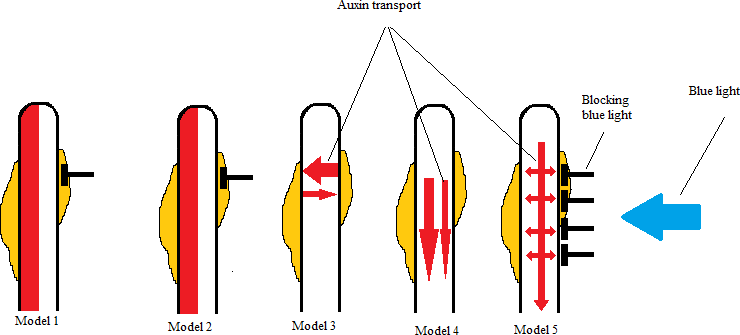
- Hormone redistribution: the plant hormone auxin becomes more concentrated on the shaded side of a stem, promoting cell elongation there.
- Cell response: differential elongation of epidermal and cortical cells causes bending toward the light.
The classical explanation for auxin-driven bending is known as the Cholodny–Went hypothesis, which proposes that lateral auxin gradients produce unequal growth rates across the organ. Auxin transport carriers and cellular redistribution under uneven illumination generate the gradient; for notes on cellular participants, see plant cells and the role of transport proteins.
History and experimental foundations
Observations and experiments on phototropism date back to early naturalists who recorded seedling bending toward light. Later experimental work—famously by early plant physiologists—used coleoptiles and decapitation/covering experiments to show that the tip perceives light and communicates a signal to the growing zone. Those foundational studies led to the identification of mobile growth regulators and to biochemical work linking auxin to differential growth; additional modern research has clarified the molecular photoreceptors and signaling cascades. For historical background and classical experiments, see discussions of the coleoptile experiments and the development of auxin theory in plant physiology texts.
Ecological and practical importance
Phototropism has clear ecological consequences: seedlings that bend toward light can outcompete neighbors and establish photosynthetic capacity rapidly. Horticulture and controlled-environment agriculture account for phototropic behavior when arranging light sources, pruning, or training vines. Some climbing plants exploit negative phototropism at shoot tips to find solid supports—growing toward darker vertical surfaces—an adaptive strategy in dense vegetation. Roots, often influenced more strongly by gravity than light, may show complex responses; see root behavior and interactions with gravitropic cues.
Related concepts and notable points
Phototropism interacts with other tropisms—most notably gravitropism—and with internal developmental programs. The role of auxin is central but interacts with other hormones and with light-signaling networks mediated by phytochromes and cryptochromes. For concise summaries of hormonal action and signaling, consult resources on plant growth hormones and auxin. Modern genetic and molecular methods have used mutants and reporter lines to trace signaling steps and visualize auxin distribution; many reviews and educational pages provide summaries of these methods and findings at accessible levels, for example in resources listed under gravitropism and light interactions.
Phototropism remains a lively area of study because it links environmental perception with developmental plasticity. Understanding its molecular basis informs crop management, greenhouse lighting strategies, and fundamental questions about how plants integrate multiple external cues to shape form and function.
Questions and answers
Q: What is phototropism?
A: Phototropism is growth in the direction of light.
Q: What organisms can display phototropism other than plants?
A: Fungi can also display phototropism.
Q: What is the plant growth hormone that causes phototropism to occur?
A: The plant growth hormone that causes phototropism to occur is called auxin.
Q: What happens to the cells on the farthest side from the light in a plant displaying positive phototropism?
A: The cells on the farthest side from the light in a plant displaying positive phototropism have elongated cells.
Q: What is the difference between positive and negative phototropism?
A: Growth towards a light source is a positive phototropism, while growth away from light is called negative phototropism.
Q: What is the phenomenon called when vine shoot tips grow towards dark, solid objects?
A: The phenomenon called when vine shoot tips grow towards dark, solid objects is negative phototropism.
Q: Which receptors in plants are responsible for directing phototropism in Arabidopsis thaliana?
A: Blue light receptors called phototropins are responsible for directing phototropism in plants such as Arabidopsis thaliana.
Related articles
Author
AlegsaOnline.com Phototropism: plant growth responses toward light and their mechanisms Leandro Alegsa
URL: https://en.alegsaonline.com/art/76614
Sources
- abstracts.aspb.org : "American Society of Plant Biologists"
- plantphys.info : "Phytochrome"
- plantcell.org : "A Component of the Cryptochrome Blue Light Signaling Pathway"
- doi.org : 10.1105/tpc.150510