
Phonograph cylinder
Hollow cylindrical early sound recordings whose grooves encoded audio for mechanical playback. Widely used before disc records, they survive in archives, museums and restoration projects.
Overview
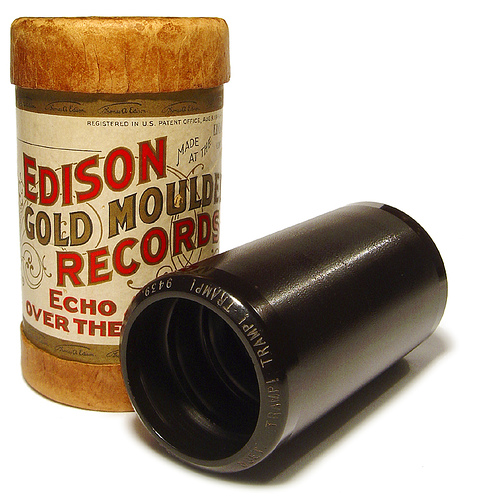
Phonograph cylinders were the first commercially exploited format for recording and reproducing sound. Typically made of wax or later celluloid over a hollow core, their outer surface carried a continuous groove that encoded vibrations. When rotated and traced by a stylus on a mechanical cylinder phonograph, these grooves produced audible sound amplified through a horn or acoustic cabinet. At the peak of their popularity they were commonly called "records" and dominated the commercial market until disc-based systems became dominant.
Image gallery
10 Images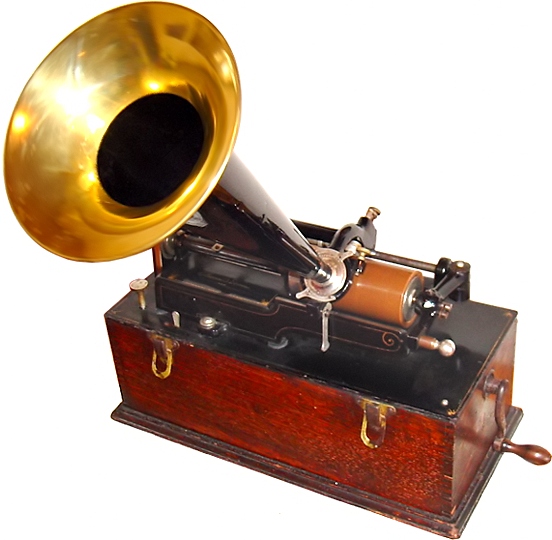



Construction and how they work
A cylinder's sound information is inscribed as a helical groove running along its length. During playback the cylinder turns while the stylus moves slowly along the axis so the groove can be followed from one end to the other. The groove modulation—often described as "hill-and-dale"—causes the stylus to vibrate. Those mechanical vibrations are converted into sound through a diaphragm and horn. Early home machines allowed live recording directly onto blank wax cylinders; commercial issues were mass-produced from moulds.
Formats and varieties
- Home-wax blanks for personal recordings and demonstrations.
- Commercial moulded cylinders sold in popular lengths—early issues commonly held about two minutes of audio; later developments extended play to roughly four minutes.
- Materials evolved from soft wax to harder compositions and finally to celluloid and other plastics for greater durability.
Development and historical context
The phonograph cylinder emerged in the late 19th century and represented the first widespread means of capturing sound for replay. Competing technologies were developed in parallel, most notably the flat disc record. Over time discs became favored commercially because they were easier to store, label, duplicate and press in large quantities. Nevertheless, cylinders played a crucial role in the early sound industry and in documenting musical and spoken performance practices of the era.
Uses and cultural importance
Cylinders carried popular songs, instrumental music, spoken word, and early field recordings. They were used in parlors, exhibitions and by businesses for dictation. As one of the earliest mass media for recorded sound, they made music and speech portable in a way that had not existed before and helped establish markets for performers and recording businesses.
Decline, legacy and preservation
By the 1910s the disc record system eclipsed cylinders in commercial importance. Today cylinders are valuable historical artifacts: museums, archives and private collectors preserve them, and specialists transfer their contents to modern formats for study and listening. Conservation poses challenges because wax and early plastics are fragile; specialized playback equipment and careful digitization are required to recover audio without damaging originals. Museums and online projects document surviving cylinders and reproduce selected recordings for research and public access. For more on playback hardware see mechanical cylinder phonographs and for the alternative disc-based systems see disc records.
Questions and answers
Q: What were phonograph cylinders?
A: Phonograph cylinders were the earliest commercial method for recording and reproducing sound.
Q: What were they commonly known as?
A: They were commonly known simply as "records" in their era of greatest popularity (c. 1896–1915).
Q: How were the audio recordings engraved on the cylinders?
A: The audio recordings were engraved on the outside surface of the cylinders.
Q: How can the sound be reproduced from the cylinders?
A: The sound can be reproduced when they are played on a mechanical cylinder phonograph.
Q: When did the competing disc record system become more popular?
A: In the 1910s, the competing disc record system became the more popular commercial audio medium.
Q: Where can some of the cylinders and their recorders be found?
A: Some of the cylinders and their recorders can be found in local museums.
Q: What is the significance of phonograph cylinders in the history of audio recordings?
A: Phonograph cylinders were the earliest commercial method for recording and reproducing sound, and played a significant role in the development of audio technology.
Related articles
Author
AlegsaOnline.com Phonograph cylinder Leandro Alegsa
URL: https://en.alegsaonline.com/art/76560
Sources
- prezi.com : "History of Recorded Music"
- pbs.org : "Chronology:Technology and the Music Industry"