
Autophagy: cellular self-digestion, mechanisms, and biological roles
Autophagy is a conserved cellular process that degrades and recycles internal components. This article explains its mechanisms, types, physiological roles, medical relevance, and key historical milestones.
Autophagy (literally "self-eating") is a fundamental, conserved process by which cells break down and recycle their own components. It helps maintain cellular homeostasis by removing damaged organelles, misfolded proteins and invading pathogens, and by providing nutrients during periods of stress. Autophagy is one of several intracellular quality-control and turnover systems and is often discussed alongside the proteasome and endolysosomal pathways; see related cell mechanisms for context.
Image gallery
2 Images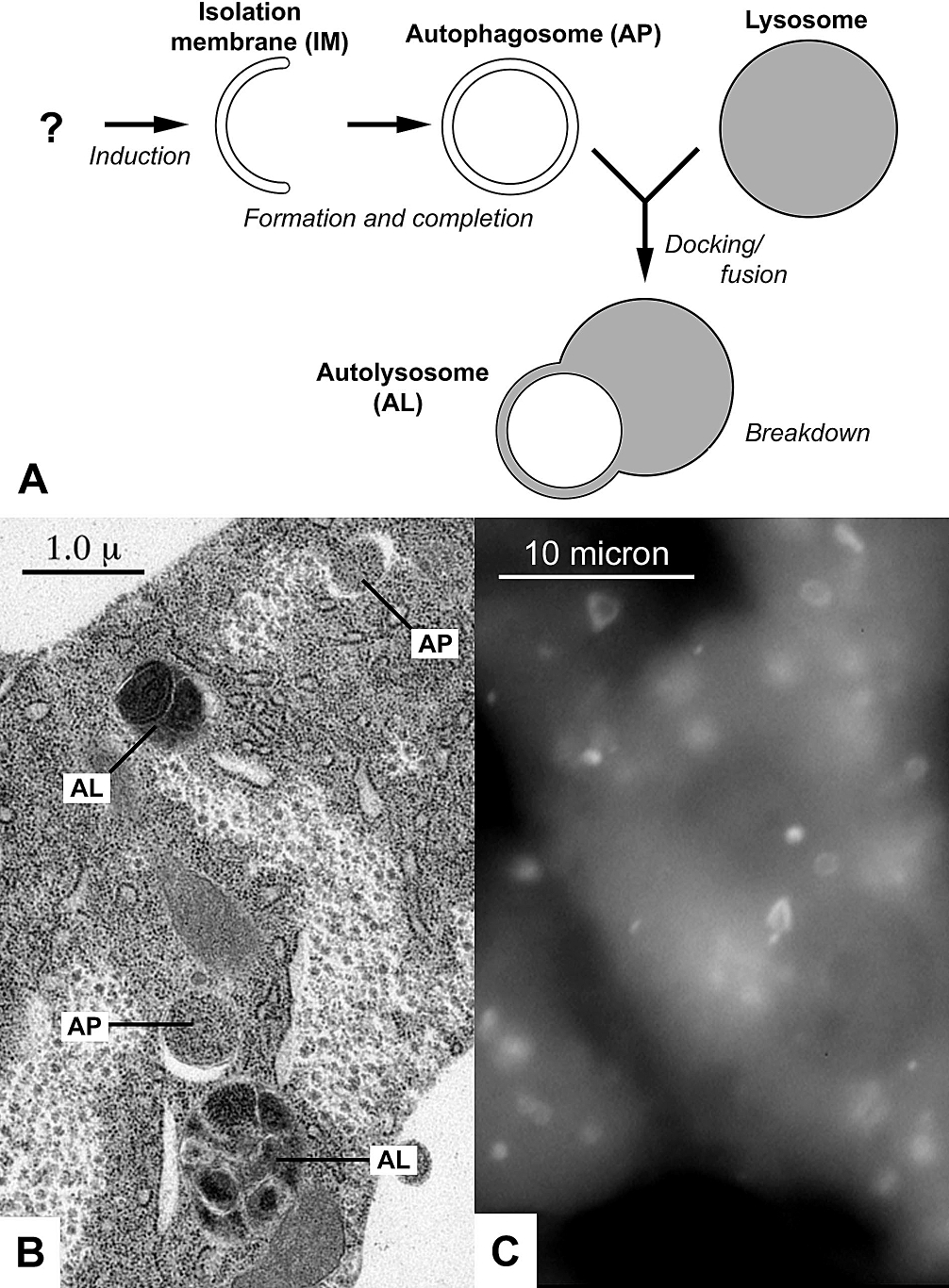

How autophagy works
The canonical route—often called macroautophagy—begins with formation of a membrane sac (the phagophore) that expands and encloses targeted material to form an autophagosome, a double-membraned vesicle. The autophagosome then fuses with an lysosome, where hydrolases degrade the cargo and constituent molecules are released for reuse. A regulated series of proteins (originally identified as autophagy-related or Atg proteins) controls initiation, membrane dynamics and fusion. Key signalling pathways that influence these steps include nutrient sensors such as mTOR, which suppresses autophagy when nutrients are abundant, and AMPK, which promotes autophagy under energy stress.
Major types and selectivity
- Macroautophagy: bulk or selective sequestration of cytoplasm within autophagosomes.
- Microautophagy: direct invagination of the lysosomal membrane to sequester small portions of cytosol.
- Chaperone-mediated autophagy: selective translocation of proteins across the lysosomal membrane aided by chaperones.
Autophagy can be nonselective (for recycling during starvation) or selective—targeting mitochondria (mitophagy), protein aggregates (aggrephagy), pathogens (xenophagy), lipid droplets (lipophagy) and portions of the endoplasmic reticulum (ER-phagy). Selective recognition often relies on receptor proteins and ubiquitin signals that link cargo to the forming autophagic membrane.
Physiologically, autophagy contributes to development, differentiation and adaptation to nutrient deprivation. It is central to cellular quality control and immune defence, and it influences organismal processes such as lifespan, response to exercise, and adaptation to fasting. In medicine, autophagy has complex roles: it can protect against neurodegeneration by clearing aggregates, yet cancer cells may also exploit autophagy to survive stress; manipulating autophagy is therefore an active area of research for diseases ranging from infections to metabolic disorders.
Experimental modulation and measurement of autophagy use pharmacological agents and biochemical markers. Rapamycin and other mTOR inhibitors induce autophagy, while lysosomotropic agents like chloroquine impair autophagic degradation. Common laboratory readouts include monitoring LC3 lipidation and the levels of the selective-autophagy adaptor p62/SQSTM1, together with microscopy to visualize autophagosomes.
The conceptual history of autophagy dates to the mid-20th century: the term was coined by Christian de Duve in 1963, and later genetic and molecular dissection in yeast during the 1990s identified many Atg genes that clarified the pathway. Work in yeast and other systems transformed the field; for example, studies in yeast revealed core mechanisms and components. These advances culminated in the awarding of the 2016 Nobel Prize in Physiology or Medicine to Yoshinori Ohsumi for his discoveries on autophagy. For accessible overviews and primary resources see writings by de Duve and research summaries referring to Ohsumi and subsequent work, and consult general reviews of cellular mechanisms for broader context.
Despite progress, important questions remain about how selectivity is achieved in different cell types, how chronic modulation of autophagy affects aging and disease, and how to translate laboratory findings into safe therapies. Current research combines genetics, biochemistry and imaging to map autophagy’s roles and to develop clinical approaches that either stimulate or inhibit the pathway as appropriate for particular diseases.
Questions and answers
Q: What does autophagy mean?
A: Autophagy means "eating itself".
Q: What is the purpose of autophagy?
A: The purpose of autophagy is to allow the controlled breaking down of cell parts which do not work, or are not needed.
Q: How are cell parts broken down through autophagy?
A: Targeted cell parts may be isolated from the rest of the cell in an autophagosome, which fuses with lysosomes and the contents are broken down and recycled.
Q: In what extreme case does the breakdown of cellular components promote cellular survival?
A: In the extreme case of starvation, the breakdown of cellular components promotes cellular survival by maintaining cellular energy levels.
Q: Who coined the term "autophagy" and when?
A: Belgian biochemist Christian de Duve coined the term "autophagy" in 1963.
Q: When were autophagy-related genes identified in yeast?
A: Autophagy-related genes in yeast were identified in the 1990s.
Q: Who was awarded the 2016 Nobel Prize in Physiology or Medicine for their work on autophagy?
A: Japanese researcher Yoshinori Ohsumi was awarded the 2016 Nobel Prize in Physiology or Medicine for his work on autophagy.
Related articles
Author
AlegsaOnline.com Autophagy: cellular self-digestion, mechanisms, and biological roles Leandro Alegsa
URL: https://en.alegsaonline.com/art/7634
Sources
- doi.org : 10.4161/auto.6398
- pubmed.ncbi.nlm.nih.gov : 18567941
- pubmed.ncbi.nlm.nih.gov : 22078875
- doi.org : 10.1248/bpb.b15-00096
- pubmed.ncbi.nlm.nih.gov : 26235572
- doi.org : 10.1146/annurev-cellbio-092910-154005
- pubmed.ncbi.nlm.nih.gov : 17909521
- pubmed.ncbi.nlm.nih.gov : 1400574
- pubmed.ncbi.nlm.nih.gov : 1400575
- pubmed.ncbi.nlm.nih.gov : 8050581
- pubmed.ncbi.nlm.nih.gov : 8224160
- pubmed.ncbi.nlm.nih.gov : 7593182
- nobelprize.org : "The Nobel Prize in Physiology or Medicine 2016"