
Phaistos Disc
A unique Bronze Age clay disc from Crete bearing stamped pictorial signs in a spiral; undeciphered and notable as an early example of stamped inscription from the Minoan world.
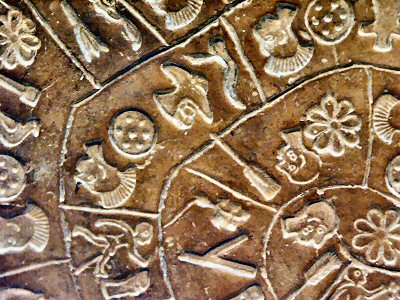
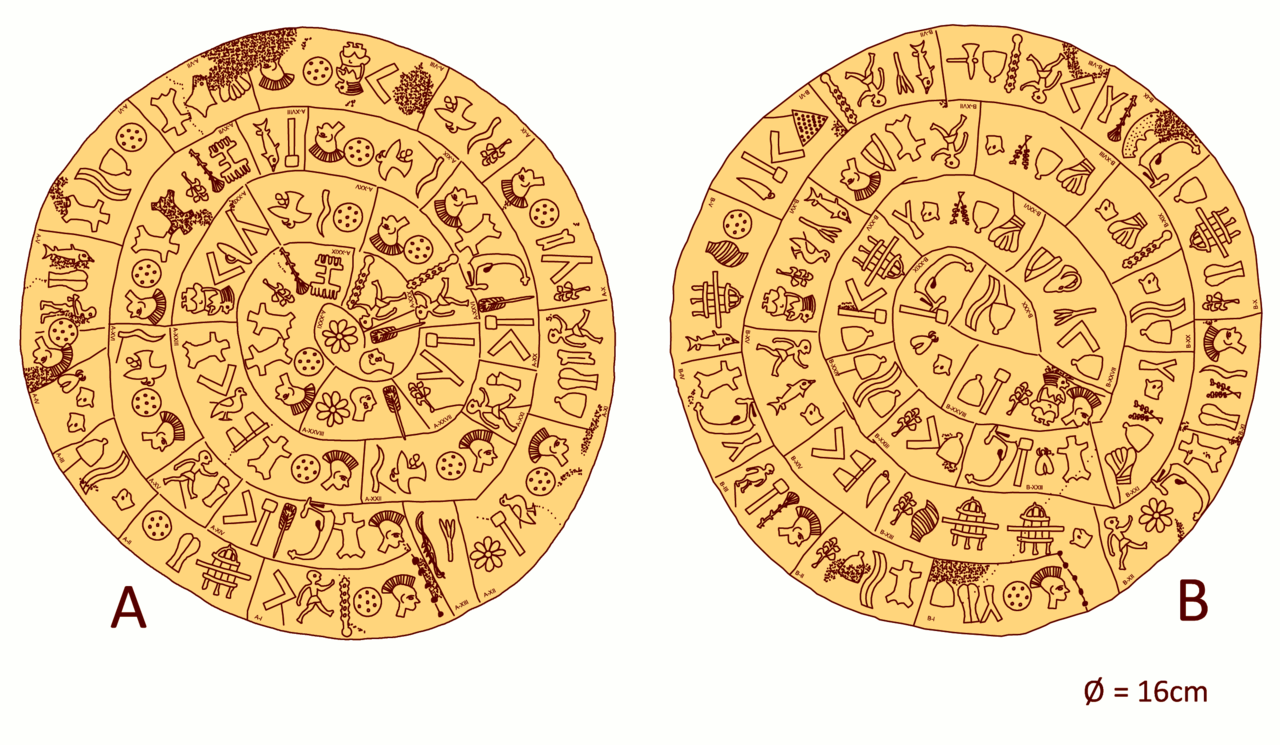
The Phaistos Disc is a small, circular clay object discovered in Crete and dated to the Bronze Age. Measuring roughly 15 centimetres across, it is impressed with a sequence of pictorial signs on both faces arranged in a continuous spiral. The symbols were not incised by hand but appear to have been pressed into the soft clay with a set of individual stamps or punches, a technique that has led some scholars to describe it as an early example of stamped or "printed" inscription.
Image gallery
10 Images




Physical description and manufacture
Both sides of the disc are divided by a spiral of stamped symbols that run from the rim toward the centre. The motifs depict a variety of stylised objects and figures — humans, animals, parts of plants, tools and everyday items — rendered in a consistent set of forms. Scholars have identified about 45 distinct sign types used on the disc and roughly 240 sign impressions (tokens) distributed into groups separated by lines. The object was formed from clay, impressed while soft, and then baked, producing the only known surviving example of this particular technique in the Aegean Bronze Age.
Discovery and archaeological context
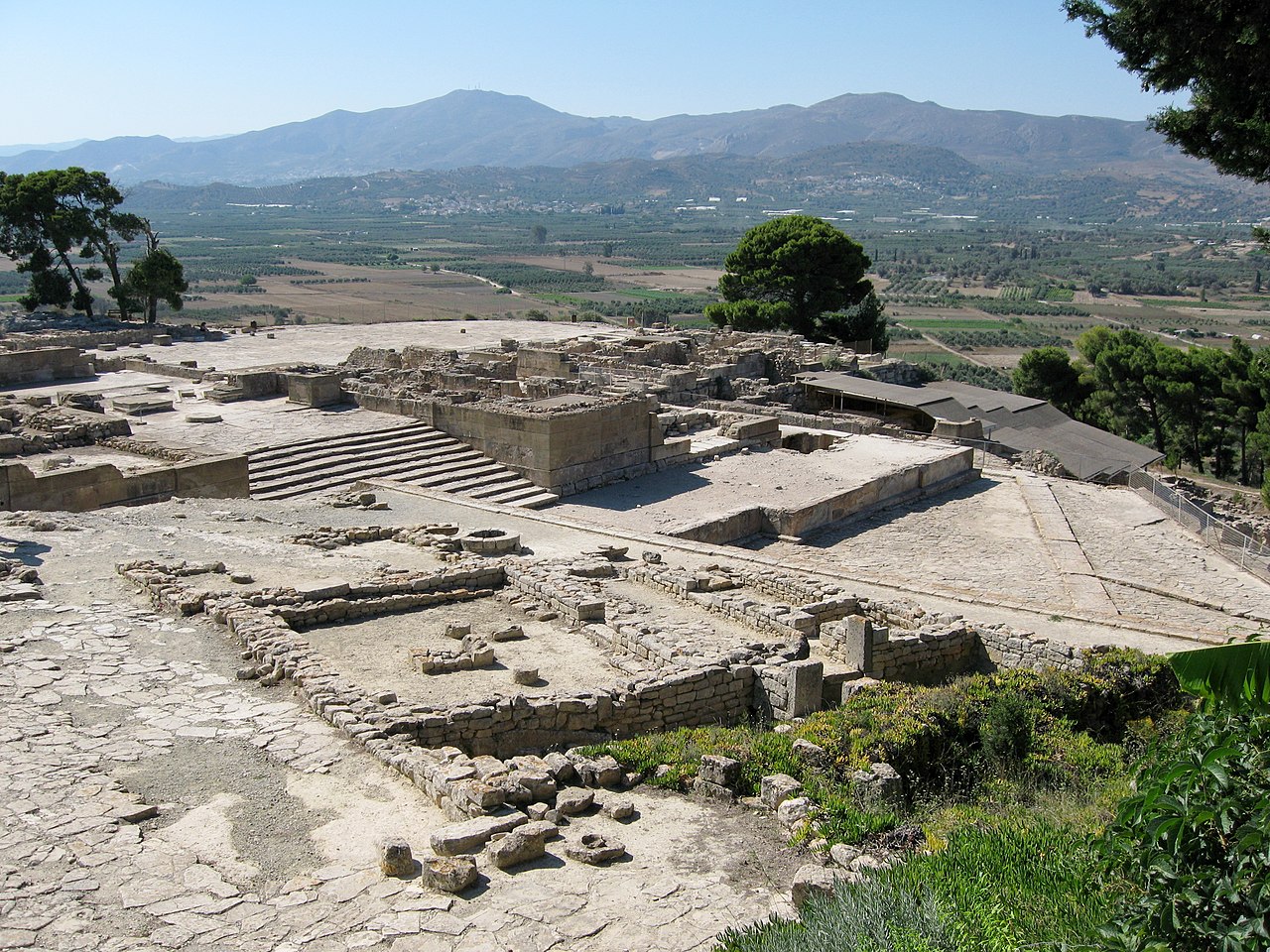
The disc was found during early 20th-century excavations at the site of Phaistos, a palace complex on the south-central coast of Crete. It emerged from a stratigraphic context associated with the Minoan civilization, commonly assigned to the middle to late second millennium BCE. The excavation report and subsequent publications drew immediate attention because of the disc’s unique appearance and the unprecedented method of stamping, which has no close parallel among securely dated Aegean inscriptions.
Writing, signs and attempts at decipherment
Because the markings appear systematic and repeat in patterns, researchers have long debated whether they constitute true writing, a proto-writing system, or a constrained set of ritual or emblematic symbols. The short length of the text, its uniqueness, and the absence of a bilingual inscription mean that proposed readings and decipherments remain speculative. A variety of hypotheses have linked the signs—tentatively—to other Bronze Age scripts or to independent sign systems, but none of these proposals has achieved general acceptance in the scholarly community.
Significance and scholarly debate
The disc attracts attention for several reasons: its manufacture by stamping suggests an early use of reusable sign-matrices; its pictorial repertoire offers rare evidence for iconography at Phaistos; and its undeciphered sequence challenges methods used for other ancient scripts. A number of debates persist, including questions about precise dating, the relationship (if any) of the signs to Linear A or other Aegean scripts, and even occasional claims about forgery, which most specialists reject on archaeological grounds.
Where it can be seen and further resources
The object is conserved in a major museum collection on Crete. Scholars and interested readers can consult detailed excavation records, specialist studies and museum catalogues for photographs, drawings, and sign lists. For introductory summaries and technical analyses see: archaeological report, museum catalogue, photographic documentation and comparative studies listed in specialist bibliographies: sign catalogues, technical analyses, interpretive reviews, recent discussions.
- Material: fired clay, circular disc about 15 cm across.
- Decoration: stamped pictographs in a spiral on both sides.
- Sign inventory: roughly 45 distinct signs and about 240 impressions, grouped into about 60 clusters.
- Date and culture: placed in the Minoan Bronze Age, second millennium BCE (approximate).
- Current status: unique, undeciphered, and subject of ongoing research.
Questions and answers
Q: What is the Phaistos disc?
A: The Phaistos disc is a bronze age artifact made of clay that is about 15 centimeters in diameter and is covered with many symbols.
Q: Where is the Phaistos disc from?
A: The Phaistos disc is from the civilization of Minoa on the Greek island of Crete, possibly from the 2nd millennium BC.
Q: What do the symbols on the Phaistos disc represent?
A: The symbols on the Phaistos disc show everyday things and were stamped onto the disc when it was still soft.
Q: How are the symbols arranged on the Phaistos disc?
A: The symbols on the Phaistos disc run in a spiral and cover both sides of the disc. They are arranged in 61 groups, separated by lines, and there are 242 tokens on the disc, taken from a set of 45 unique signs.
Q: Is the Phaistos disc considered a form of writing?
A: Many questions have been asked if the signs shown on the Phaistos disc actually represent writing.
Q: Is the Phaistos disc the only artifact of its kind?
A: Yes, the Phaistos disc is the only artifact of its kind.
Q: Why is it unlikely that the Phaistos disc will be deciphered?
A: Because the "text" on the Phaistos disc is very short and the disc is unique, it is likely that it will not be deciphered.
Related articles
Author
AlegsaOnline.com Phaistos Disc Leandro Alegsa
URL: https://en.alegsaonline.com/art/76323
Sources
- skydrive.live.com : An "actions report" of a manager of the ancient Phaistos commercial center