
Phagocyte
A phagocyte is an immune cell that engulfs microbes, dead cells, and debris; central to innate defense, tissue cleanup, and triggering adaptive immunity.
Phagocytes are cells of the immune system that identify, engulf and destroy particles such as microbes, damaged cells and foreign material. In vertebrates many phagocytes circulate in the blood or reside in tissues and act as first responders to injury or infection. Commonly described as a class of white blood cells, they remove bacteria and cellular debris and help coordinate the later adaptive immune response; see white blood cells and the role of phagocytosis against bacteria.
Image gallery
10 Images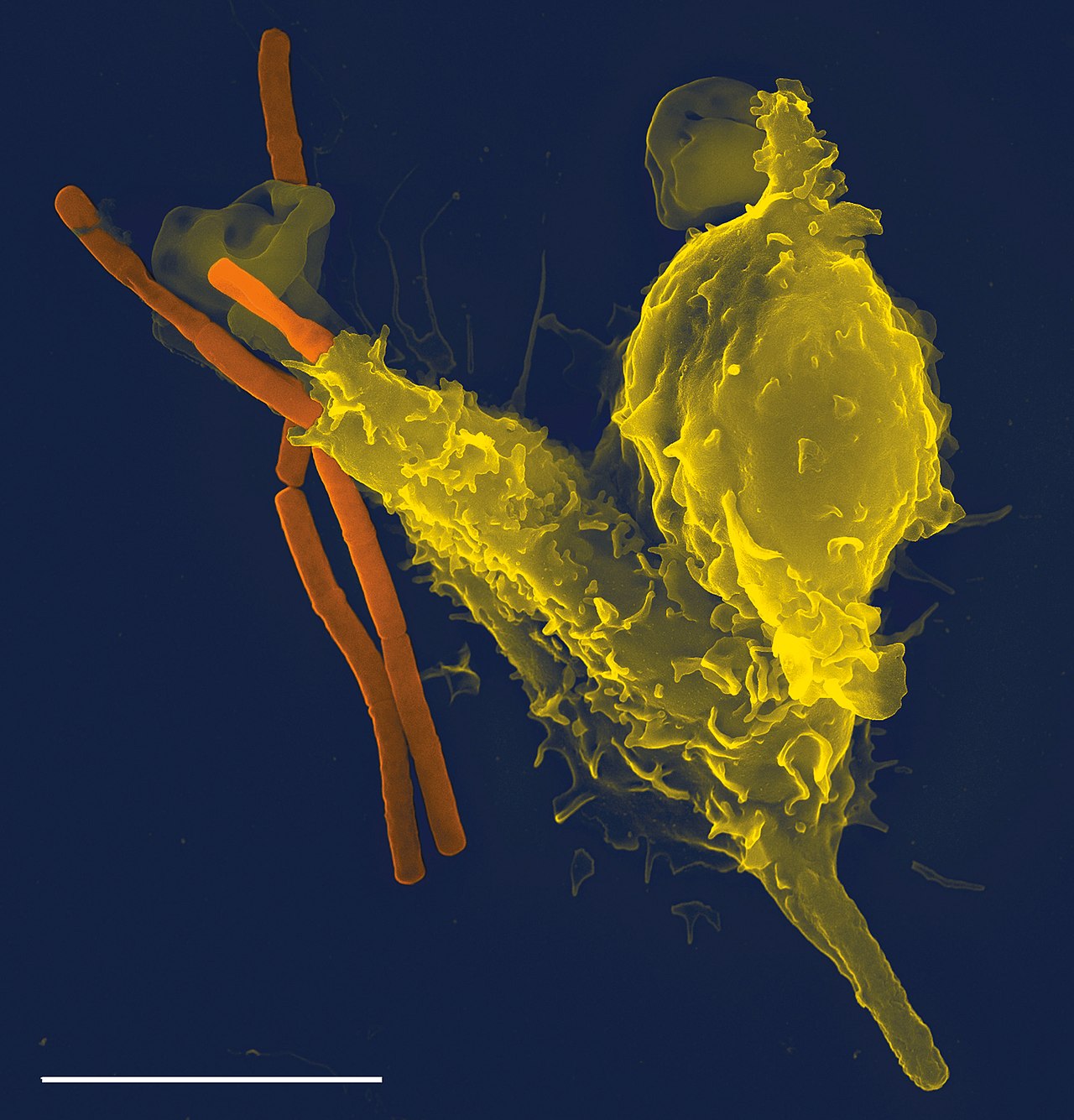





Types and key characteristics
Not all phagocytes are identical. Professional phagocytes are specialized to ingest and kill particles efficiently; the main types are:
- Neutrophils – abundant, short-lived cells that rapidly attack bacteria.
- Macrophages – longer-lived, tissue-resident cells that clear debris and support repair.
- Dendritic cells – bridge innate and adaptive immunity by presenting captured material to lymphocytes.
- Monocytes – blood precursors that can migrate into tissues and become macrophages or dendritic cells.
Other cell types can perform phagocytosis less efficiently and are sometimes called "non-professional" phagocytes. Phagocytes also ingest dead or dying host cells to maintain tissue health. In humans they are numerous — roughly on the order of magnitude of billions per liter of blood, often quoted as about six billion phagocytic cells — reflecting their central role in surveillance.
How phagocytosis works
The process proceeds in steps: migration toward a target (chemotaxis), recognition and binding (often aided by opsonins such as antibodies or complement), engulfment to form a phagosome, and fusion with lysosomes to form a phagolysosome where acids, enzymes and reactive oxygen species kill and digest the contents. This cellular digestion helps resolve infections and clears material that might otherwise provoke chronic inflammation. Some phagocytes then display fragments of the digested material on their surface to inform adaptive immunity (developing immune responses).
Origin, distribution and evolution
Phagocytes in vertebrates arise from stem cells in the bone marrow and differentiate under the influence of growth factors and cytokines. Phagocytic cells are not unique to vertebrates: many invertebrates possess circulating or tissue phagocytes (hemocytes) that perform similar cleanup and defensive functions, indicating an ancient evolutionary role for particle ingestion in animal defense.
Clinical importance and distinctions
Proper phagocyte function is essential for host protection. Genetic defects that impair engulfment, microbial killing or migration increase susceptibility to specific infections and can cause ongoing inflammation. Conversely, excessive or misdirected phagocyte activity contributes to tissue damage in inflammatory diseases. Because some phagocytes present antigens to T cells, they are also important targets and mediators in vaccination and immunotherapy. Distinguishing professional from non-professional phagocytes and understanding their activation states are central concerns in immunology research and clinical practice.
For concise practical summaries and further reference materials, see curated overviews and clinical guides: overview of immune cells, microbial interactions, cell clearance mechanisms, infection control, adaptive immunity links, and population or measurement notes on cell counts.
Questions and answers
Q: What are phagocytes?
A: Phagocytes are white blood cells that protect the body by eating bacteria and dead or dying cells.
Q: What is the function of phagocytes?
A: The function of phagocytes is to protect the body by eating bacteria and dead or dying cells. They are important for fighting infections and becoming immune.
Q: Are phagocytes present in all animals?
A: Yes, phagocytes are present in all animals.
Q: What is the complexity of phagocytes in vertebrates?
A: Phagocytes are very complex in vertebrates.
Q: How many phagocytes are present in one liter of human blood?
A: One liter of human blood has about six billion phagocytes.
Q: Why are phagocytes important for becoming immune?
A: Phagocytes are important for becoming immune because they help the body to recognize and remember infectious agents that they have encountered before.
Q: What is the significance of phagocytes for fighting infections?
A: Phagocytes are significant for fighting infections because they are capable of phagocytosing bacteria and dead or dying cells that can cause harmful infections in the body.
Related articles
Author
AlegsaOnline.com Phagocyte Leandro Alegsa
URL: https://en.alegsaonline.com/art/76322
Sources
- pathmicro.med.sc.edu : "Immunology — Chapter One: Innate (non-specific) Immunity"
- nobelprize.org : Ilya Mechnikov
- nobelprize.org : Nobel Lectures
- doi.org : 10.1126/science.7878464
- pubmed.ncbi.nlm.nih.gov : 7878464
- doi.org : 10.1038/nrmicro1004
- pubmed.ncbi.nlm.nih.gov : 15378046
- cell.com : cell.com/trends/microbiology/abstract/S0966-842X(02)02343-0?_returnURL=http%3A%2F%2Flinki…
- textbookofbacteriology.net : textbookofbacteriology.net/antiphago.html
- commons.wikimedia.org : Phagocytes