
Autonomous Province of Kosovo and Metohija
Overview of the Autonomous Province of Kosovo and Metohija: names, geography, history, contested status, administration, demographics, and contemporary significance.
The Autonomous Province of Kosovo and Metohija is a historic and politically contested area in the central Balkans. It is known by several names in local languages: see the Serbian form via Serbian name and the Albanian form via Albanian name. In everyday usage the territory is often called Kosovo in English and other languages; an Albanian-language variant is available at Kosova. The Serbian shorthand KiM (КиМ) or the compound Kosmet are also in use. The name "Metohija" derives from the Greek term metochion, referring to land historically owned by monasteries.
Image gallery
9 Images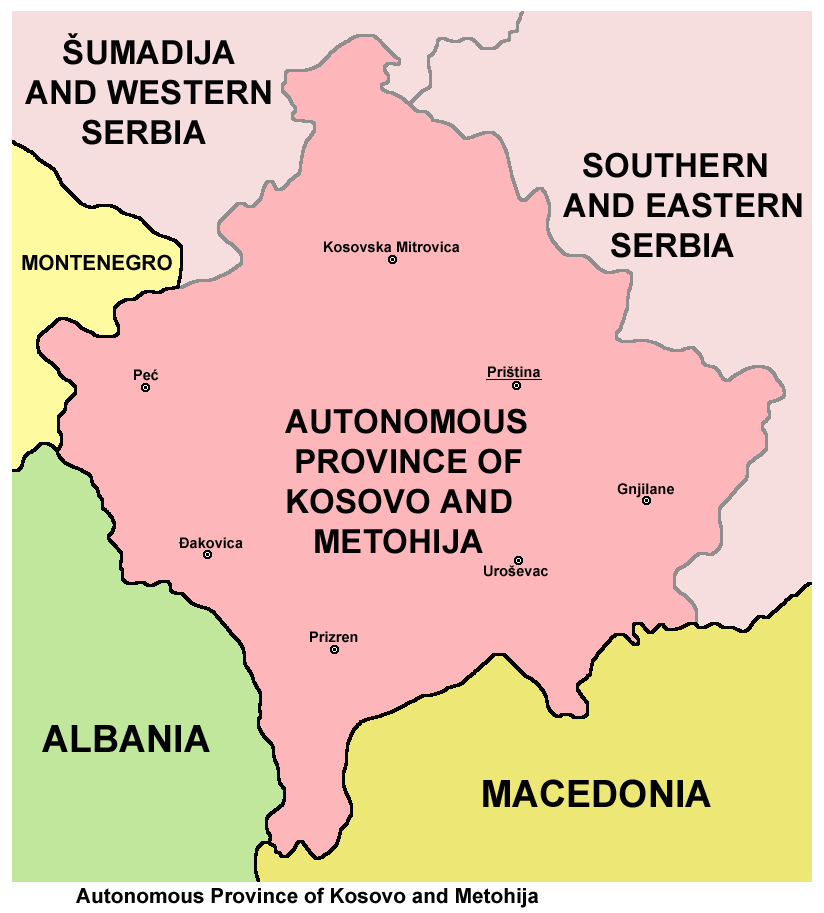


Geography and administrative claims
The province occupies a landlocked upland region in southeastern Europe, with the city of Pristina serving as its largest urban center and administrative locus according to local institutions; see Pristina. Under the constitution of the Republic of Serbia the area is defined as the Autonomous Province of Kosovo and Metohija and remains part of Serbia's territorial framework. Other authorities, notably the institutions formed after 2008, exercise de facto control over most of the territory.
Historical background
Kosovo's history reflects a succession of empires, principalities and modern states. It was part of the Ottoman Empire for centuries and after the Balkan Wars became incorporated into the Kingdom of Serbia and later Yugoslavia. In the socialist period Kosovo held an autonomous status within the Yugoslav federation, with autonomy expanded by the 1974 constitutional arrangements. That arrangement changed during the political upheavals of the 1990s linked to the rise of Slobodan Milošević; see Slobodan Milošević. Tensions between the province's Albanian majority and Serbian authorities culminated in armed conflict in the late 1990s (Kosovo War), followed by a NATO-led intervention and deployment of international civilian administration.
Post-1999 transition and political status
Following the 1999 conflict the United Nations Security Council adopted Resolution 1244, which authorized an international presence and interim governance; see UN mission references and regional context. The United Nations Interim Administration in Kosovo (UNMIK) administered the territory for several years and remains a key part of that transitional story—details at administrative context and legal references. In February 2008 representatives of Kosovo's majority community declared independence as the Republic of Kosovo; see Republic of Kosovo. That declaration is accepted by many states but not by others, including Serbia. International diplomacy produced the 2013 Brussels Agreement aimed at normalizing relations between Belgrade and Pristina; see Brussels Agreement.
Demographics, language and institutions
The population is ethnically and religiously mixed but dominated by ethnic Albanians, with a significant Serb minority concentrated in northern pockets and various enclaves. Languages most used in public life include Albanian and Serbian; both languages figure prominently in local governance and cultural life. Since 2008 Kosovo has developed institutions of self-government—parliament, government and judiciary—that operate across much of the territory, even as arrangements for minority representation and local autonomy remain subjects of negotiation and international facilitation. For the period before and during the 1990s see the 1991 declaration of the separate Republic of Kosova referenced at 1991 events and the later administrative changes described at regional names.
Significance and contemporary issues
- Political status: Kosovo/Metohija remains among the most sensitive sovereignty disputes in Europe; the legal and diplomatic status continues to evolve through bilateral talks, international mediation and court rulings.
- Security and governance: International missions and local authorities cooperate on rule-of-law, returns of displaced people, and minority protection, while local policing and municipal institutions operate under varying arrangements; background on international roles is available via UN and other missions.
- Cultural heritage: The territory contains religious and historic sites important to several communities, including medieval Serbian Orthodox monasteries and Ottoman and Illyrian-era remains—heritage that figures in identity and tourism discussions.
- Regional impact: Developments in Kosovo affect wider Balkan diplomacy, EU engagement, and relations between Belgrade and Pristina; see related policy overviews at political history and recent accords.
Because the contemporary situation mixes legal claims, on-the-ground governance and international diplomacy, descriptions of Kosovo and Metohija vary by source. Readers seeking primary documents and local perspectives can consult authoritative repositories and statements from the Republic of Serbia, the institutions of Kosovo, the United Nations and other international organizations; representative entry points include Serbian sources, Albanian-language materials, the Pristina administration, historical summaries at regional histories, and mediation texts at conflict accounts and diplomatic records.
Questions and answers
Q: What is the full name of Kosovo and Metohija?
A: The Autonomous Province of Kosovo and Metohija, or in Serbian: Аутономна Покрајина Косово и Метохиja; in Albanian: Krahina Autonome e Kosovës dhe Metohisë.
Q: What is the short form for Kosovo and Metohija?
A: Commonly known as Kosovo and Metohija, or in Serbian: Косово и Метохија; in Albanian: Kosova dhe Metohija, or Kosovo, or in Serbian: Косово; in Albanian: Kosova.
Q: Who currently has control over the land?
A: The self-declared Republic of Kosovo currently has actual control over the land.
Q: When was it part of Serbia?
A: Before the Republic of Kosovo, the area was controlled by Serbia (while Serbia was part of Yugoslavia) between 1912 and 1999.
Q: What happened during Slobodan Milošević's Anti-bureaucratic Revolution?
A: During Slobodan Milošević's Anti-bureaucratic Revolution that happened in 1990 when Kosovo was part of Yugoslavia, Kosovo's government became less powerful and that Serbia had more control, like in 1971–74.
Q: How many UN member states recognize the independence of Kosovo?
A: 95 UN member states recognize the independence of Kosovo.
Related articles
Author
AlegsaOnline.com Autonomous Province of Kosovo and Metohija Leandro Alegsa
URL: https://en.alegsaonline.com/art/7628
Sources
- publikacije.stat.gov.rs : "Региони у Републици Србији"
- vojvodina.gov.rs : "Autonomous Province of Vojvodina"
- books.google.com : The Kosovo Conflict and International Law: An Analytical Documentation 1974-1999
- b92.net : "Šta donosi predlog novog ustava Srbije"
- srbija.gov.rs : "Republic of Palau suspends recognition of Kosovo"
- rs-lat.sputniknews.com : "Sve manje „države Kosovo", sve više — Kosovo je Srbija!"
- nato.int : "NATO – Topic: NATO's role in Kosovo"
- stripes.com : "Kosovo aims to form military force and join NATO – News"
- un.org : "Kosovo's declaration of independence did not violate international law – UN court"
- bbcnewsamerica.com : "ICJ,International Court of Justice:Declaration of independence of Kosovo from Serbia is not a violation of international law"
- insajder.net : insajder.net
- balkaninsight.com : Serbia Pulls Plug on North Kosovo Assemblies