
Petrushka — Stravinsky's 1911 ballet of puppets, love and tragedy
Petrushka is a four-scene ballet created by Igor Stravinsky and Alexandre Benois for Diaghilev's Ballets Russes. It mixes music, mime and design to tell the tragic story of three enchanted puppets.
Petrushka is a four-scene theatrical work that combines music, dance and stage design to tell a short, dramatic story of jealousy and loss. Written for Sergei Diaghilev’s company, it was conceived by Alexandre Benois and Igor Stravinsky, scored by Stravinsky and choreographed by Michel Fokine. At its 13 June 1911 premiere in Paris the production was mounted by Diaghilev’s Ballets Russes. Petrushka is often described as a ballet and, because of its comic‑tragedy tone, sometimes as a musical burlesque.
Image gallery
10 Images


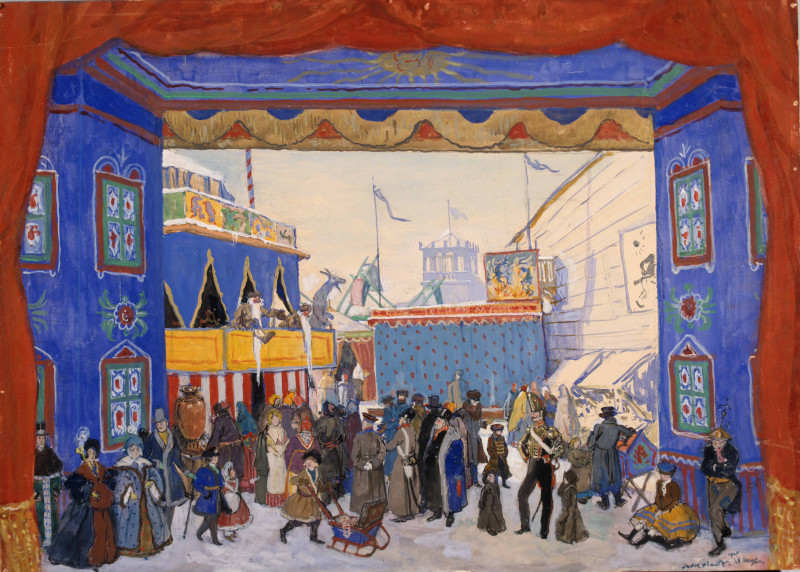


Story and dramatic outline
The plot follows three puppets brought to life by a conjurer known as The Charlatan. Set during a raucous Shrovetide fair in St. Petersburg, the puppet characters—Petrushka, The Ballerina and The Moor—display human passions. Petrushka loves The Ballerina, but she favors The Moor. Jealousy erupts: Petrushka confronts his rival, and the Moor stabs him with a scimitar. In the final episode the dead puppet’s spirit appears above the little theatre to accuse The Charlatan, then collapses in a last, spectral death. The story is concise, concentrated into four scenic tableaux that alternate crowd spectacle and intimate pantomime.
Music and choreography
Stravinsky’s score for Petrushka marked him as an innovative voice in early 20th‑century music. The music is notable for its vivid orchestration, driving rhythms, repeated motifs and unexpected harmonic juxtapositions. Music historians point to particular sonorities—now commonly associated with the work—as emblematic of Stravinsky’s early style. Stravinsky also integrated popular and folk‑like tunes into the texture, contrasting crowd scenes with Petrushka’s private laments. Choreographer Michel Fokine and the original cast used expressive mime and stylized movement rather than classical ballet spectacle; Nijinsky’s portrayal of Petrushka emphasized awkward, puppet‑like gestures and strong acting, while Tamara Karsavina created the role of The Ballerina.
Design, premiere and key performers
Visual identity was central to Petrushka. Benois designed bold, painterly sets and costumes that evoked a provincial fair and a cramped puppet booth; those designs helped to define the tone and continue to influence later productions. At the premiere the role of The Moor was danced by Alexandre Orlov and The Charlatan was performed by Enrico Cecchetti. The collaboration among Benois, Stravinsky, Fokine and Diaghilev’s troupe is often cited as a model of integrated stagecraft where music, movement and décor are conceived as a single artistic organism.
Legacy and significance
Petrushka quickly became one of the most admired Ballets Russes pieces and has remained a touchstone in both dance and music. It is frequently revived, often preserving Benois’s original visual scheme and the spirit of Fokine’s choreography even when directors adapt movement for new casts. Stravinsky himself treated elements of the score for concert performance, and the work’s bold rhythmic and harmonic language influenced later composers and choreographers. Critics and historians continue to praise the work’s compact dramaturgy and its achievement in uniting three arts into a single expressive statement.
Structure and notable facts
- Form: Four scenes that alternate public fairground episodes and private puppet encounters.
- Creators: libretto/story by Alexandre Benois and Igor Stravinsky; music by Stravinsky; choreography by Michel Fokine.
- Premiere company and place: Diaghilev’s Ballets Russes, Paris, 13 June 1911.
- Original cast highlights: Nijinsky as Petrushka; Tamara Karsavina as The Ballerina; Alexandre Orlov as The Moor; Enrico Cecchetti as The Charlatan.
- Genre notes: often called a ballet with elements of burlesque and commedia‑style pantomime.
Petrushka remains an instructive example of early modern collaboration between composer, choreographer and designer; its concentrated narrative, striking music and memorable imagery explain why it endures in both repertory programming and scholarly discussion.
Questions and answers
Q: What is Petrushka?
A: Petrushka is a ballet burlesque in four scenes. It was written by Alexandre Benois and Igor Stravinsky, with music composed by Stravinsky, choreography designed by Michel Fokine, sets and costumes designed by Benois, and first performed in Paris on 13 June 1911.
Q: Who wrote the story of the ballet?
A: The story of the ballet was written by Alexandre Benois and Igor Stravinsky.
Q: Who composed the music for Petrushka?
A: The music for Petrushka was composed by Igor Stravinsky.
Q: Who choreographed the work (designed the dances)?
A: The work (dances) were choreographed (designed) by Michel Fokine.
Q: What is the story of Petrushka about?
A: The story of Petrushka tells of the loves and jealousies between three puppets brought to life at a Shrovetide Fair in 1830s St Petersburg. One puppet, Petrushka, falls in love with a Ballerina who rejects him because she likes another puppet called The Moor; this leads to an altercation between them which ends with The Moor killing Petruskha with his scimitar.
Q: How has it been received over time?
A: Over time, it has been highly praised as one of the greatest ballets due to its perfect fusion of music, choreography, décor and theme - that being "the timeless tragedy of the human spirit". It continues to be popular today and usually performed using original designs and dances from when it premiered in 1911.
Tags
Related articles
Author
AlegsaOnline.com Petrushka — Stravinsky's 1911 ballet of puppets, love and tragedy Leandro Alegsa
URL: https://en.alegsaonline.com/art/76241
Sources
- books.google.com : Petrushka
- books.google.com : Pop Culture Russia! : Media, Arts, and Lifestyle
- books.google.com : Petrushka: Sources and Contexts