
Petrolacosaurus — an early diapsid reptile of the Late Carboniferous
Petrolacosaurus was a small, early diapsid reptile from Pennsylvanian-aged Kansas. This article reviews its discovery, anatomy, ecology, and significance for early amniote evolution.
Overview
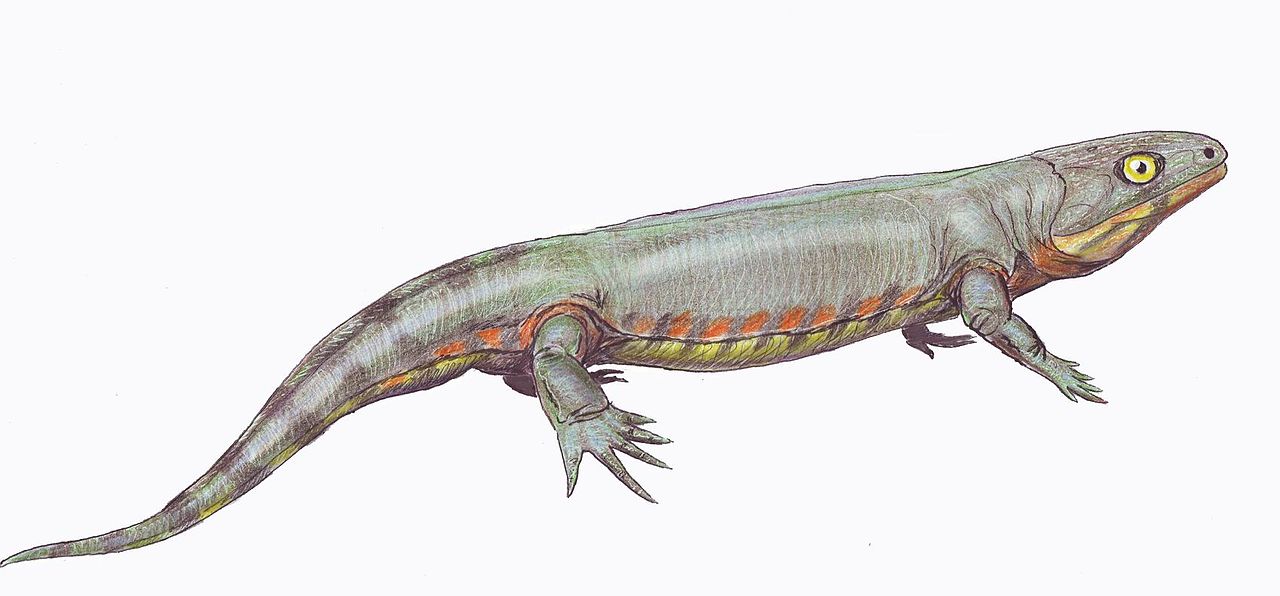
Petrolacosaurus is one of the earliest known small amniotes showing the diapsid condition. It lived in what is now North America during the Late Carboniferous (Pennsylvanian) and is known from well-preserved fossils that reveal skull and partial skeleton anatomy important to studies of early reptile evolution. The animal is commonly reconstructed as roughly 40 centimetres in total length and lightly built.
Image gallery
10 Images




Discovery and geological context
Fossils of Petrolacosaurus were recovered from Pennsylvanian-aged strata in what is now Kansas. These layers are part of the later Carboniferous sequence and are usually assigned to the Pennsylvanian subperiod. Radiometric and biostratigraphic work place the material in the early Pennsylvanian, roughly three hundred million years ago, providing a useful minimum age for some splits among early amniote lineages.
Anatomy and skull structure
The skull of Petrolacosaurus exhibits two temporal openings on each side, the defining feature of a diapsid. This arrangement increased the surface area available for attachment of jaw muscles and is associated with more powerful and versatile biting mechanics compared with more primitive skull types. Its dentition included small pointed teeth with a few enlarged, canine-like (caniniform) teeth that probably helped in grasping or killing small prey.
Postcranial skeleton and locomotion
Postcranial remains indicate a gracile limb skeleton and a flexible spine consistent with an agile, terrestrial lifestyle. Limb proportions suggest Petrolacosaurus was capable of rapid movements on the ground and could have foraged among low vegetation or litter. Its tail was likely used for balance rather than as a specialized prehensile organ.
Diet and ecology
Functional interpretation of tooth shape and jaw mechanics supports an insectivorous or small-vertebrate diet, with prey items such as early insects and other arthropods. As a small predator in Late Carboniferous environments, Petrolacosaurus probably occupied an ecological niche feeding on abundant terrestrial invertebrates and occasionally on tiny vertebrates.
Phylogenetic significance
Petrolacosaurus is an early representative of the diapsid branch of the amniote tree and therefore illustrates that the two-temporal-fenestra condition had evolved by the Pennsylvanian. Because synapsids (the lineage that ultimately gave rise to mammals) possess a single temporal opening and diverged early from other amniotes, Petrolacosaurus cannot be regarded as an ancestor of mammals. Its position helps clarify the sequence of character changes among early amniote groups.
Comparisons with other early amniotes
Comparative study with contemporary and slightly younger taxa shows that several skull and dental traits evolved in parallel in different lineages. Petrolacosaurus differs from early synapsids in the number and arrangement of temporal fenestrae and in other cranial details. These differences are used by paleontologists to reconstruct branching patterns among early reptiles and their relatives.
Research history and interpretation
The taxon has featured in scientific literature since its description and has been the subject of anatomical and phylogenetic studies that refine its placement among early diapsids. Interpretations have been cautious where material is incomplete, and new discoveries or reanalyses of known specimens continue to inform its biology and relationships.
Public perception and common misconceptions
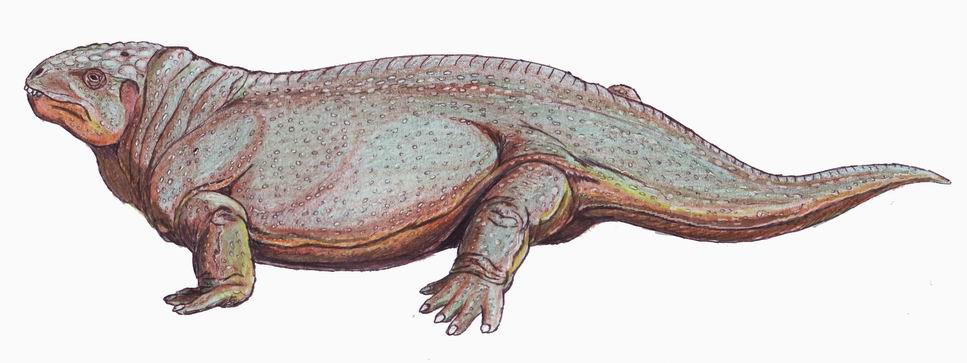
Popular media occasionally simplify complex evolutionary relationships. For example, broadcasters such as the BBC and programs like Walking with Dinosaurs have at times presented Petrolacosaurus as if it were a direct ancestor of both reptiles and mammals. Accurate evolutionary accounts emphasize that it represents a specialized early member of the diapsid lineage rather than a common ancestor of all later amniotes.
Summary of key points
- Small, agile terrestrial amniote from Pennsylvanian strata of Kansas.
- Exhibits the two temporal openings characteristic of diapsids, reflecting attachment sites for jaw muscles.
- Likely insectivorous, feeding on insects and other small prey.
- Important for understanding early branching among amniotes in the Late Carboniferous (Pennsylvanian).
Further reading
Readers interested in early amniote evolution can consult paleontological reviews and textbooks for broader context. Many museum and educational outlets provide accessible summaries and images that illustrate Petrolacosaurus and related taxa; these are valuable starting points for non-specialist audiences.
Questions and answers
Q: How big was Petrolacosaurus?
A: Petrolacosaurus was a small animal, only 40 centimetres (16 inches) long.
Q: What is Petrolacosaurus' diet?
A: Petrolacosaurus' diet was probably small insects.
Q: What is the age of the strata where Petrolacosaurus was found?
A: The strata where Petrolacosaurus was found in Kansas are of Pennsylvanian age, approximately 302 million years old.
Q: What is distinctive about Petrolacosaurus' teeth?
A: Petrolacosaurus had distinctive canine-like secondary-sized teeth, a trait found mainly in therapsids, and later in mammals.
Q: Where were Petrolacosaurus fossils found?
A: Petrolacosaurus fossils were found in Kansas, USA.
Q: Is Petrolacosaurus the ancestor of all modern forms?
A: Petrolacosaurus was too derived to be the ancestor of all modern forms.
Q: Why can't Petrolacosaurus be the ancestor of any synapsids?
A: Petrolacosaurus cannot have been the ancestor of any synapsids because it was already a diapsid, with two openings on each side of its skull to add attachment points for jaw muscles. Synapsids diverged from the common amniote tree before the diapsids did.
Related articles
Author
AlegsaOnline.com Petrolacosaurus — an early diapsid reptile of the Late Carboniferous Leandro Alegsa
URL: https://en.alegsaonline.com/art/76226
Sources
- findarticles.com : article