
Acrocanthosaurus: the high‑spined theropod of the Lower Cretaceous
Acrocanthosaurus was a large high‑spined theropod from Lower Cretaceous North America, notable for tall neural spines, robust forelimbs, and its likely placement among the carcharodontosaurids.
Acrocanthosaurus was a large, carnivorous theropod dinosaur that lived in what is now North America during the Lower Cretaceous. Its genus name, meaning "high‑spined lizard," refers to unusually tall neural spines on the vertebrae that would have supported a visible ridge, sail or hump along the animal's back. Known from several partial skeletons and isolated bones, Acrocanthosaurus is regarded as one of the largest predatory dinosaurs of its time on the continent.
Image gallery
10 Images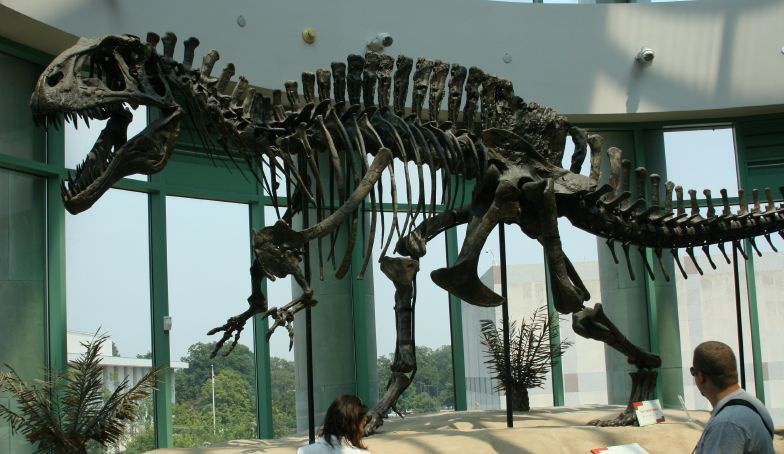


Anatomy and distinguishing features
The most striking trait of Acrocanthosaurus is the elongation of the dorsal neural spines, which rose well above the height of the vertebral centra and gave the animal its name. The skull was elongated and low, bearing ridges above and beside the snout; these cranial ridges extend from the nasal region toward the eye and onto the lacrimal bones. Teeth were laterally compressed and serrated, suitable for slicing flesh. Forelimbs were relatively long and powerfully built compared with later giant tyrannosaurids, ending in three large, clawed digits.
Size and proportions
- Length: commonly estimated at about 11 metres (roughly 36 feet).
- Mass: rough estimates place it in the multi‑ton range; some authors suggest around 6–7 short tons (weight estimate), but such figures vary by method.
- Body plan: a large skull, robust neck and torso, long hips and tail, with the characteristic tall neural spines along much of the back.
Classification and scientific history
Early workers compared Acrocanthosaurus to several groups because the high spines superficially resembled those of spinosaurids such as Spinosaurus. Subsequent studies place it within the broader group of carnosaurs, and many paleontologists consider it a member of the carcharodontosaurids — a lineage that includes other large, blade‑toothed predators (carnosaur relationships). The genus was named and described in the mid‑20th century based on fossils from the southern United States, and additional material has clarified its anatomy and affinities over time.
Fossil discoveries and notable localities
Most definite Acrocanthosaurus remains come from formations in Oklahoma and Texas, where partial skeletons have yielded skull, vertebrae and limb elements. A famous set of trackways at the Paluxy River in Texas has been interpreted by some researchers as evidence of predator–prey interactions possibly involving Acrocanthosaurus and sauropod trackmakers; that interpretation is intriguing but not conclusively proven and remains debated in the literature (Paluxy hypothesis).
Paleobiology and ecological role
As a large apex predator, Acrocanthosaurus would have been capable of hunting sizable contemporaneous herbivores such as iguanodontians and sauropods. Its strong forelimbs and curved claws suggest it may have grappled with prey, while its teeth and skull shape indicate a shearing bite. The tall neural spines may have served for display, muscle attachment, thermoregulatory functions, or a combination of roles; their exact purpose is uncertain.
Notable facts and distinctions
- Its name literally describes a conspicuous skeletal feature: high neural spines.
- Though once compared to spinosaurids, it is now typically associated with carcharodontosaurids within the larger carnosaurs group—a shift reflecting improved anatomical comparisons and phylogenetic analyses (carnosaur).
- Acrocanthosaurus remains remain relatively rare, so reconstructions rely on combining partial skeletons and comparisons with better‑known relatives.
For general background on theropod anatomy and the geological context of its fossils, see introductory resources on theropods and the Lower Cretaceous environments of North America. Additional museum exhibits and published descriptions discuss the cranial ridges and lacrimal features that help diagnose the genus (lacrimal bones), while regional field reports cover the historic Paluxy trackway and other local discoveries. For more on comparative taxa and earlier alternate classifications see discussions that reference Spinosaurus and the broader dinosaur record (size and mass, carnosaur affinities).
Questions and answers
Q: What is Acrocanthosaurus?
A: Acrocanthosaurus was a type of theropod dinosaur that lived during the Lower Cretaceous period in North America.
Q: What does the name Acrocanthosaurus mean?
A: The name Acrocanthosaurus means "high-spined lizard," referring to the spines on its vertebrae.
Q: How is Acrocanthosaurus classified?
A: The classification of Acrocanthosaurus is uncertain, but it is now classified as a carnosaur, with most paleontologists believing it was a carcharodontosaurid.
Q: How big was Acrocanthosaurus?
A: Acrocanthosaurus was 36 feet long and weighed about 6 or 7 short tons, almost as large as Tyrannosaurus rex.
Q: Was Acrocanthosaurus the largest theropod in North America?
A: Yes, Acrocanthosaurus was the largest theropod in North America before the evolution of the tyrannosaurs.
Q: What is a characteristic feature of all allosaurids?
A: Long, low ridges that start at the nasal bones and run along each side of the snout from the nostril back to the eye, continuing onto the lacrimal bones, is a characteristic feature of all allosaurids.
Q: What has been discovered in the Paluxy, Texas trackway?
A: A trackway in Paluxy, Texas shows tracks that are believed to have been made by an Acrocanthosaurus and its prey, but the hypothesis is difficult to prove and other explanations exist.
Tags
Related articles
Author
AlegsaOnline.com Acrocanthosaurus: the high‑spined theropod of the Lower Cretaceous Leandro Alegsa
URL: https://en.alegsaonline.com/art/759
Sources
- species.wikimedia.org : Acrocanthosaurus
- ncbi.nlm.nih.gov : "Estimating mass properties of dinosaurs using laser imaging and 3D computer modelling"
- ui.adsabs.harvard.edu : 2009PLoSO...4.4532B
- doi.org : 10.1371/journal.pone.0004532
- pubmed.ncbi.nlm.nih.gov : 19225569