
Perimeter (geometry) — length around a plane figure
Perimeter is the total length of the boundary of a flat shape. This article gives definitions, common formulas, measurement methods, history, practical uses, and notable mathematical facts.
The perimeter of a planar figure is the total distance measured along its boundary. In basic geometry this concept appears when measuring polygons, curved shapes and real-world outlines. For an introduction to its geometric context see geometry. A simple example: a rhombus with four equal sides of 2 inches has perimeter 2+2+2+2 = 8 inches; see rhombus for related properties.
Image gallery
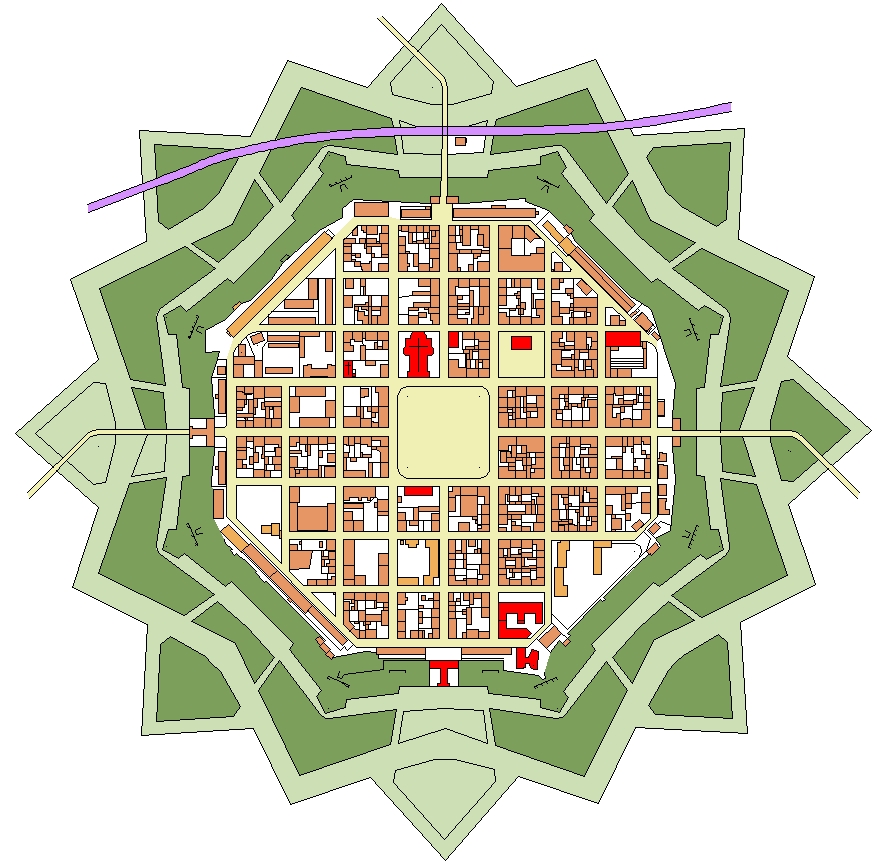
3 Images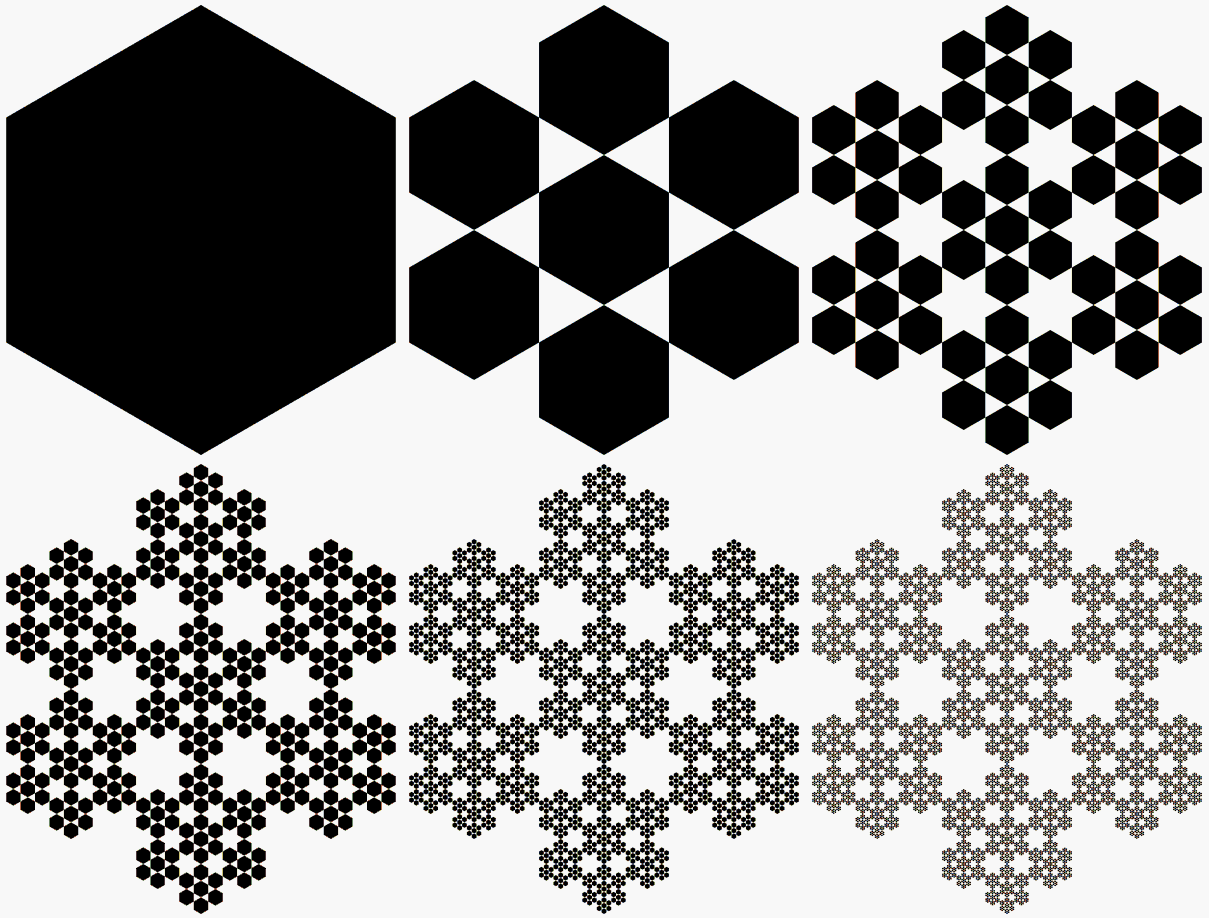

Definition and common formulas
For polygons the perimeter equals the sum of the lengths of all sides. Thus for a polygon with sides s1, s2, …, sn, the perimeter P = s1 + s2 + … + sn. Special cases include the square (P = 4a for side a) and the rectangle, where the perimeter is P = 2(l + w) for length l and width w. See polygon for general cases.
For curved shapes the perimeter is often called the circumference when the figure is a circle. The circumference C of a circle can be written C = 2πr = πd, where r is the radius, d the diameter, and π is the mathematical constant pi. For a discussion of circles see circle.
Computation for smooth curves and ellipses
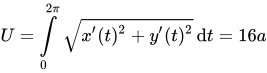
When boundaries are not straight-line polygons the perimeter is the arc length of a closed curve. In calculus this is computed with an integral that sums infinitesimal distances along the curve. Some shapes lack simple closed-form perimeters: for example the exact perimeter of an ellipse involves elliptic integrals; practical work uses approximations. Well-known approximations, such as formulas by Ramanujan, give highly accurate estimates for the ellipse's circumference.
History and applications
The idea of measuring boundary length dates back to ancient surveyors who measured fields and property lines; Greeks and Egyptians developed early techniques of land measurement and geometric reasoning. In modern settings perimeter figures in tasks such as planning fences, calculating trim length in construction, determining the length of race tracks and sports fields, and manufacturing parts where edge length matters — for example a football field's outline or perimeter is used in site planning; see football for specific field dimensions.
Important distinctions and notable facts
- Perimeter vs area: perimeter measures boundary length, area measures the region enclosed; they are related but distinct.
- Terminology: the term "circumference" is commonly reserved for circles and circular arcs; see circumference.
- Units: perimeter has linear units (meters, feet, etc.), independent of orientation.
- Isoperimetric principle: among all plane shapes with a given perimeter, the circle encloses the largest area — a classical result in geometry.
For further technical reading and formula tables consult introductory geometry references and mathematical handbooks; see general resources linked in context such as geometry and specialized entries for polygons, circles and ellipses.
For historical notes and constants consult entries on pi and classical geometry, and for applications in sport and planning see the example of a regulated field layout at football. Additional conceptual background is available at rhombus and circumference.


![{\displaystyle \gamma \colon [0,2\pi ]\rightarrow \mathbb {R} ^{2}}](https://www.alegsaonline.com/image/63900262a960d64137e54e681e881ab7ae9d2b7d.svg)



Related articles
Author
AlegsaOnline.com Perimeter (geometry) — length around a plane figure Leandro Alegsa
URL: https://en.alegsaonline.com/art/75812