
Pericles' Funeral Oration
An encyclopedic overview of Pericles' Funeral Oration: context, ritual setting, textual transmission, themes, authorship questions, interpretations, and its reception in later civic rhetoric.
Introduction
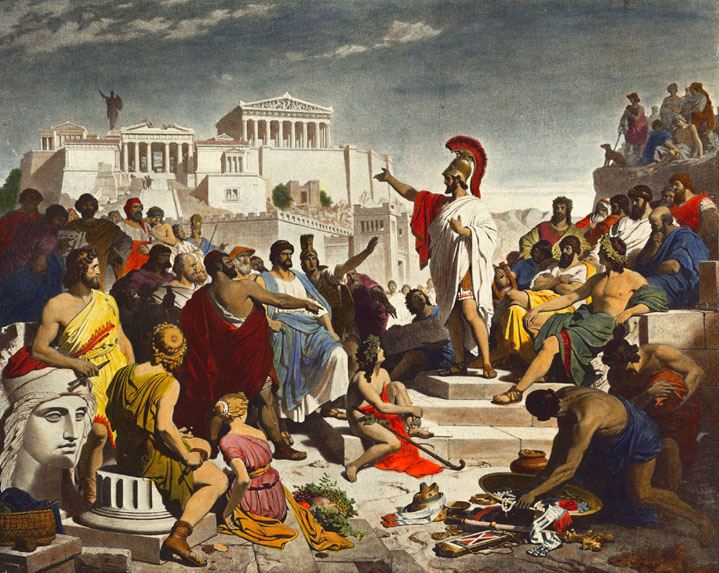
Pericles' Funeral Oration is the best-known Greek funeral speech preserved from classical Athens. It survives in the history of the Peloponnesian War as recorded by Thucydides and is printed in Book 2 of his work, often cited under the title History of the Peloponnesian War. The oration is attributed to the Athenian leader Pericles and is set at the end of the first campaigning season of the Peloponnesian War (431–404 BCE). It is both a formal public eulogy for the war dead and a carefully constructed statement about Athenian identity and civic values.
Image gallery
2 Images
Ritual and historical setting
Athens observed an official civic funeral for those who had fallen in battle. According to accounts preserved in classical sources, the bodies of the dead were sometimes displayed for a limited period to permit offerings and public visitation; some sources describe a temporary shelter or tent for this purpose. Contemporary descriptions and later scholarship explain that such rites combined private mourning with public remembrance and were occasions for an appointed speaker to address the citizenry. In Thucydides' narrative the oration is delivered within this ritual framework and is intended to honor sacrifice while shaping public opinion during wartime.
Textual transmission and authorship
Thucydides presents the oration as a speech given by Pericles, but he also explains in his prefatory remarks that speeches in his history are not verbatim transcripts. He reconstructed or composed the speeches so as to convey their essential arguments and rhetorical effect. Scholars therefore treat Thucydides' version as a literary rendering that preserves the probable themes and structure of the original while acknowledging that exact wording is uncertain. It is generally accepted that Pericles or another prominent Athenian delivered a formal address after the first campaign season, but the precise degree of Thucydidean shaping remains a topic of scholarly caution and debate.
Structure and rhetorical features
The recorded oration follows a conventional pattern found in public funeral speeches: an opening address that consoles the audience, a paean to the virtues of the fallen, and a broader encomium that praises the city and its institutions. Thucydides' account emphasizes several rhetorical strategies used in the speech: balanced antitheses, appeals to shared memory, exempla of civic conduct, and the framing of military death as the highest form of public service. Pericles' speech is often noted for its calm, elevated tone and for shifting the focus from personal virtues of individuals to the collective greatness of the polis.
Themes and aims
- Civic identity: The oration celebrates the laws, customs, and public spirit that define Athens and distinguish it from other Greek states.
- Democratic ideals: It praises equal treatment under the law, public participation, and the meritocratic aspects of Athenian institutions.
- Valor and sacrifice: The fallen are honored as exemplars whose courage validates the city's way of life.
- Political pedagogy: The speech seeks to console the bereaved while instructing the living in the duties of citizenship.
Political purpose and interpretation
Scholars read the oration both as consolation and as deliberate political rhetoric intended to sustain morale, justify policy, and foster unity during a dangerous war. Interpretations vary: some emphasize its role in consolidating democratic sentiment and civic pride, while others highlight tensions between praise of freedom and the realities of Athenian imperial power. The oration has been analyzed as an expression of ideology that could be read in different ways depending on historical and modern perspectives.
Reception and influence
The Funeral Oration has long attracted attention beyond the narrow field of ancient history. It has been taught as a model of civic rhetoric, compared with later public speeches, and cited in discussions of nationalism and democratic ideology. For example, modern commentators often compare the oration's concentrated civic theme to other famous funerary addresses and national memorials. Readers interested in editions and commentary may consult standard scholarly translations and studies that place the speech within the broader history of Athenian political culture.
Debates and further study
Major areas of scholarly debate include the oration's fidelity to Pericles' original utterance, whether Thucydides' interpolation altered its political meaning, and how the text reflects or masks social inequalities in fifth-century Athens. Specialists also examine the ritual context and funeral customs, including the temporary display of the dead and the public ceremonies, which are described in fragmentary detail in surviving sources. Those researching the event can find discussions of ritual practice and public commemoration in works addressing the public funeral custom and the settings for commemoration such as the temporary tent or shelter (tent).
Primary and secondary sources
The primary surviving account is Thucydides' narrative in Book 2 of his history (Thucydides; History of the Peloponnesian War). For biographical context on the speaker see studies of Pericles and his career as an Athenian politician. General treatments of the conflict appear under discussions of the Peloponnesian War and analyses of wartime commemoration and memory often reference broader histories of Greek war and civic ritual.
Conclusion
Pericles' Funeral Oration remains a central text for understanding Athenian self-presentation in the fifth century BCE. Its mixture of ritual function, political instruction, and literary craft makes it a rich source for historians, classicists, and students of rhetoric. While uncertainties about exact wording persist, the oration as preserved by Thucydides continues to serve as a primary witness to how a leading Athenian articulated the values and expectations of his city in a time of crisis.
Questions and answers
Q: What is Pericles' Funeral Oration?
A: Pericles' Funeral Oration is a famous speech from Thucydides' History of the Peloponnesian War. It was delivered by Pericles at the end of the first year of the war and was part of a yearly public funeral for those who died in the war.
Q: Who wrote down Pericles' Funeral Oration?
A: The speech was recorded by Thucydides in book two of his History of the Peloponnesian War.
Q: How much did Thucydides change or correct the speeches he recorded?
A: Thucydides says that he changed or corrected some parts of what was said, but kept to main ideas and themes.
Q: Why is this speech important?
A: The Funeral Oration is important because it was different from usual Athenian funeral speeches, as it focused on celebrating Athens and encouraging its people.
Q: When did this speech take place?
A: This speech took place at the end of the first year of the Peloponnesian War (431 - 404 BCE).
Q: What custom did people in Athens have regarding funerals for those who died in war?
A: People in Athens had a custom of holding a public funeral for those who died in war, where their bodies were left out for three days with offerings made to them.
Q: Is it certain that Pericles delivered this speech?
A: Yes, it is quite certain that Pericles delivered a speech at the end of the first year of war, although there is uncertainty over how much Thucydides' record matches up with what he actually said.
Tags
Related articles
Author
AlegsaOnline.com Pericles' Funeral Oration Leandro Alegsa
URL: https://en.alegsaonline.com/art/75797
Sources
- en.wikisource.org : Pericles's Funeral Oration