
Pepin the Short: Carolingian King and Founder of Papal Alliance
Pepin the Short (c.714–768), first Carolingian king of the Franks, ended Merovingian rule, secured papal support, made the Donation of Pepin, and set the stage for Charlemagne's empire.
Overview
Pepin the Short (c. 714 – 24 September 768) was the first king of the Franks from the Carolingian dynasty. He transformed the position held by his family — previously powerful mayors of the palace — into a hereditary royal line. His reign (751–768) ended the nominal Merovingian kingship and prepared the political and religious groundwork that enabled his son, Charlemagne, to expand and consolidate a large Western European realm.
Image gallery
10 Images





Background and rise to power
Born around 714 at Jupille, Pepin was a son of Charles Martel and Chrotrud. After Charles Martel's death, Pepin and his brother Carloman initially shared authority as mayors of the palace. Pepin consolidated secular power when his brother retired to religious life, and with the approval of the papacy he moved to depose the last Merovingian king and assume the royal title. This change was justified by the contemporary church as putting actual authority and royal dignity in the hands of those who exercised it.
Reign: policies, military action, and papal alliance
Pepin's reign combined military campaigns with institutional reforms. He campaigned against neighboring Lombards in Italy and supported papal interests when the pope sought military help. In exchange for his assistance against Lombard aggression, Pepin granted territories in central Italy to the pope — an arrangement commonly known as the Donation of Pepin — which provided the basis for the Papal States and reshaped the relationship between Frankish kings and the Roman church.
Administration, anointing, and reforms
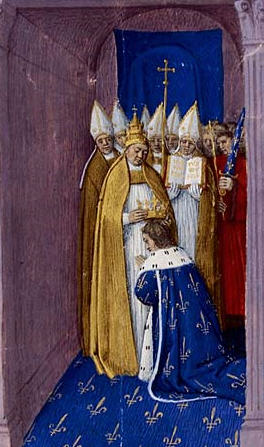
Unlike earlier Merovingian rulers, Pepin pursued closer cooperation with bishops and church authorities to legitimize his rule. He received formal anointing as king, a ceremony that enhanced the sacred aspect of kingship and became a precedent for later Carolingian rulers. Domestically he worked to strengthen royal control over lands, to regularize military obligations, and to support ecclesiastical reform movements led by figures such as Saint Boniface.
Family, succession, and death
In about 740 Pepin married Bertrada of Laon, daughter of Caribert of Laon. Their children included Charlemagne, Carloman II and a daughter, Gisela. On his death he was buried at the royal necropolis of Saint-Denis, in the basilica, alongside his wife Bertrada. The kingdom was divided between his sons, a division that soon favored Charlemagne's rise to preeminence after Carloman's early death.
Legacy and historical significance
- Pepin ended Merovingian titular rule and established the Carolingian dynasty as Frankish kings.
- His alliance with the papacy, and the territorial donation to the pope, altered the political map of Italy and strengthened papal temporal authority.
- The anointing of Pepin reinforced the sacral character of kingship, a precedent that shaped medieval European monarchy.
- His policies and family set the stage for the expansion under his son Charlemagne and the later Carolingian renaissance.
Pepin is remembered as a transitional figure: neither simply a military strongman nor a distant monarch, he combined martial authority with ecclesiastical sanction to create a more stable and institutionalized kingship that endured in Europe for centuries.
Questions and answers
Q: Who was Pepin the Short?
A: Pepin the Short was a King of the Franks from 751 to 768.
Q: Who were Pepin's parents?
A: Pepin's parents were Charles Martel and Chrotrud.
Q: When and where was Pepin born?
A: Pepin was born in Jupille, Belgium, in the year 714.
Q: Whom did Pepin marry?
A: Pepin married Bertrada of Laon in the year 740.
Q: How many children did Pepin and Bertrada have?
A: They had two sons and a daughter who lived long enough to become adults.
Q: What happened to Pepin's son Pepin?
A: Pepin died at Saint Denis and is buried in the basilica with his wife, Bertrada of Laon.
Q: Who succeeded Pepin the Short as King of the Franks?
A: Pepin's sons, Charlemagne and Carloman, were each King of half the Kingdom of the Franks after him.
Related articles
Author
AlegsaOnline.com Pepin the Short: Carolingian King and Founder of Papal Alliance Leandro Alegsa
URL: https://en.alegsaonline.com/art/75702