
Acritarchs: organic-walled microfossils and the early eukaryote record
Acritarchs are organic-walled microfossils, likely resting cysts of eukaryotic algae and protists. They are abundant in Proterozoic–Palaeozoic rocks and important for biostratigraphy, paleoecology and studies of early life.
Overview
Acritarchs are microscopic, organic-walled fossils found in sedimentary rocks from the Proterozoic through the early Palaeozoic. The term means "uncertain origin" and is used as a form taxon for a wide variety of small organic microfossils. Many acritarchs are interpreted as the resistant cysts, resting stages or covers produced by single-celled eukaryotic algae and other protists, although the group almost certainly includes a mix of unrelated biological sources. For general background see introductory sources and summaries of early microfossil research (eukaryote evidence).
Image gallery
1 Image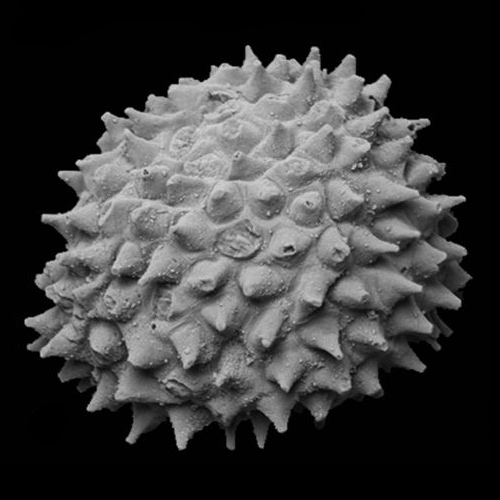
Morphology and composition
Forms range from simple, smooth spheres to elaborate bodies with spines, processes, pits and reticulate ornamentation. The walls are composed of organic macromolecules that convert to kerogen during burial; they are not mineral skeletons such as calcite. Preservation tends to favour organic-rich shales and siltstones where acid maceration and palynological preparation can extract isolated specimens for study. Light microscopy reveals overall form and size, while scanning electron microscopy and chemical analyses probe surface detail and wall chemistry; see comparative morphology discussions at morphology review and compositional studies (chemical composition work).
Geological history and distribution
Acritarchs appear sporadically in older rocks but become abundant in many organic-rich shales and siltstones of the Mesoproterozoic to Neoproterozoic. Well-known assemblages occur in rocks about 1.4–1.6 billion years old, and a general trend toward greater abundance, larger size and more complex ornamentation is evident by around one billion years ago. Major turnovers are associated with global environmental events: populations decline or change markedly across Cryogenian glaciations and then diversify again during the Ediacaran–Cambrian interval. They persist with varied diversity into the Palaeozoic and are recorded at least into the Ordovician in many regions; consult regional occurrence syntheses (Proterozoic records, Phanerozoic occurrences).
Ecology and functional interpretations
The dominant ecological interpretation is that many acritarchs represent reproductive cysts or resting stages of planktonic eukaryotes, analogous to modern dinoflagellate cysts and other algal cysts. Their resistant walls allowed dispersal in the water column and preservation in sediments. Changes in morphology through time, especially the evolution of spines and elaborate processes, have been linked to ecological functions such as slowing sinking rates, increasing surface area for buoyancy, or deterring predators capable of ingesting or fragmenting cells. Studies exploring these ideas and their implications for Neoproterozoic ecosystems can be found at ecological implications and case studies of defensive features (defence hypotheses).
Methods of study
Common laboratory methods include acid digestion of silicate matrix to concentrate organic residues, sieving and mounting for transmitted light microscopy, and imaging with electron microscopes to reveal surface sculpture. Geochemical techniques, such as biomarker and isotopic analysis, help confirm organic composition and provide environmental context. Palynological terminology and methods are discussed in general introductions and methodological reviews (palynology primer, taphonomy and preservation).
Biostratigraphic and paleoenvironmental uses
Because acritarch assemblages change through time and can be regionally widespread, they are useful as biostratigraphic markers for correlating sedimentary sequences, particularly where other fossils are scarce. Their diversity and morphological traits also serve as proxies for ancient surface-ocean conditions, planktonic ecosystem structure and the timing of eukaryote diversification. Practical summaries of their use in stratigraphy and paleoecology are available (regional stratigraphy, biostratigraphy summary).
Taxonomy, limitations and open questions
Acritarchs are a form taxon grouped by morphology rather than by known phylogenetic relationships. Consequently, the assemblage likely includes cysts of multiple algal clades, other protists and possibly fragments of varied organic-walled organisms, complicating efforts to infer precise evolutionary lineages. Open questions include the full range of biological affinities, the balance of ecological versus abiotic drivers of morphological diversification, and the taphonomic biases that affect which organisms are preserved. Reviews addressing these uncertainties and proposing avenues for future work are summarized at Cryogenian context and broader syntheses (Snowball Earth studies).
Notable patterns and evolutionary significance
The rise in acritarch size and ornamentation in the Neoproterozoic has been interpreted as part of a broader trend toward more complex planktonic ecosystems, possibly linked to ecological arms races as grazers and predators evolved. Recoveries and radiations after environmental perturbations show how protistan communities responded to global change. Acritarch records contribute to debates about when complex eukaryotic life became ecologically significant, how early food webs were structured, and the timing of major evolutionary events such as the Cambrian radiation (Cambrian radiation, Palaeozoic diversity peak).
Further reading
Questions and answers
Q: What are acritarchs?
A: Acritarchs are early microfossils, the remains of eukaryote cells. They have a single-layered cell wall or a cover secreted by the cell walls that can be found in rocks from the Proterozoic era.
Q: What is their chemical composition?
A: Acritarchs are organic in their chemical composition, not calcium carbonate.
Q: When did they first appear?
A: Acritarchs first appeared 1.4 to 1.6 billion years ago in organic-rich shales and siltstone strata.
Q: Are they monophyletic?
A: It is not clear whether or not acritarchs are monophyletic due to the wide range of forms they take on.
Q: Why did their populations crash during the Cryogenian period?
A: The populations of acritarchs crashed during the Cryogenian period 860 million years ago due to Snowball Earth episodes.
Q: Why did they become more spinney over time?
A: The increased spininess of acritarchs possibly resulted from the need for defence against predators large enough to swallow them or tear them apart.
Q: Did other groups of organisms also develop anti-predator defences at this time?
A: Yes, other groups of small organisms from the Neoproterozoic era also show signs of anti-predator defences.
Related articles
Author
AlegsaOnline.com Acritarchs: organic-walled microfossils and the early eukaryote record Leandro Alegsa
URL: https://en.alegsaonline.com/art/757
Sources
- nrm.se : The fossil record of predation. The Paleontological Society Papers 8
- ncbi.nlm.nih.gov : PMID 20164911
- ncbi.nlm.nih.gov : PMID 20139963