
Pentane: properties, isomers, uses and safety
Pentane is a five‑carbon alkane (C5H12) with three structural isomers. This article covers its structure, physical and chemical properties, production, industrial uses, nomenclature and safety considerations.
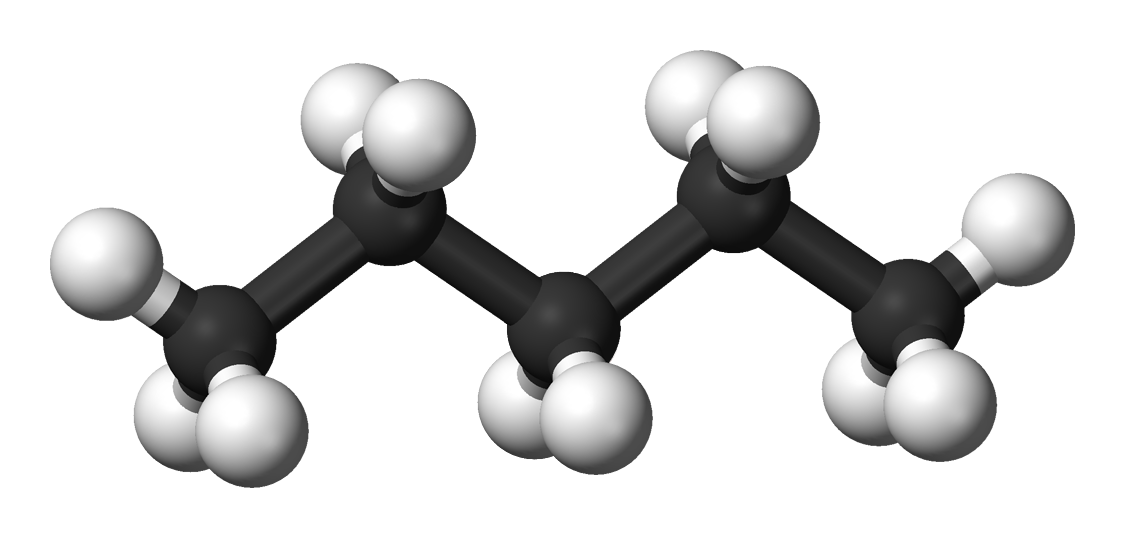
Pentane is a simple hydrocarbon in the alkane series with the chemical formula C5H12. In everyday usage the name often covers all three structural isomers of C5H12, but strict IUPAC nomenclature reserves the unprefixed name pentane for the unbranched or straight‑chain form.
Image gallery
3 Images

Structure and isomers
There are three constitutional isomers of the C5H12 formula. The straight chain is n‑pentane. The singly branched isomer is commonly called isopentane or by its systematic name 2‑methylbutane. The fully compact, highly branched isomer is usually called neopentane and has the systematic name 2,2‑dimethylpropane. These three structural isomers differ in connectivity, which affects boiling point, melting point and chemical reactivity. All contain five carbon atoms but arranged differently.
Occurrence and production
Pentane occurs naturally as a component of petroleum and natural gas liquids and is commonly isolated by fractionation and refining of crude oil. It also appears as a major component in light hydrocarbon streams used by petrochemical industries. Industrial production and separation are performed by distillation, solvent extraction and molecular‑sieving techniques when purer fractions are required.
Physical and chemical properties
Pentane and its isomers are colorless, volatile, nonpolar liquids under typical ambient conditions; they are immiscible with water but mix readily with most organic solvents and hydrocarbon fuels. Branching tends to lower boiling points and increase volatility. Pentanes burn readily, producing carbon dioxide and water in complete combustion, and can undergo typical alkane reactions such as radical halogenation and cracking under appropriate conditions.
Industrial and laboratory uses
- As a light hydrocarbon blendstock in gasoline and other fuel formulations, where it contributes volatility.
- As a nonpolar solvent in extraction, chromatography and laboratory procedures.
- As a blowing agent for polymer foams (e.g., expanded polystyrene) because of favorable volatility and lower ozone‑depletion potential than older chlorinated agents.
- As a refrigerant‑laboratory coolant and in specialized heat‑transfer mixtures in research settings.
Nomenclature and related compounds
When precision is required, the three isomers are named n‑pentane, 2‑methylbutane and 2,2‑dimethylpropane. Related small alkanes include butane (C4) and higher homologues; cyclic hydrocarbons such as cyclopentane have the same number of carbon atoms but a different hydrogen count and distinct properties.
Safety, handling and environmental considerations
Pentane is highly flammable and forms explosive mixtures with air; storage and handling require grounding, bonding and well‑ventilated areas away from ignition sources. Inhalation of high concentrations can cause central nervous system effects such as dizziness and headache, so occupational exposure limits and material safety data sheets should be consulted before use. As a volatile organic compound (VOC), pentane contributes to atmospheric photochemical reactions and its emissions are controlled in some applications.
References and further reading
For authoritative technical data, safety guidance and nomenclature rules consult chemical databases, industrial safety manuals and IUPAC recommendations. Useful starting points include entries on the isomerism of alkanes, general alkane chemistry at standard references and material safety documents linked to industry suppliers. Additional overview material can be found in petroleum chemistry texts and solvent safety handbooks; see also related pages on organic compounds, hydrocarbon formulas and practical notes on the use of light hydrocarbons in manufacturing and laboratories.
Questions and answers
Q: What is the chemical formula of pentane?
A: The chemical formula of pentane is C5H12.
Q: How many carbon atoms does pentane have?
A: Pentane has five carbon atoms.
Q: Does "pentane" refer to all three isomers in general terms?
A: Yes, usually "pentane" refers to all three isomers (n-pentane, isopentane and neopentane).
Q: Does the IUPAC use a different definition for pentane than what is used generally?
A: Yes, in the IUPAC, pentane only represents n-pentane. The other two isomers are 2-methylbutane and 2,2-dimethylpropane.
Q: Is cyclopentene an isomer of pentene?
A: No, cyclopentene's chemical formula is C5H10 so it is not an isomer of pentene.
Related articles
Author
AlegsaOnline.com Pentane: properties, isomers, uses and safety Leandro Alegsa
URL: https://en.alegsaonline.com/art/75633
Sources
- rspl.royalsocietypublishing.org : "I. On the action of trichloride of phosphorus on the salts of the aromatic monamines"
- doi.org : 10.1098/rspl.1866.0018
- cdc.gov : "NIOSH Pocket Guide to Chemical Hazards #0486"
- gestis-en.itrust.de : Record of n-Pentane