
Austro‑Bavarian (Bairisch): an overview of the Upper German dialect group
Austro‑Bavarian (Bairisch) is a major Upper German dialect group spoken in Austria, southern Germany and parts of Italy; it includes several regional varieties and related minority dialects.

Austro‑Bavarian (German: Bairisch) denotes a collection of Upper German varieties traditionally spoken across much of Austria, the Bavarian region of Germany and neighboring alpine areas. As part of the High German branch, these varieties share historical roots with Standard German but differ markedly in pronunciation, vocabulary and some grammatical forms. Most native speakers today are also fluent in the standardized language used for education and official communication.
Image gallery
3 Images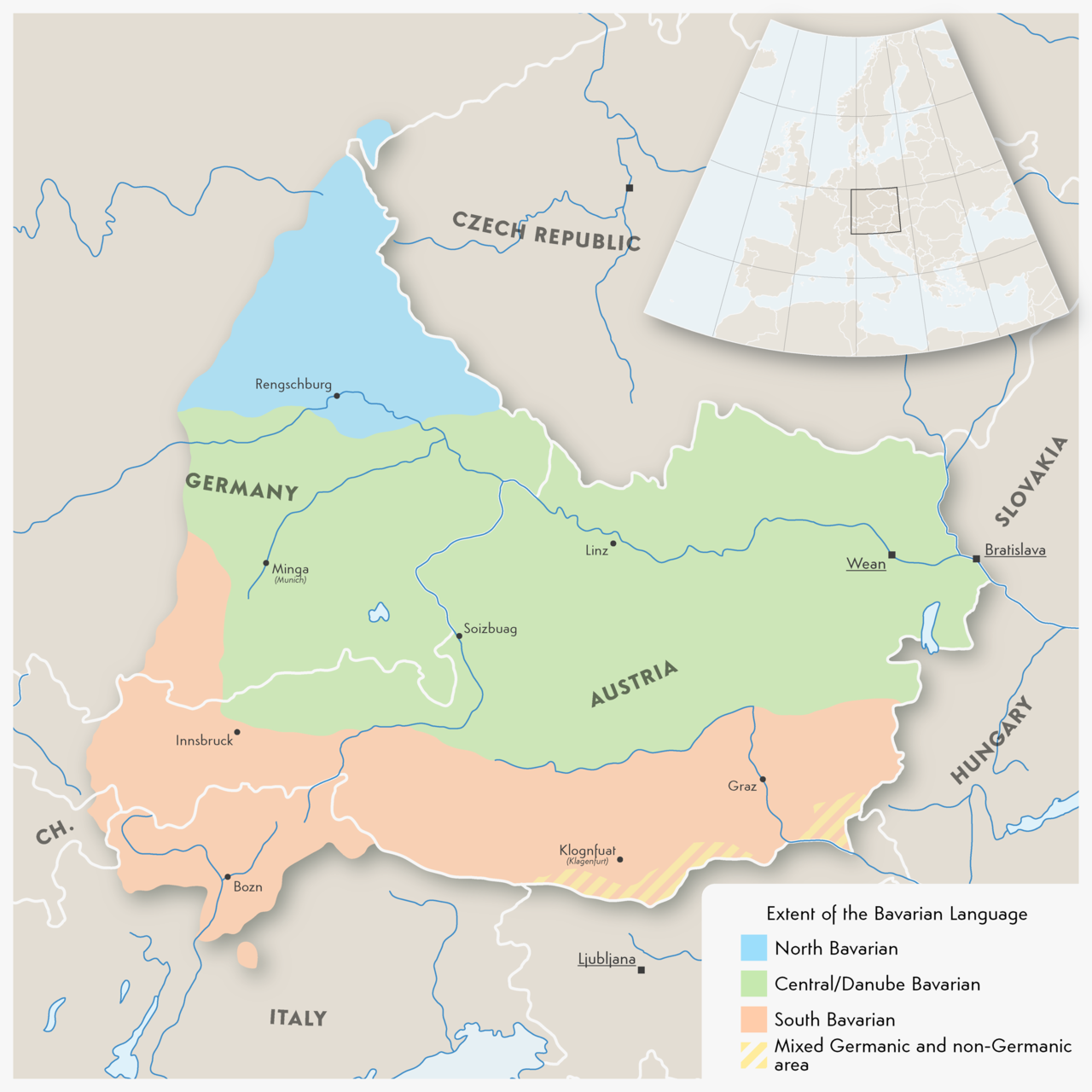


Geographic range and major subdivisions
The Austro‑Bavarian group is commonly divided into three broad regional clusters: Northern Bavarian, Central Bavarian and Southern Bavarian. Central Bavarian varieties are widespread in much of Austria and in the Munich region, while Northern and Southern groups are found respectively in northern Bavaria and the Alpine south. Closely related or historically associated Germanic varieties such as Cimbrian and Mócheno in northern Italy, and Hutterite German in North America, are sometimes discussed alongside Austro‑Bavarian in dialectology because of shared features and common origins. For more context on related minority varieties see Cimbrian and Mócheno.
Distinctive features
Austro‑Bavarian dialects are characterized by systematic differences from Standard German in several areas. Phonology (sound patterns) and prosody often diverge, producing recognizably different vowel and consonant qualities. There is also a rich set of regional vocabulary, preserved idioms and certain morphological or syntactic patterns that have been retained or developed separately from the standard language. Greetings and everyday phrases, such as regional forms of "hello" and "goodbye," illustrate how speech habits reinforce local identity. These differences can make Austro‑Bavarian varieties difficult for non‑native listeners to understand, even for native speakers of Standard German.
History and development
The varieties now labeled Austro‑Bavarian evolved from the Upper German dialects of the early medieval period and were shaped by centuries of internal migration, political boundaries and contact with neighboring languages and dialects. The High German consonant shifts and subsequent regional developments produced the characteristic features of the southern German speech continuum. Over time, the rise of a standardized German used in administration, literature and schooling led to a diglossic situation: local speech remained the language of home and community, while Standard German became dominant in written and formal contexts.
Uses, cultural importance and modern status
Today Austro‑Bavarian remains an important marker of regional identity. It is used in folk music, theater, local media and everyday conversation. While most speakers switch to Standard German in formal situations, dialects continue to thrive in rural and urban communities alike. Language preservation efforts, academic study and cultural initiatives document and celebrate regional varieties. At the same time, factors such as mobility, media exposure and schooling influence ongoing change, leading to both convergence with Standard German and the creation of new regional registers.
Distinctions and practical notes
- Classification: Austro‑Bavarian is an Upper German group within High German, distinct from Standard German yet closely related.
- Varieties: Central, Northern and Southern Bavarian are the principal subgroups; related minority dialects may be grouped for study.
- Bilingualism: Most speakers are competent in both their local variety and Standard German, using each in different contexts.
Scholars and language enthusiasts approach Austro‑Bavarian both as a living family of speech forms with internal diversity and as a subject of cultural and linguistic research. Its continued use in everyday life and in cultural expressions ensures that these varieties remain a vibrant part of the German‑speaking landscape.
Questions and answers
Q: What is Bavarian?
A: Bavarian (also known as Austro-Bavarian) is a major group of Upper German varieties spoken in Switzerland, Austria and southern Germany.
Q: How does it differ from Standard German?
A: While both are High German languages, they are not the same language. However, Austro-Bavarian and Standard German have influenced each other and the vast majority of Austro-Bavarian speakers speak Standard German as well.
Q: What are the variants of Bavarian?
A: The variants of Bavarian include Central Bavarian, Southern Bavarian, and Northern Bavarian.
Q: Is Austro-Bavarian only used to refer to this dialect group?
A: No, Austro-Bavarian is also used to refer to the dialect group which includes the Cimbrian, Hutterite German, and Mócheno dialects of Germany.
Tags
Related articles
Author
AlegsaOnline.com Austro‑Bavarian (Bairisch): an overview of the Upper German dialect group Leandro Alegsa
URL: https://en.alegsaonline.com/art/7550