
Pederpes — an early Carboniferous tetrapod
Pederpes is an extinct early Carboniferous tetrapod genus known from a single near-complete skeleton found in Scotland; its limb and foot anatomy show early adaptations for terrestrial walking.
Overview
Pederpes is an extinct genus of early Carboniferous tetrapod known from a single near-complete skeleton. The specimen is dated to the lower Mississippian (the earliest part of the Carboniferous, commonly called the Tournaisian, about 359–345 million years ago) and represents one of the few well-preserved tetrapod remains from this interval. The type and only named species is P. finneyae, an animal estimated to have been about one metre in length when alive. The fossil provides important anatomical evidence for how early tetrapods used their limbs and feet during the first phases of terrestrialization.
Image gallery
10 Images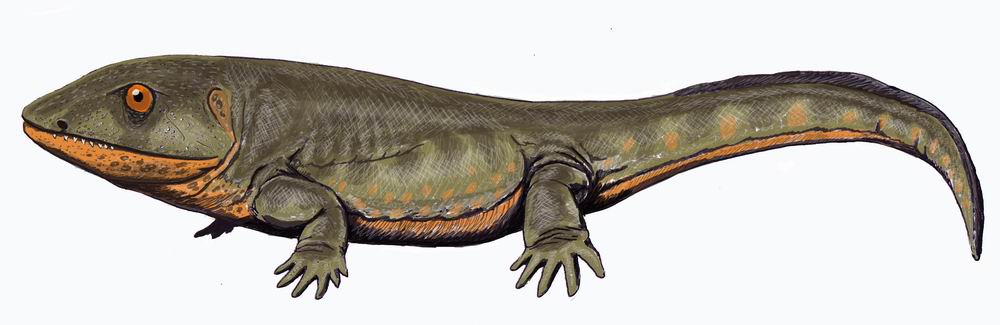


Anatomy and adaptations
The preserved skeleton includes most of the skull and trunk, as well as fore- and hindlimbs, although the tail and parts of the digits are not preserved. The skull appears relatively large and triangular in dorsal outline, a shape that recalls the skulls of some later early tetrapods such as Whatcheeria. Limb bones are comparatively robust, and the preserved hind feet show distinct digits with joints and proportions more consistent with weight-bearing and stepping than with purely paddle-like swimming appendages.
- Limbs: limb bones indicate capacity for supporting body weight on land rather than exclusively aquatic propulsion.
- Feet: the morphology of the hind feet suggests a capacity for placing the foot on substrates and making controlled steps, an early adaptation for terrestrial locomotion.
- Skull and feeding: cranial features are broadly similar to other early tetrapods and consistent with a generalist shallow-water or marginal-terrestrial predator.
Discovery and geological context
The single known specimen was recovered from the East Kirton quarry in West Lothian, Scotland. It was collected from early Carboniferous strata that record environments shortly after the Devonian Period, when the earliest vertebrate excursions onto land had already begun. Fossils from this part of the rock record are comparatively uncommon, so the Pederpes specimen is particularly valuable for filling in information about post-Devonian tetrapod anatomy and distribution.
Locomotion and lifestyle
Interpretations of the preserved anatomy suggest that Pederpes was capable of terrestrial locomotion. Its limb and foot morphology contrasts with the more fin-like or paddle-like appendages of many Devonian tetrapodomorph fishes and early stem-tetrapods, and instead shows features associated with stepping and supporting the body on land. This has led researchers to regard Pederpes as among the earliest known tetrapods adapted for moving effectively on land, although it was likely still tied to aquatic habitats for reproduction and perhaps for parts of its life cycle.
Paleoenvironment and ecology
The depositional setting of the East Kirton quarry suggests a landscape of rivers, floodplains and shallow coastal or deltaic waters in the early Carboniferous. In such settings, tetrapods with the ability to move on land would have had access to new feeding and shelter opportunities, such as hunting invertebrates or small fish along shorelines and among vegetation. While direct evidence of diet is limited for Pederpes, its skull and teeth morphology are consistent with a carnivorous or opportunistic predatory habit typical of early tetrapods.
Significance for tetrapod evolution
Pederpes occupies a critical position in the fossil record between the more aquatic Devonian tetrapods and the more fully terrestrial tetrapods that appear later in the Carboniferous. Its anatomy is often cited in discussions of the early stages of terrestrial adaptation because the feet show an early example of structures suited to stepping on land. The genus helps to illuminate the interval sometimes referred to as "Romer's Gap," a span of geological time with relatively few tetrapod fossils, by providing direct anatomical data that bridge earlier and later forms.
Comparisons and research context
Pederpes is compared with both Devonian stem-tetrapods and later Carboniferous taxa to trace the sequence in which terrestrial adaptations arose. For example, comparisons with Whatcheeria and other early Carboniferous genera highlight similarities and differences in skull shape, limb proportions, and inferred locomotor capability. Summaries and syntheses of Early Carboniferous tetrapod research provide broader context for these comparisons and can be consulted for more detailed phylogenetic and environmental discussion via general overviews of Early Carboniferous vertebrate studies.
Limitations and future work
Because the genus is known from a single specimen, interpretations of its biology and relationships are provisional. Missing parts, such as the tail and some digit elements, limit detailed reconstructions of gait and swimming ability. Future discoveries of additional specimens from similar-aged deposits could confirm or refine current interpretations, clarify variation within the species, and improve understanding of how widespread such terrestrial adaptations were in the earliest Carboniferous. Ongoing fieldwork and re-examination of early Carboniferous localities continue to be important for resolving questions about early tetrapod diversity and dispersal.
Further reading
For accessible summaries of the significance of Pederpes and related taxa, see general discussions of early tetrapod evolution and terrestrialization. Entries on taxonomic overviews and regional fossil records can be helpful starting points; see linked summaries on early tetrapods and terrestrial adaptation in the Early Carboniferous literature and specialist reviews of limb evolution and functional anatomy that address how anatomy relates to terrestrially adapted lifestyles.
Questions and answers
Q: What is Pederpes?
A: Pederpes is an extinct genus of early Carboniferous tetrapod, dating from the lower Mississippian, 359–345 million years ago (mya).
Q: How long was Pederpes?
A: Pederpes was 1 meter long.
Q: Where was the fossil of Pederpes found?
A: The fossil of Pederpes was found in East Kirton quarry, West Lothian, Scotland, in early Carboniferous rocks.
Q: Is Pederpes the only known tetrapod from the earliest Carboniferous?
A: Yes, Pederpes is the first (and only) known near-complete skeleton of a tetrapod from the earliest Carboniferous.
Q: What parts are missing from the skeleton of Pederpes?
A: The skeleton of Pederpes lacks only the tail and some digits.
Q: What is significant about the feet of Pederpes?
A: The specimen of Pederpes shows the earliest example of a foot adapted for walking on land. The feet look like the feet of later, more terrestrially adapted Carboniferous forms.
Q: Where does Pederpes fit in the fossil record?
A: Pederpes fits in the middle of a gap in the fossil record which separates the aquatic Devonian tetrapods from the terrestrial ones of the mid-Carboniferous.
Related articles
Author
AlegsaOnline.com Pederpes — an early Carboniferous tetrapod Leandro Alegsa
URL: https://en.alegsaonline.com/art/75406
Sources
- nature.com : nature.com/articles/nature00824?error=cookies_not_supported&code=8f5f5ec2-efa9-4b2a-99f7-…
- books.google.com : Pederpes