
Austrian Empire (1804–1867): Habsburg monarchy, political evolution and territorial legacy
Overview of the Austrian Empire (1804–1867): Habsburg rule, political evolution from the Holy Roman Empire to Austria-Hungary, and its territorial legacy across modern Central and Southeastern Europe.
The empire known as the Austrian Empire existed in central Europe between 1804 and 1867. Centered on what is today Austria, it emerged from the political changes that followed the end of the Holy Roman Empire in 1806. The final Holy Roman Emperor, Francis II, continued as the ruler of the new state under the title Francis I of Austria.
Image gallery
10 Images





Monarchy and succession
After Francis I, the imperial crown passed to Ferdinand I and later to Franz Joseph I, who became one of the longest-reigning Habsburg monarchs. In 1867 the political structure of the Habsburg lands changed when the Austrian Empire was reformed into the dual monarchy commonly called Austria-Hungary.
End of the empire and aftermath
The successor state, Austria-Hungary, survived until the collapse of the Central Powers at the close of World War I in 1918. The defeat led to the breakup of the Habsburg realms and the creation or expansion of several modern nation-states.
Territorial legacy
Territories that had been part of the Austrian Empire now lie within multiple contemporary countries. Significant portions became parts of present-day Austria, Hungary, and the Czech Republic. Other areas were incorporated into Slovakia, Romania, Slovenia, Croatia, and Italy.
Population
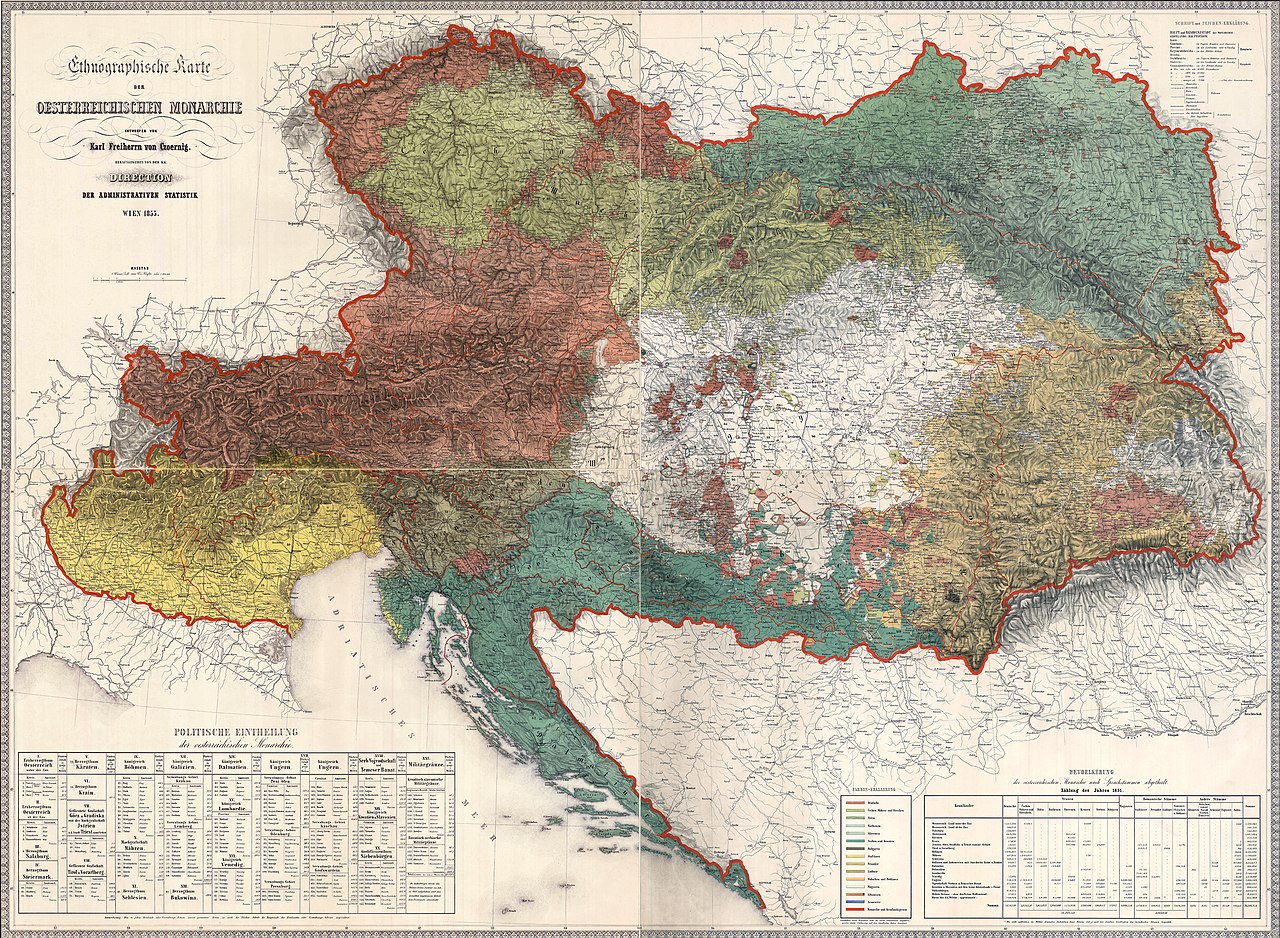
The Empire of Austria was a multi-ethnic empire in which several nationalities settled (mainly Germans, Magyars, Czechs, Slovaks, Poles, Ruthenians, Romanians, Serbs, Croats, Slovenes, Italians). These influenced each other, which produced peculiarities in culture, cuisine, language or architecture. Even long after the fall of the Danube Monarchy, this influence is still noticeable today in its successor states, for example in Austrian German, which has numerous loan words from Czech, Slovak, Hungarian, Slovenian, Italian and also Yiddish that are not known in German.

Countries in the Austrian Empire
Administrative division of the Empire of Austria, mainly from the Congress of Vienna in 1815, with the territorial reforms of 1848 until the October Diploma of 1860 - at its foundation in 1804 it was partly organized differently (compare title of Emperor Franz I.)
Archduchy of Austria and Dependencies
- Crown land Archduchy of Austria under the Enns
- Crown land Archduchy of Austria ob der Enns
- Duchy of Salzburg from 1805, 1809-1815 French/Bavarian, 1815-1850 Salzach district of Upper Austria, then crown land
- Crown land Duchy of Styria
- Crown land Gefürstete Grafschaft Tirol with the land Vorarlberg, 1805-1815 Bavarian/French, 1861 divided into:
- Crown land Princed County of Tyrol
- Province of Vorarlberg
- Crown land Kingdom of Illyria formed in 1814 from Carinthia, Carniola and the restituted French Illyrian provinces (former "Habsburg Litorale"), divided again in 1849/50 into:
- Crown land Duchy of Carinthia
- Crown land Duchy of Carniola
- Crown land Coastal land (Principality of Gorizia and Gradisca, Trieste, Margraviate of Istria)
Bohemia and neighbouring countries
- Crown land Kingdom of Bohemia
- Crown land Margraviate of Moravia
- Crown land Duchy of Silesia
- Crown land Kingdom of Galicia and Lodomeria
- Crown land of the Duchy of Bukovina spun off in 1850
Hungary and neighbouring countries
- Crown land Kingdom of Hungary
- Crown land Kingdom of Croatia (Civil Croatia)
- Crown land Kingdom of Slavonia
1849 both united to the Kingdom of Croatia and Slavonia
Other countries and territories
- Crown land Kingdom of Lombardo-Venetia from 1815, 1851 divided into:
- Crown land of Lombardy, lost in 1859 to the Empire of France/Kgr. Sardinia-Piedmont
- Crown land Venetia, lost to Kgr. Italy in 1866
- Crown land Kingdom of Dalmatia
- Crown land Grand Duchy of Transylvania, 1849-1854 military administration, 1867 assigned to the Hungarian Crown
- Crown land Serbian Voivodeship and Timisoara Banat (Voivodina and Banat), formed in 1849 by secession from Hungary and areas of the Serbian military border, divided in 1860 between Hungary and Croatia-Slavonia
- Military border:
- Croatian military border (Military Croatia)
- Slavonian Military Frontier
- Banater Military Frontier
- Transylvanian Military Frontier

Tags
Related articles
Author
AlegsaOnline.com Austrian Empire (1804–1867): Habsburg monarchy, political evolution and territorial legacy Leandro Alegsa
URL: https://en.alegsaonline.com/art/7538