
Paul Bunyan: The Legendary American Giant Lumberjack
Paul Bunyan is a legendary figure of North American tall-tale folklore: an enormous lumberjack associated with feats of strength, the blue ox Babe, and stories that explain landscapes and logging culture.
Overview
Paul Bunyan is a central character in the North American tall-tale tradition, portrayed as an extraordinary lumberjack whose size and strength exceed human limits. Stories about him are part of oral folklore from logging regions and became widely known through early 20th‑century print adaptations. The figure functions as a humorous and hyperbolic symbol of frontier labor, resource work, and regional identity.
Image gallery
9 Images




Typical characteristics and motifs
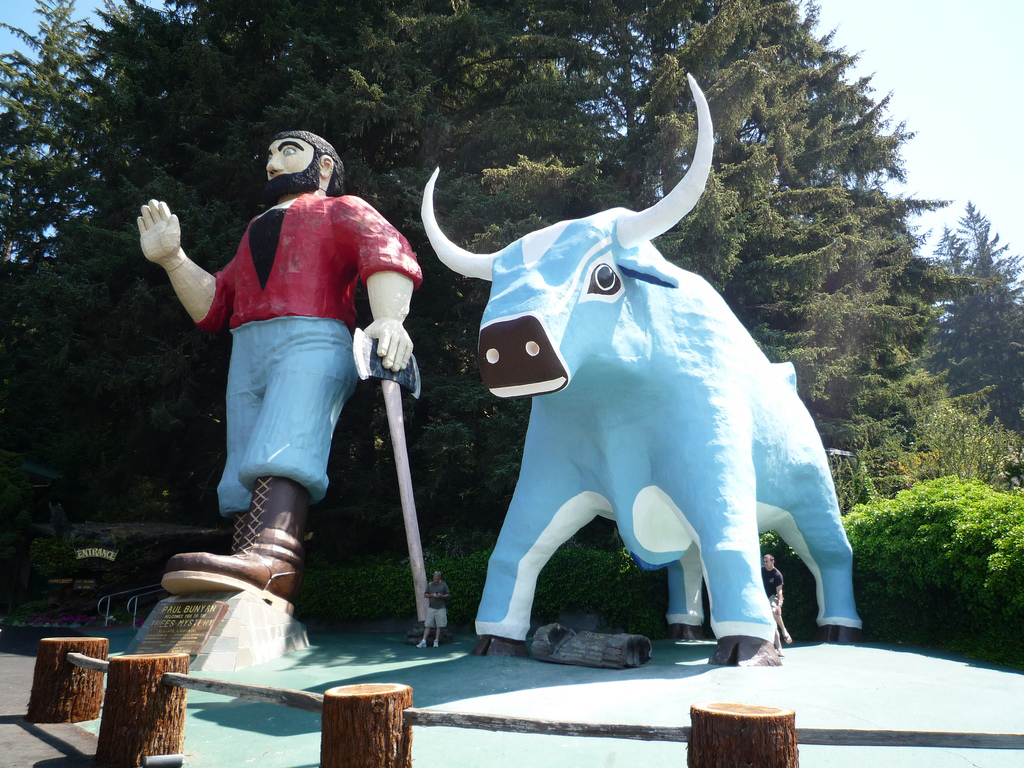
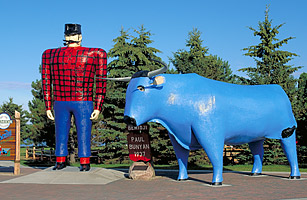
Accounts describe Paul Bunyan as larger-than-life in stature and appetite, accompanied by a gigantic blue ox named Babe. Tales attribute impossible feats to him: clearing forests with a single swing, forging rivers and lakes by dragging tools, or creating geographic features accidentally. These motifs reflect the tall-tale style—deliberate exaggeration, comic logic, and playful origin myths for natural landmarks.
Origins and development
The character grew from oral stories told by loggers in forests of the United States and Canada. The earliest known printed account appears in 1910; that publication helped preserve a version of the oral material. In 1916, an advertising pamphlet further shaped the modern image by emphasizing enormous scale and heroic proportions. For readers interested in those early print forms, see James MacGillivray's 1910 account and William Laughead's 1916 advertisement, which popularized the giant portrayal.
Common themes and examples
- Exaggeration as entertainment: each tale heightens ordinary tasks into epic deeds.
- Companion animals: Babe the Blue Ox is a recurring partner, emphasizing companionship and scale.
- Landscape explanations: many stories offer whimsical origins for lakes, rivers, or hills.
- Regional variation: story details and tone differ by logging camp and community.
Uses and cultural influence
Paul Bunyan has been widely used in advertising, children's literature, roadside sculptures, and festivals. His image helped promote logging towns and tourism in areas proud of their timber heritage. As a cultural symbol he can be invoked both affectionately and critically—celebrated as a folk hero and examined as an example of commercialized folklore.
Notable facts and distinctions
As with many folk figures, there is no single authoritative biography. Versions of Bunyan range from a large but human logger to an impossible giant; the 20th‑century printed portrayals amplified size and spectacle. Scholars treat Paul Bunyan as part of the American tall-tale genre: a living oral tradition adapted to print, advertising, and popular culture, illustrating how local stories evolve into broader symbols.
Questions and answers
Q: Who is Paul Bunyan?
A: Paul Bunyan is a fictional giant lumberjack.
Q: When was the earliest known writing about Paul Bunyan?
A: The earliest known writing about Paul Bunyan was in 1910 by James MacGillivray.
Q: Who wrote an advertisement that featured Paul Bunyan?
A: William Laughead wrote an advertisement that featured Paul Bunyan.
Q: When was the advertisement featuring Paul Bunyan written?
A: The advertisement featuring Paul Bunyan was written in 1916.
Q: What did William Laughead decide to do with Paul Bunyan in his advertising writing?
A: William Laughead decided to make Paul Bunyan a giant in his advertising writing.
Q: Is Paul Bunyan a real historical figure?
A: No, Paul Bunyan is a fictional character.
Q: Why is Paul Bunyan famous?
A: Paul Bunyan is famous for being a giant lumberjack in American folklore.
Related articles
Author
AlegsaOnline.com Paul Bunyan: The Legendary American Giant Lumberjack Leandro Alegsa
URL: https://en.alegsaonline.com/art/75110
Sources
- paulbunyanscenicbyway.org : paulbunyanscenicbyway.org
- biographi.ca : "Biography – MONTFERRAND, Favre, JOSEPH – Volume IX (1861-1870) – Dictionary of Canadian Biography"
- mainewriter.com : "From French-Canadian to Franco-American"
- mybaycity.com : "MyBayCity.com Bay City's Roots in the Paul Bunyan Tales To Be Subject of Documentary Film"
- americanfolklore.net : americanfolklore.net