
Australian Overland Telegraph Line
The 19th-century telegraph link that connected Darwin with southern Australia, completing a global communications route and transforming the continent's settlement, administration and economy.
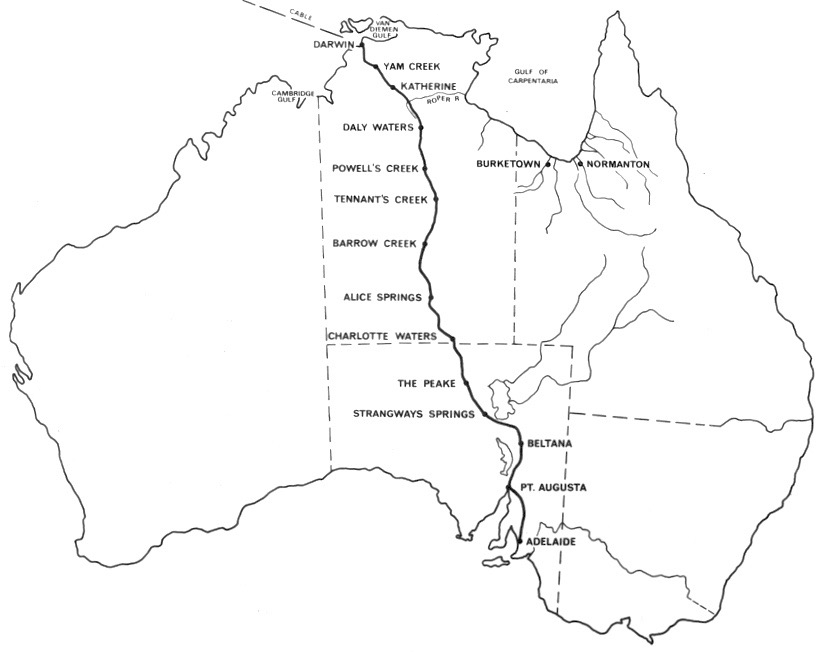
The Australian Overland Telegraph Line was a continental telegraph route completed in 1872 that connected Darwin in the north to Port Augusta in South Australia. Spanning roughly 3,200 kilometres, the line made near‑instantaneous communication between Australia and the rest of the world possible for the first time. Built along the inland corridor pioneered by explorer John McDouall Stuart, the project is remembered as one of the major engineering achievements in 19th‑century Australia and a turning point in the continent's integration into global communications networks.
Image gallery
9 Images




Route, planning and construction
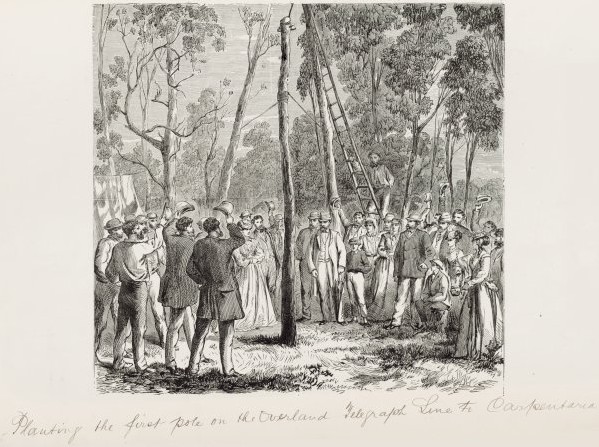
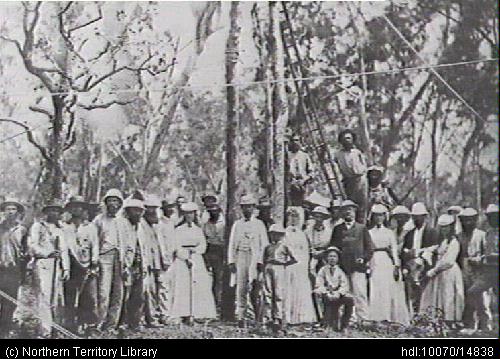
Surveying and construction followed the north–south track established by Stuart in the 1860s. Work was organized and overseen by colonial telegraph authorities and engineers, and construction began in the early 1870s. The line terminated at Port Augusta, where it linked to southern telegraph networks, and at Darwin, where an undersea cable connected Australia to the international submarine telegraph system. Building the line required erecting thousands of poles, installing insulators and laying wires across varied terrain — plains, deserts and seasonal river systems — often under extreme climatic conditions.
Technology, repeater stations and operation
Telegraph messages were transmitted in Morse code over a single conductor. Because signal strength weakened over distance, repeater (or relay) stations were spaced along the route at regular intervals — typically several hundred kilometres apart — where operators received and retransmitted messages. These stations housed batteries, instruments, accommodation and stores, and they became focal points for maintenance, weather observation and local administration. The crews who staffed them had to contend with heat, storms, pests and frequent repairs to timber poles and insulators.
Social and economic impact
The Overland Telegraph Line reduced communication time with Britain and other countries from months to hours, accelerating news flow, trade, colonial administration and scientific exchange. Some repeater stations grew into permanent settlements: for example, the site that became Alice Springs began as a telegraph station, and Tennant Creek grew around another repeater post. At the same time, construction and subsequent settlement brought disruption to Aboriginal communities and altered traditional land use patterns.
Legacy and preservation
Many original station sites, ruins and segments of the route survive and are recognised for their heritage value. A number of former repeater stations have been conserved or interpreted for visitors; others remain remote ruins. The line is often cited in histories of Australian engineering and communications. Key historical figures and places associated with the project include the explorer John McDouall Stuart, the cities of Darwin and Port Augusta, and the colony of South Australia. The technology itself — the telegraph — and the connection it provided to the rest of Australia are central to its historical significance.
- Length: about 3,200 km across the continent.
- Completion: 1872, linking to international submarine cables.
- Stations: repeater sites every few hundred kilometres, some becoming towns.
- Challenges: climate extremes, maintenance, and impacts on Indigenous peoples.
For further reading on technical aspects, contemporary accounts and preserved sites, consult specialist histories and heritage resources that describe the line's construction methods, the lives of station operators and the broader consequences of bringing instantaneous communication to central Australia. Many regional museums and interpretive centres reference the Overland Telegraph Line as a formative element in the continent's colonial and technological history.
Related topics and resources are available via archives and heritage listings that document the surviving station buildings, equipment and route alignments, which together tell the story of an ambitious effort to span a vast and challenging landscape with a single wire.
See also: telegraph, Darwin, Port Augusta, South Australia, Australia, engineering, John McDouall Stuart.
Questions and answers
Q: What was the Australian Overland Telegraph Line?
A: The Australian Overland Telegraph Line was a 3200 km telegraph line that joined Darwin with Port Augusta in South Australia.
Q: When was the Overland Telegraph Line completed?
A: The Overland Telegraph Line was completed in 1872.
Q: What did the Overland Telegraph Line allow for?
A: The Overland Telegraph Line allowed for fast communication between Australia and the rest of the world.
Q: Who discovered the route followed by the Overland Telegraph Line?
A: The route followed by the Overland Telegraph Line was discovered by the explorer John McDouall Stuart in 1862.
Q: What were some of the limits of the technology used in the Overland Telegraph Line?
A: One of the limits of the technology used in the Overland Telegraph Line was that telegraph messages could only travel about 300 km along the line.
Q: Why were repeater stations built along the Overland Telegraph Line?
A: Repeater stations were built along the Overland Telegraph Line so that messages could be resent due to the limits of technology.
Q: What were some of the stations along the Overland Telegraph Line and what happened to them?
A: Some of the stations along the Overland Telegraph Line became the start of cities such as Alice Springs or Tennant Creek, while others became forgotten ruins, such as the Peake Repeater Station built near Freeling Springs in South Australia.
Related articles
Author
AlegsaOnline.com Australian Overland Telegraph Line Leandro Alegsa
URL: https://en.alegsaonline.com/art/7506
Sources
- nationaltreasures.nla.gov.au : W.A. Crowder’s diary: the Overland Telegraph Line
- gabcc.org.au : "The Peake Overland Telegraph Repeater Station"