
Australian megafauna: giant prehistoric animals of Pleistocene Australia
Large-bodied Australian animals of the Pleistocene — unique marsupials, giant birds and monotremes — known from fossils and Aboriginal traditions; extinct mainly by the late Pleistocene for debated reasons.
Overview
Australian megafauna refers to a variety of very large animals that lived on the Australian continent during the late Pleistocene. They include enormous marsupials, flightless birds and other outsize species that had no exact modern equivalents. Knowledge of these animals comes from fossil remains and from studies of ancient environments; interest in them spans paleontology, archaeology and Indigenous cultural research. Key timeframes are constrained by dating methods applied to fossil deposits from a few thousand to many tens of thousands of years ago — the precise timing of their disappearance remains debated.
Image gallery
10 Images


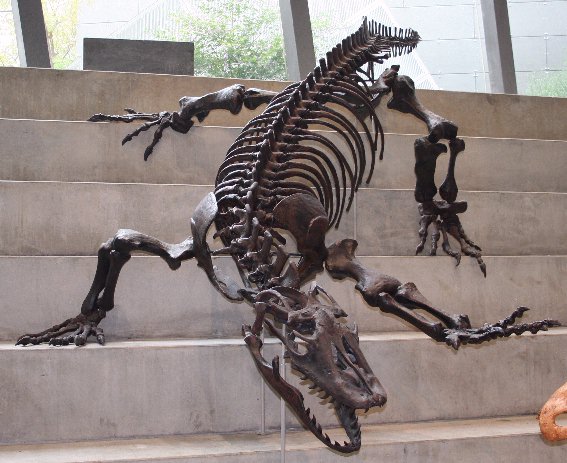


Characteristics and major groups
These megafaunal species typically exceeded most modern relatives in body mass and often occupied dominant ecological roles. Notable examples are often cited by name: Diprotodon (a rhinoceros-sized marsupial herbivore), the giant short-faced kangaroo Procoptodon, the carnivorous marsupial lion Thylacoleo carnifex, the giant flightless bird Genyornis and several large browsing marsupials such as Zygomaturus and Palorchestes. These animals show adaptations for grazing, browsing or predation that mirror the niches filled by unrelated large mammals in other continents.
Fossil record and research sites
Fossils and trace evidence come from cave deposits, lake beds and other sedimentary sites across the continent. Well-known fossil localities include Riversleigh and Naracoorte, where layered deposits preserve bones, tracks and associated material that researchers use to reconstruct past ecosystems. Dating techniques such as radiocarbon and other geochronological methods help place specimens in the Pleistocene, though dating can be complicated by preservation and taphonomic issues. For collections and summaries see fossil databases and regional reports on megafauna sites.
Causes of extinction
The disappearance of the megafauna is a subject of active study. Two broad explanations dominate: climatic and environmental change at the end of the Pleistocene, and the arrival and activities of humans. Likely scenarios emphasize a combination of factors — habitat shifts driven by climate, increased fire regimes and hunting or landscape modification by early Aboriginal peoples — rather than a single sole cause. See discussions on climatic records and archaeological evidence for more context about the timing of human colonization and subsequent ecological changes (Pleistocene, extinction).
Cultural connections and significance
Aboriginal oral traditions and dreamtime stories sometimes contain descriptions and motifs that researchers compare with megafaunal remains; scholars treat such parallels cautiously, recognizing that oral histories can preserve deep-time memory but are not direct scientific records. The megafauna continue to capture public imagination and inform museum exhibits, education programs and scientific outreach about how ecosystems respond to change.
Why it matters
Studying Australian megafauna helps scientists understand past biodiversity, the effects of climate shifts and human arrival on large animal communities, and the island-like evolutionary paths taken by isolated faunas. Ongoing excavations, improved dating and collaboration with Indigenous knowledge holders refine models of how and when these remarkable animals lived and ultimately vanished from the continent. For introductory summaries and curated materials see broader resources on Australia paleontology and conservation summaries (fossil databases, site reports).
Questions and answers
Q: What is Australian megafauna?
A: Australian megafauna refers to a group of animal species in Australia that are larger than their closest living relatives.
Q: When did these species become extinct?
A: These species became extinct during the Pleistocene, which is estimated to be between 16,100±100 to 50,000 years before present.
Q: Have the exact extinction dates been known for a long time?
A: No, the exact dates for their extinction have only been discovered recently.
Q: Are there any similarities between Australian megafauna and creatures from Aboriginal dreamtime?
A: Yes, some mythological creatures from the Aboriginal dreamtime look similar to animals from the prehistoric Australian megafauna.
Q: Why is it called "megafauna"?
A: These animals are referred to as megafauna because they are much larger than their closest living relatives.
Q: Are there any living animals in Australia that are considered megafauna?
A: No, there are no living animals in Australia that are considered megafauna.
Q: Why did these species become extinct?
A: The reasons for their extinction are not entirely clear, but it is believed that climate change and human activity played a role.
Related articles
Author
AlegsaOnline.com Australian megafauna: giant prehistoric animals of Pleistocene Australia Leandro Alegsa
URL: https://en.alegsaonline.com/art/7498
Sources
- ncbi.nlm.nih.gov : PMID 16002615