
Parkour: Principles, History, Techniques and Safety
Overview of parkour: origins, philosophy, common movements, distinctions from freerunning, training methods and safety advice for practitioners.
Parkour is a physical discipline focused on moving through an environment as quickly, smoothly and efficiently as possible using the human body. Practitioners—commonly called traceurs (male) and traceuses (female)—use running, jumping, vaulting, climbing and rolling to negotiate obstacles in urban and rural settings. While it can be recreational or artistic, parkour has a distinct philosophy emphasizing economy of motion, adaptability and problem solving under pressure. For accounts of varied practice sites see urban and rural examples.
Image gallery
9 Images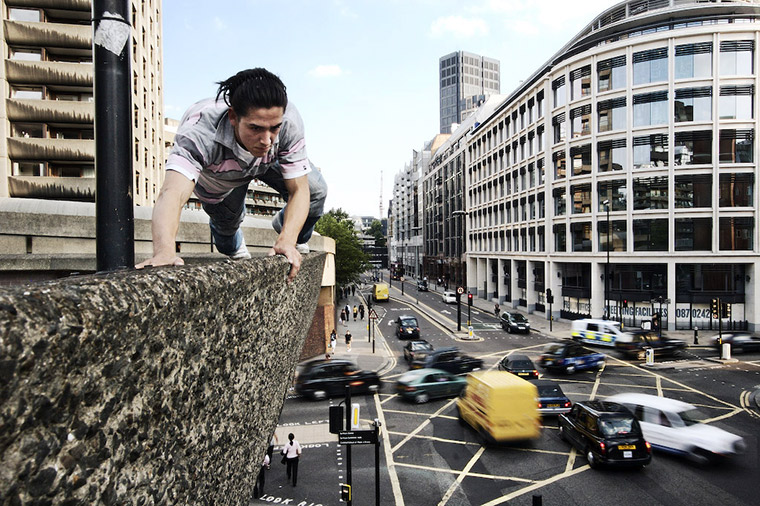



Core ideas and characteristics
The aim of parkour is functional movement: getting from point A to point B with minimal wasted effort and maximal control. Training develops strength, coordination, spatial awareness and mental resilience. Practitioners learn to assess risk, choose efficient lines, and use safe progressions to master new moves. The practice often stresses bodyweight conditioning, repetition of basic techniques and careful attention to landing and rolling mechanics to reduce impact.
History and development
Parkour emerged in France in the late 1980s and 1990s. David Belle is widely credited with shaping the discipline after drawing on military obstacle-course training and his own family background in rescue and physical preparedness. Early groups such as the Yamakasi helped popularize a shared training ethic and creative urban movement. For background on founders and early groups see origin accounts and contemporary retrospectives at historical summaries.
Common movements and progression
Techniques range from basic to advanced and are typically learned in stages with emphasis on safety. Basic building blocks include balance, precise jumping and controlled landings; intermediate techniques add vaults, climbs and wall-based moves. A non-exhaustive list of frequently practiced elements follows; different schools and practitioners use varied names for the same actions:
- Landing and roll (to disperse impact)
- Precision jumps (one- and two-foot targets)
- Vaults: speed vault, kong (or catleap), dash and lazy vault
- Underbar, tic-tac (rebound off a wall) and wall run
- Cat balance (catching an edge) and wall catch techniques
- Lache (dynamic swing through), dismounts and transitions
Some practitioners incorporate acrobatic flips and spins for aesthetics; those moves are often associated with freerunning, a related discipline that places greater emphasis on stylistic expression rather than strict efficiency. For discussions that contrast the two approaches see freerunning comparisons.
Uses, culture and media
Parkour appears in films, commercials and video games, where its visual qualities are used for stunts and choreography. Locally it is practiced in informal jams, classes and workshops that teach movement fundamentals and community etiquette. The discipline attracts people seeking physical challenge, creative expression, or supplemental training for other activities. Many resources and instructional groups provide structured progressions; beginners can consult beginner guides and local organizations at training resources and community directories.
Risks, safety and responsible practice
Parkour carries inherent risks. Injuries can range from minor strains to fractures or worse when moves are attempted beyond one’s ability or without proper preparation. Best practices include gradual progression, supervised learning, adequate warm-ups, proper footwear, and choosing appropriate obstacles and landing surfaces. Many experienced traceurs recommend learning safe falling and rolling techniques first and practicing new skills at low height or in padded environments. For official guidance and safety materials see safety and training advice.
In sum, parkour is a modern movement discipline blending physical technique, mental training and creative problem solving. Its practitioners value efficiency and control, while a wider culture around freerunning explores stylistic acrobatics. As with any high-skill physical activity, responsible instruction and measured progression are essential.
Questions and answers
Q: What is parkour?
A: Parkour is an activity in which the goal is to move from one place to another as quickly and efficiently as possible, using the abilities of the human body. It helps to overcome barriers, and can be practiced in rural and urban areas.
Q: Who founded parkour?
A: Parkour was founded by David Belle in France.
Q: How did David Belle become involved with parkour?
A: David Belle was influenced by his father Raymond Belle, who was a great fireman. At 15 years old, he left school at 16 and his father helped him make himself stronger. He then began creating new actions with his classmates that they named parkour.
Q: Are acrobatics part of parkour?
A: Acrobatics such as flips and wall flips are not part of parkour because they are inefficient for a difficult situation or emergency. Freerunning is the branch of parkour when such flips are used rather than efficient movement.
Q: What are some basic motions of parkour?
A: Some basic motions of parkor include landing, roll, rolling, swan dive, balance, cat balance, precision one foot take offs/two footed take offs , dismounts , turn vaults , wall runs , tic tac movements , crane movements , moonsteps , catleaps , 180% cats running cats tic tac to cats monkey vaults kingkong vaults double kingkongs diving kingkongs kong precisions kingkong cats dash vaults lazy vaults speed vaults underbars laches handstands flags palmspins wall spins aerials sideflips backflips frontflips star jumps etc..
Q: Are there risks associated with practicing Parkour?
A: Yes - practicing Parkour does involve risks and many people get injured every day ranging from simple concussions to broken limbs or even death.
Related articles
Author
AlegsaOnline.com Parkour: Principles, History, Techniques and Safety Leandro Alegsa
URL: https://en.alegsaonline.com/art/74729