
Parachute
A parachute is a fabric device that produces aerodynamic drag to slow descent through air. Used for emergency egress, sport skydiving, military drops and vehicle deceleration, with varied designs and history.
Overview
A parachute is a mechanical device that increases aerodynamic drag and sometimes lift to slow the fall of a person, vehicle or cargo through the atmosphere. Most parachutes are made of a flexible canopy attached by suspension lines to a harness, cargo container or vehicle. By converting a portion of the object's downward motion into air resistance, the parachute reduces terminal velocity and enables a controlled descent and a survivable landing in situations where an unassisted fall would be dangerous or fatal.
Image gallery
10 Images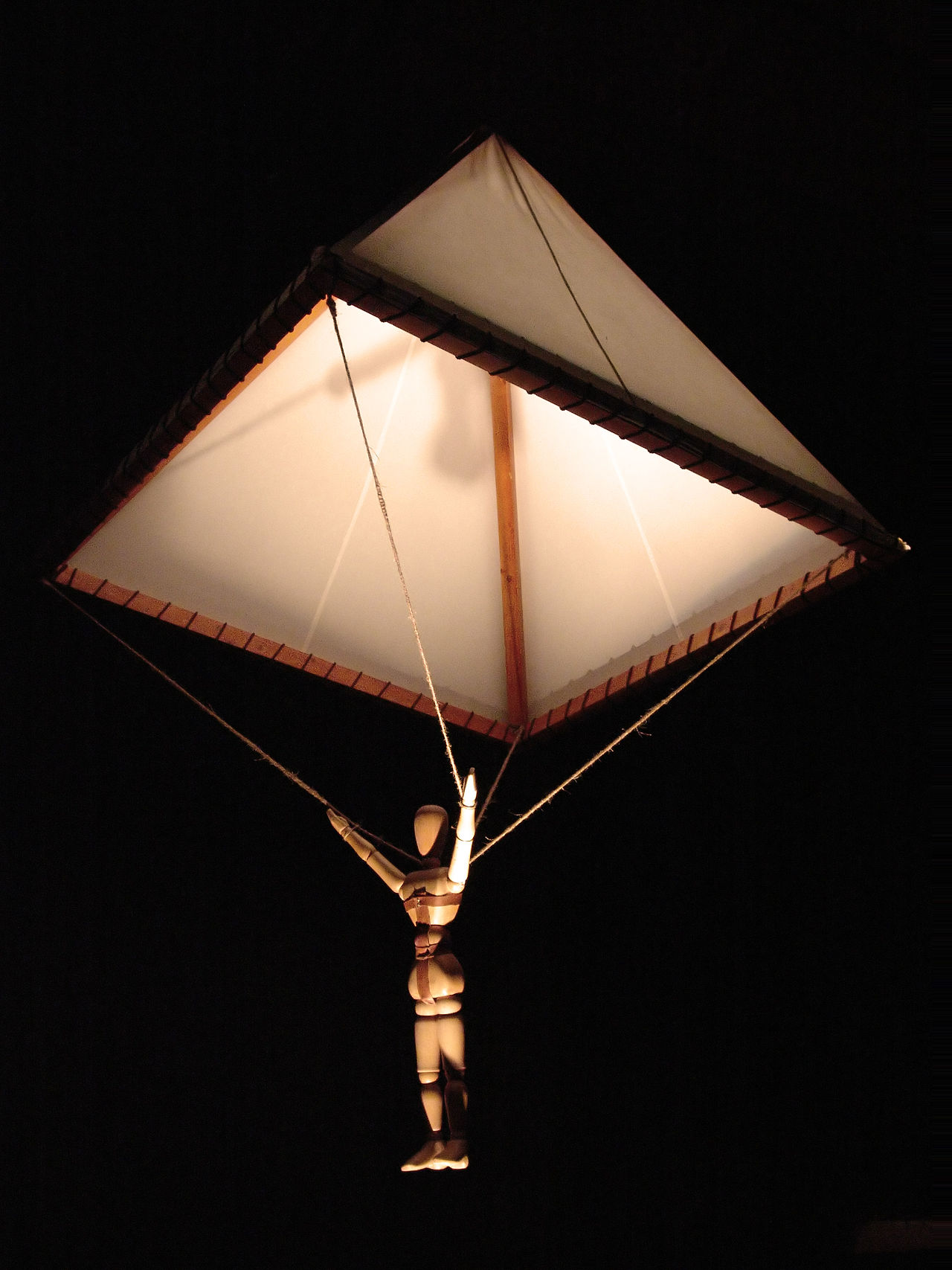




Main parts and common types
Typical parachute systems include several key elements that work together during deployment and descent:
- Canopy — the fabric surface that captures air; shapes range from simple round domes to highly refined wing-like canopies.
- Suspension lines — cords that connect the canopy to the harness or payload and distribute load across the canopy.
- Harness or container — where the jumper or payload is secured; containers may also house pilot and reserve parachutes.
- Pilot chute and deployment devices — small auxiliary parachutes or mechanical systems that extract the main canopy from its pack.
- Slider — a device used on ram-air parachutes to control opening speed and reduce line twists.
Parachutes are commonly grouped by shape and purpose: round or cruciform canopies for military and cargo drops; ram-air (rectangular) parafoils that provide steerable lift for sport skydiving and precision landings; drogue parachutes used primarily for deceleration or stabilization; and reserve parachutes kept as a safety backup.
How they work and are deployed
When a parachute opens, air fills the canopy and creates drag. Deployment methods vary: a pilot chute may be thrown into the relative wind to pull out the main canopy, a static line attached to an aircraft can deploy a parachute automatically when the jumper exits, or rocket or mortar systems can project a canopy away from a vehicle. Modern ram-air canopies act as inflatable wings, allowing the user to control direction and forward speed for a softer, targeted landing. Drogue parachutes slow vehicles in the horizontal axis or stabilize them during high-speed regimes.
History and development
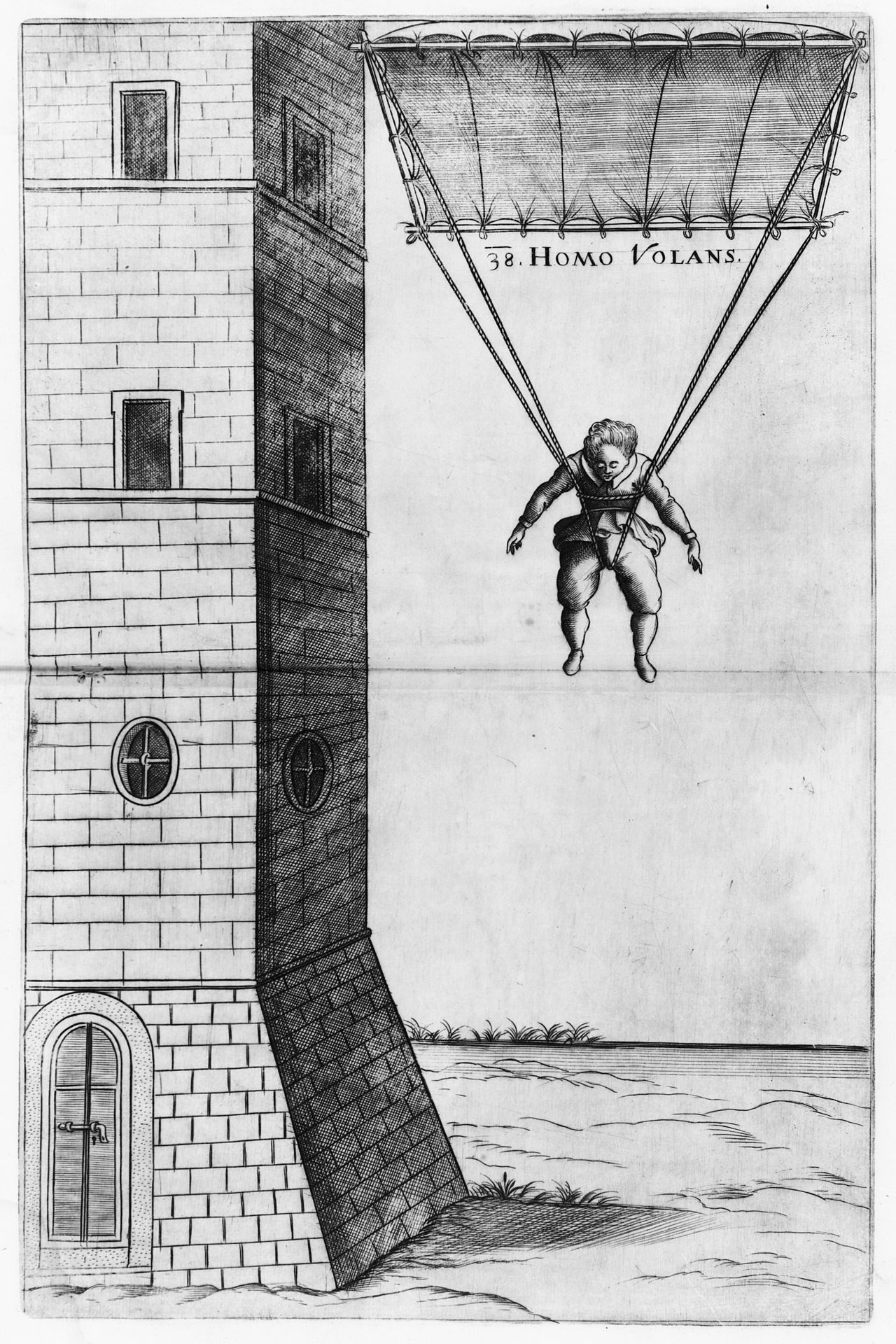
Concepts for parachutes appear in a range of historical sources. A sketch attributed to Leonardo da Vinci in the late 15th century shows a pyramidal canopy held open by a frame; later experiments and records in Europe and Asia documented early droppers and devices to rescue people from height. Over the 18th and 19th centuries parachute designs evolved from rigid-framed canopies to foldable fabrics, and the 20th century saw rapid improvements tied to aviation, military airborne operations and the emergence of recreational skydiving.
Uses and notable examples
Parachutes serve multiple roles: emergency escape systems for aircraft occupants, cargo delivery and air drops for military logistics, descent control for space capsules and atmospheric reentries, deceleration devices for land speed attempts, and sport applications such as skydiving. Military airborne infantry known as paratroopers have used parachutes since the early 20th century to insert forces behind enemy lines. BASE jumping, canopy piloting and precision landing competitions demonstrate how modern canopies can combine safety with significant maneuverability.
Safety, maintenance and differences
Safety depends on design, proper packing, routine maintenance and user training. Most certified systems include a main and a reserve parachute, plus an automatic activation device (AAD) that will deploy the reserve at a preset altitude if the jumper is incapacitated. Materials such as high-tenacity nylon and advanced sewing techniques have increased reliability, while aerodynamic refinements allow for better glide ratios and softer landings. Distinctions between types — emergency round chutes versus steerable ram-air canopies, or drogues used for stabilizing high-speed vehicles — reflect differing priorities: simplicity and reliability versus maneuverability and performance.
Parachutes remain an essential technology bridging safety, sport and engineering: a deceptively simple concept that has evolved into a set of specialized systems for a wide range of aerial applications.
Questions and answers
Q: What is a parachute?
A: A parachute is a device that uses drag to slow down something moving in the air, such as a person or object.
Q: Where does the word "parachute" come from?
A: The word "parachute" comes from the French words "parer" meaning to protect and "chute" meaning fall carefully down making sure you are safe.
Q: How are drogue parachutes used?
A: Drogue parachutes are used to aid horizontal deceleration of a vehicle, such as a fixed-wing aircraft or a drag racer, or to provide stability during a tandem free-fall or after the landing of a space shuttle.
Q: What is the sport of skydiving?
A: Skydiving is a sport that utilizes a parachute for a controlled descent to the ground after jumping from an airplane.
Q: Who are paratroopers?
A: Paratroopers are soldiers who attack by jumping from an airplane using parachutes.
Q: Who invented the parachute?
A: The inventor Leonardo Da Vinci sketched a parachute in his Codex Atlanticus (folio 381v) in about 1485.
Q: What happened with Leonardo's parachute design in modern times?
A: The feasibility of Leonardo's pyramidal design was successfully tested by skydivers in 2000 and 2008, marking the origin of the parachute as we know it according to technology historian Lynn White.
Related articles
Author
AlegsaOnline.com Parachute Leandro Alegsa
URL: https://en.alegsaonline.com/art/74494
Sources
- news.google.com : "Reading Eagle August 14, 1911 page 4- Google News Archive Search"