
Parabolic Trough: Concentrating Solar Thermal Collector and Its Uses
A parabolic trough is a linear concentrating solar collector that focuses sunlight onto a receiver tube to produce high-temperature heat for electricity generation, industrial heat, and thermal storage.
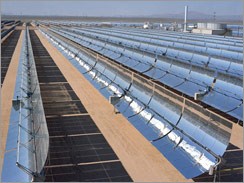
A parabolic trough is a type of concentrating solar power (CSP) collector that uses long, curved mirrors to concentrate sunlight onto a slim receiver tube running along the focal line. By focusing solar radiation, the trough raises the temperature of a heat-transfer fluid inside the receiver, which can then be used to produce steam or to supply process heat. In principle it serves the same purpose as other solar technologies — such as flat-plate solar panels — but it concentrates rather than converts sunlight directly to electricity.
Image gallery
4 Images


How it works
Parabolic troughs are mounted on single-axis trackers that follow the sun from east to west, keeping the mirrors aligned so that solar energy is reflected onto the receiver. The receiver is usually a metal tube with a selective coating and often an evacuated glass envelope to reduce heat loss. A heat-transfer fluid (HTF) circulating through the tube — historically thermal oil, and in some designs molten salt or pressurized water — carries the captured heat to a heat exchanger or boiler. The thermal energy is then converted to mechanical energy with a rotary turbine and finally to electricity via a generator. Early thermal machines used reciprocating steam pistons in engines, but modern utility-scale plants use turbines and electrical transformers (transformer) for grid integration.
Main components
- Parabolic mirror arrays mounted on a supporting structure and tracking system.
- Receiver (absorber) tube with selective coating and often an evacuated envelope.
- Heat-transfer fluid loop, pumps, and heat exchangers.
- Power block (steam generator, turbine, generator) and electrical equipment.
History and development
The parabolic trough concept has evolved from early laboratory concentrators to large field installations. Commercial development accelerated in the late 20th century with utility-scale plants demonstrating the feasibility of trough-based CSP. Advances in mirror manufacture, selective coatings, and tracking control have improved efficiency and reduced costs, while newer receiver materials and working fluids allow higher operating temperatures.
Uses, advantages and limitations
Parabolic troughs are used primarily for utility-scale electricity generation and for industrial process heat where high-temperature thermal energy is required. They can be paired with thermal energy storage to provide dispatchable power and combined with fossil backup in hybrid plants. Advantages include proven technology, relatively simple construction, and mature supply chains. Limitations include large land use, sensitivity to direct sunlight (reduced performance in cloudy regions), and the need for water in some cooling and steam cycles.
Distinguishing features and notable facts
Parabolic troughs are one of several CSP geometries; others include power towers and parabolic dishes. Compared with linear Fresnel systems, troughs typically have higher optical efficiency but can be costlier to build. Their widespread use in several large plants worldwide has helped demonstrate CSP's role in low-carbon electricity systems that benefit from thermal storage and hybrid operation.
For further technical details and plant examples, see sources that cover CSP technology and parabolic trough design in depth (overview, thermal cycles, power conversion, historical engines, electricity, transformers).
Questions and answers
Q: What is a parabolic trough?
A: A parabolic trough is a device that uses parabolic mirrors to collect heat and generate electricity.
Q: How does a parabolic trough collect heat?
A: Parabolic mirrors in the trough collect and focus sunlight onto water-filled pipes, which heats up the water.
Q: What happens to the water after it is heated in the parabolic trough?
A: The water in the pipes turns into steam, which is used to rotate a turbine.
Q: How does the turbine in a parabolic trough generate electricity?
A: The rotating turbine produces electricity.
Q: What happens to the electricity generated by the turbine in a parabolic trough?
A: The electricity is transferred by transformer and then converted from DC to AC before being transferred by current lines.
Q: What is the main advantage of a parabolic trough?
A: The main advantage of a parabolic trough is that it is a renewable energy source that does not emit greenhouse gases.
Q: What is the main function of the parabolic mirrors in a parabolic trough?
A: The main function of the parabolic mirrors is to collect and focus sunlight onto water-filled pipes.
Related articles
Author
AlegsaOnline.com Parabolic Trough: Concentrating Solar Thermal Collector and Its Uses Leandro Alegsa
URL: https://en.alegsaonline.com/art/74489