
Papal States (State of the Church)
Territorial domain in central Italy governed by the popes from the early Middle Ages until 1870, whose decline shaped Italian unification and the modern Vatican State.
Overview
The Papal States, also called the State of the Church (Italian: Stato della Chiesa) or by its Latin title, were a collection of territories on the Italian Peninsula ruled directly by the Pope. Their political existence stretches from the formation of papal temporal authority in the early Middle Ages until the capture of Rome in 1870, when the papacy lost most of its secular dominions.
Image gallery
10 Images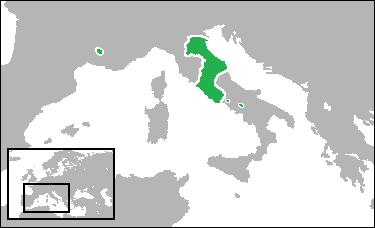




Territories and administration
The Papal States included large parts of central Italy: the city of Rome and the region of Lazio, plus areas now corresponding to Umbria, Marche, and parts of Emilia and Romagna. The pope acted as both spiritual leader and temporal sovereign, exercising powers typical of a state: issuing laws, levying taxes, minting coins and maintaining administrative and judicial institutions. Governance combined ecclesiastical offices with secular officials such as legates and governors.
Origins and development
The territorial power of the papacy grew in the early Middle Ages as Byzantine control in Italy waned and local rulers sought papal support. A key formative moment was the donation by the Frankish king Pepin in the mid-8th century, which transferred lands to papal rule and laid the groundwork for a more durable temporal domain. Over the centuries the papacy consolidated its authority, negotiated with neighboring states and reorganized territories according to political needs.
Major events and decline
- Medieval consolidation and conflicts with Lombards and later Italian princes.
- Renaissance period of cultural patronage and complex diplomacy with European monarchies.
- Disruptions from the French Revolutionary and Napoleonic era, when parts of the Papal States were occupied and reorganized.
- Restoration after 1815, followed by pressure from the 19th‑century Italian unification movement (Risorgimento).
- Progressive annexation by the Kingdom of Italy; final loss of Rome and Lazio in 1870 ended papal temporal rule over those lands.
Cultural and political significance
As a temporal power, the papacy was a major patron of art, architecture and scholarship: numerous churches, palaces and public works were commissioned by popes, especially in the Renaissance. The dual role of the pope—both head of a church with universal spiritual claims and ruler of a territorial state—created persistent tensions between religious and national politics. The so‑called "Roman Question" concerning the pope's status after 1870 remained unresolved until the Lateran agreements of 1929, which created the independent Vatican City as a sovereign territorial entity.
Legacy
The history of the Papal States is central to understanding medieval and early modern Italy, the development of papal diplomacy and the cultural achievements associated with Rome. Its collapse reshaped Italian politics and contributed to the modern distinction between the pope's spiritual authority and secular sovereignty embodied today by the Vatican.
Questions and answers
Q: What were the Papal States?
A: The Papal States were territories in the Italian Peninsula under the direct sovereign rule of the Pope.
Q: How long did the Papal States exist?
A: The Papal States existed from the 8th century until 1870.
Q: What was the official name of the Papal States?
A: The official name of the Papal States was the State of the Church, or Stato della Chiesa in Italian.
Q: What happened to much of the Papal States' territory by 1861?
A: Much of the Papal States' territory had been conquered by the Kingdom of Italy by 1861.
Q: When did the Pope lose Lazio and Rome?
A: The Pope lost Lazio and Rome in 1870.
Q: Did the Pope have any physical territory after 1870?
A: After 1870, the Pope had no physical territory at all, except for the Vatican.
Q: What was the Latin name for the Papal States?
A: The Latin name for the Papal States was Status Ecclesiasticus, or Ecclesiastical State.
Related articles
Author
AlegsaOnline.com Papal States (State of the Church) Leandro Alegsa
URL: https://en.alegsaonline.com/art/74431
Sources
- ebiblio.istat.it : Statistica della popolazione dello Stato pontificio dell'anno 1853
- digital.ub.uni-duesseldorf.de : "Status Ecclesiasticus et Magnus Ducatus Thoscanae" (1700)