
Pannotia: the late Neoproterozoic supercontinent
Pannotia, also called the Vendian or Greater Gondwanaland, is a proposed late Neoproterozoic supercontinent assembled before the Cambrian and fragmented into Laurentia, Baltica, Siberia and Gondwana.
Overview
Pannotia is the name given to a proposed supercontinent that existed in the late Neoproterozoic era. Also referred to as the Vendian supercontinent or Greater Gondwanaland, it is thought to have been present in the interval around the Ediacaran period (roughly 600–541 million years ago) and to have broken apart near the end of the Precambrian. The concept describes a large continental assembly that soon fragmented to form the continental configuration that entered the Cambrian.
Image gallery
6 Images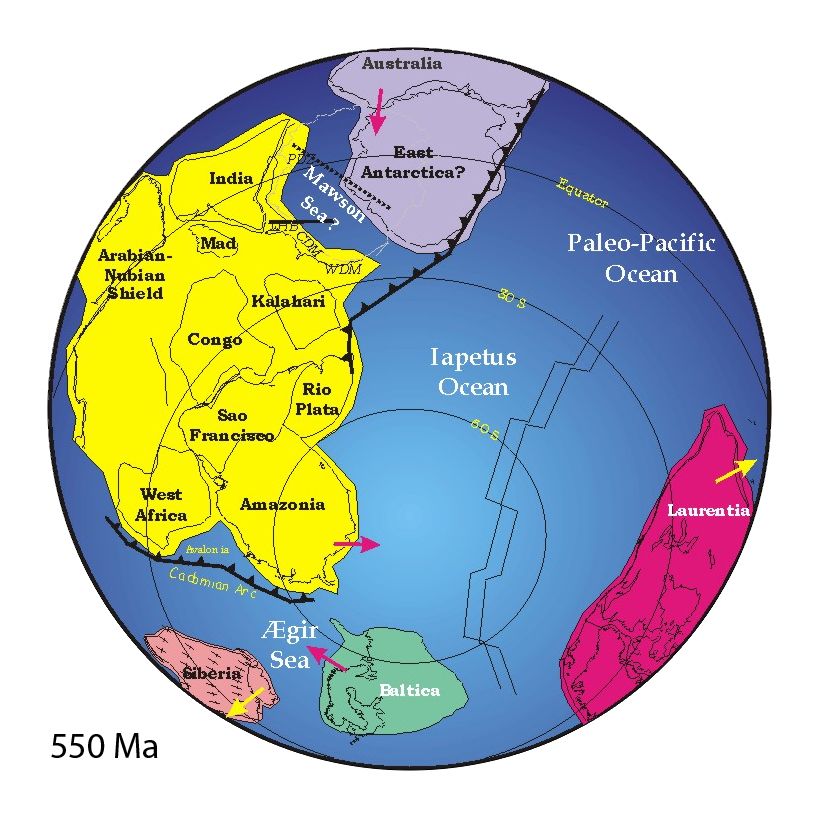


Composition and characteristics
Reconstructions of Pannotia place several major cratonic blocks together: Laurentia, Baltica, Siberia and a dominant southern mass often identified with Gondwana. These pieces were linked by active plate boundaries and orogenic belts formed as fragments rearranged after the earlier breakup of Rodinia. Because the interval involved is geologically brief compared with other supercontinents, Pannotia is sometimes described as short‑lived or transient.
Formation and breakup
The assembly of Pannotia is thought to result from collisions among continental blocks and the closure of intervening oceans during the late Neoproterozoic. Global tectonic activity in this interval included widespread mountain‑building and crustal reworking. Within a few tens of millions of years the same plate forces that united the blocks changed to extension and rifting, causing the supercontinent to disintegrate into smaller continents and open new ocean basins. Those successor landmasses set the stage for the paleogeography of the early Paleozoic.
Evidence and scientific debate
Evidence for Pannotia comes from several independent lines: paleomagnetic data that constrain the positions of cratons, matching geological belts and sedimentary sequences between now‑separate continents, and tectonic reconstructions based on orogenic histories. However, interpretations differ. Some researchers favor a coherent, single supercontinent; others argue the configuration was ephemeral or made of loosely connected blocks rather than a long‑lived, rigid assembly. Ongoing work continues to refine timings and relative motions.
Importance and legacy
Whether as a distinct supercontinent or as a transient assembly, Pannotia is important for understanding late Precambrian Earth systems. The tectonic rearrangements influenced seaways, ocean chemistry and habitats during the rise of the Ediacaran biota and the subsequent Cambrian radiation. The breakup redistributed continental margins and helped define early Paleozoic ocean basins, influencing sedimentation patterns and later mountain belts.
Key facts
- Timeframe: Late Neoproterozoic, approximately 600–541 million years ago (Ediacaran to Cambrian boundary).
- Main fragments after breakup: Laurentia, Siberia, Baltica and Gondwana.
- Alternative names: Vendian supercontinent, Greater Gondwanaland, often described as a supercontinent.
- Research resources: paleomagnetism, stratigraphy and orogenic correlations (see Precambrian tectonic studies).
For concise summaries and introductory maps consult general overviews linked to key topics: Neoproterozoic studies, reviews of supercontinent cycles and regional syntheses of the Ediacaran period.
Questions and answers
Q: What is Pannotia?
A: Pannotia is a Neoproterozoic supercontinent.
Q: When did Pannotia exist?
A: Pannotia may have existed during the Ediacaran period (~600 mya), to the end of the Precambrian (about 541 mya).
Q: What happened to Pannotia after it existed?
A: After it existed, Pannotia split into smaller continents.
Q: What were the smaller continents that Pannotia split into?
A: The smaller continents that Pannotia split into were Laurentia, Siberia and Baltica.
Q: What was the main landmass south of the smaller continents?
A: The main landmass south of the smaller continents was Gondwana.
Q: In what era did Pannotia come to exist?
A: Pannotia came to exist in the Neoproterozoic era.
Q: When did the Precambrian era end?
A: The Precambrian era ended about 541 million years ago.
Related articles
Author
AlegsaOnline.com Pannotia: the late Neoproterozoic supercontinent Leandro Alegsa
URL: https://en.alegsaonline.com/art/74379
Sources
- palaeos.com : "Pannotia"
- evolution.berkeley.edu : "Pannotia"