
Palm-leaf manuscript
Manuscripts written on dried, prepared palm leaves and used across South and Southeast Asia; inscribed with a stylus, rubbed with ink, and bound into long, landscape-format codices.
Overview
Palm-leaf manuscripts are documents produced by inscribing text on dried and treated leaves of various palm species. They have been important carriers of religious, literary, legal and scientific texts across South and Southeast Asia for many centuries. The medium yields narrow, landscape-oriented folios that are stacked and often bound together between wooden covers to form a book-like object.
Image gallery
10 Images




Material and preparation
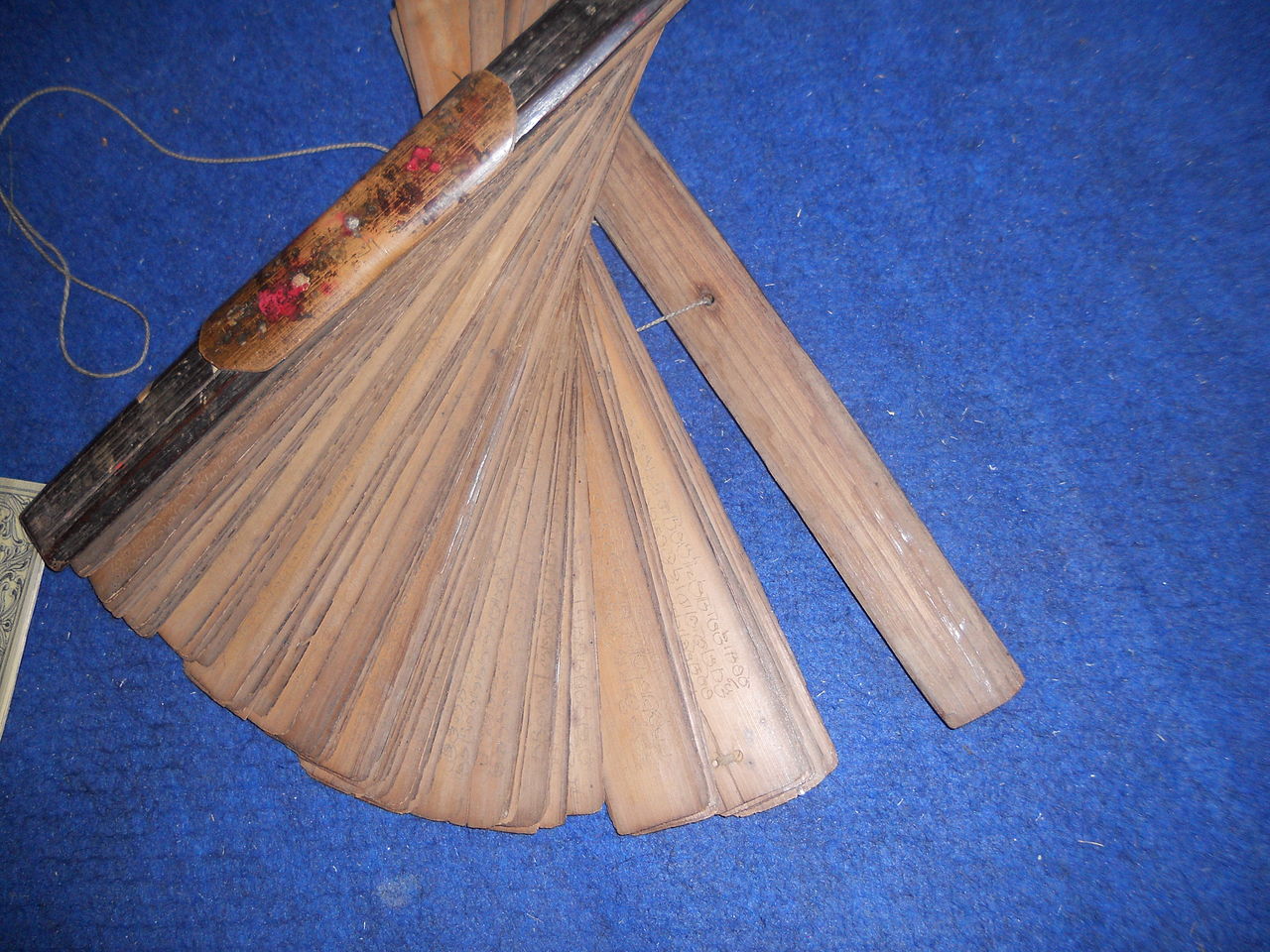
Leaves from certain palms were selected, cured and prepared before writing. In many traditions the fresh leaves were first cooked or steamed to remove moisture and then sun-dried and smoothed. Commonly used palms include species of palmyra and talipot; general reference to the material is simply palm leaf. Preparation also involved polishing to create a uniform surface and trimming to size. Many manuscripts feature one or more punched holes along the spine so the sheets can be threaded and secured.
Form, tools and scripts
The physical format is typically long and narrow, yielding a landscape format codex rather than the portrait pages familiar in paper books. Scribes wrote by incising letters with a stylus; afterwards ink or soot was rubbed into the incisions so characters became visible. Languages and scripts varied by region — Sanskrit, Pali, Tamil, Burmese, Balinese and Javanese are among those commonly preserved on palm leaves.
History and geography
Use of palm leaves for writing is attested in South and Southeast Asia from antiquity; some of the earliest surviving examples are dated to the first millennium BCE and classical descriptions suggest an earlier origin. The technology spread with religious and administrative institutions and remained in active use in many areas until paper and printing became widespread.
Uses, preservation and threats
Palm-leaf manuscripts transmitted scripture, poetry, astronomical tables, law codes and local records. They are vulnerable to organic decay; manuscripts suffer from putrefaction, insect damage and environmental deterioration. Small pests such as silverfish and termites consume leaf material, while humidity encourages mold. Conservation requires dry storage, periodic cleaning, cautious re-oiling and, where possible, copying or digitization.
Notable facts and distinctions
- Palm leaves produce a compact, portable format distinct from scrolls and paper codices.
- Scribes often used a two-step process: incision with a stylus, then ink application to reveal the text.
- Because each leaf is fragile, many collections include wooden covers and protective wrappings to reduce wear.
Collections of palm-leaf manuscripts are held in museums, monasteries and libraries and continue to be studied for their linguistic, historical and cultural value. Research and digitization projects aim to preserve texts that remain legible on this delicate organic support.
Questions and answers
Q: What were palm leaves used for in Southeast Asia?
A: Palm leaves were used as a material to write on in Southeast Asia.
Q: When did the use of palm leaves as a writing material start?
A: The use of palm leaves as a writing material is known to have started in the 5th century BC, but it may have started earlier.
Q: How are palm leaves prepared for writing?
A: Palm leaves are cooked, dried, and polished in order to prepare them for writing.
Q: What is the "landscape format" used in palm-leaf manuscripts?
A: Due to the nature of palm leaves, the manuscripts use a "landscape format".
Q: What is the range of width for palm leaves used in manuscripts?
A: The width range for palm leaves used in manuscripts is between 15 centimetres (5.9 in) and 60 centimetres (24 in).
Q: What is the range of height for palm leaves used in manuscripts?
A: The height range for palm leaves used in manuscripts is only 3 centimetres (1.2 in) to 12 centimetres (4.7 in).
Q: How are old manuscripts prone to damage?
A: Old manuscripts are prone to putrefaction and are commonly consumed by silverfish.
Related articles
Author
AlegsaOnline.com Palm-leaf manuscript Leandro Alegsa
URL: https://en.alegsaonline.com/art/74218