
Palermo Stone — fragment of the Royal Annals of Ancient Egypt
Largest surviving fragment of the Royal Annals: a basalt stele listing kings and year-by-year events from Egypt's First Dynasty through early Fifth Dynasty, held mainly in Palermo.
Overview
The Palermo Stone is the most prominent surviving piece of a larger inscribed monument commonly called the Royal Annals. Created in the Old Kingdom period, it preserves a year-by-year record of the pharaohs from Egypt's earliest dynasties through the start of the Fifth Dynasty. The fragment now known as the Palermo Stone is housed at the Antonio Salinas Regional Archaeological Museum in Palermo, Italy, which gives the object its conventional name; other fragments of the same annalistic text reside in collections in Cairo and London. The full monument is usually referred to as the Royal Annals of the Old Kingdom or simply the Annals Stone. For the larger monument see Royal Annals stele and the historical period Old Kingdom.
Image gallery
7 Images
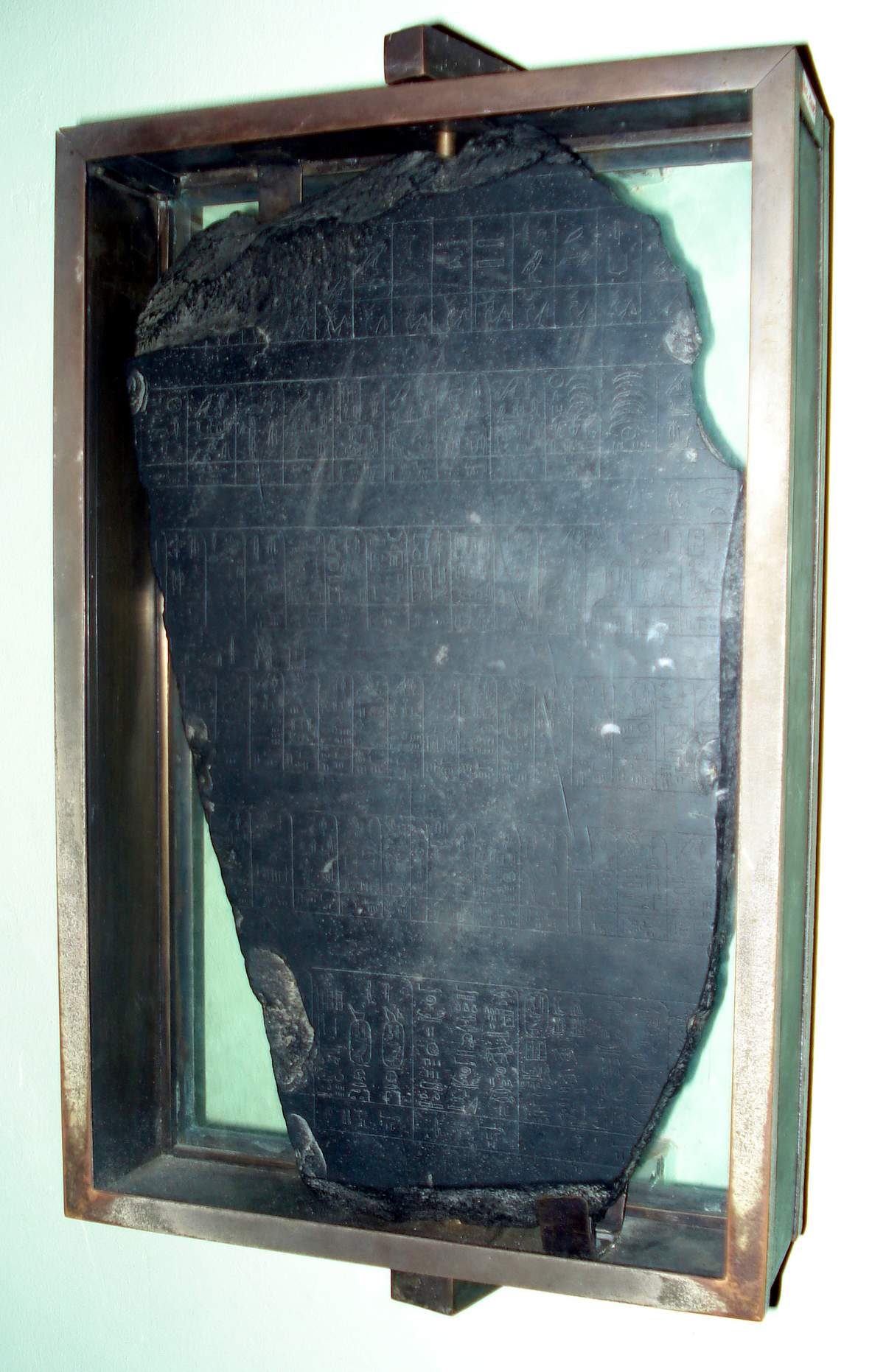


Physical characteristics and contents
The surviving Palermo fragment is a sizable piece of black stone whose surface bears rows of hieroglyphic inscriptions set out in horizontal registers. Each register contains royal cartouches and short entries that function like annual notations: a king's name followed by brief statements about notable events for that regnal year. These entries are often concise phrases rather than full narratives, and they were intended as an official chronological record rather than a literary history.
What the annals record
- Names of rulers and the sequence of successive reigns.
- Short, dated entries for individual years of a king's reign (year-names).
- Administrative and ritual matters such as temple dedications, festivals, or taxation assessments.
- Practical data like Nile inundation notes and occasionally references to military or construction activity.
History, provenance and scholarship
The stone bearing these annals was probably carved during the Fifth Dynasty or shortly thereafter, and later broken into several fragments that are now dispersed. The name "Palermo Stone" refers to the largest and best-known fragment in Palermo, while other pieces sometimes are grouped under labels such as the "Cairo Annals Stone." Scholars have used these fragments to reconstruct early king lists, approximate reign lengths, and to cross-check archaeological and textual evidence for Old Kingdom chronology. Fragments in major collections include portions kept in Cairo and London (Cairo, London), and the Palermo museum entry is catalogued at Antonio Salinas Regional Archaeological Museum in Palermo, Italy.
Importance and limitations
The Royal Annals represented by the Palermo Stone are among the earliest surviving attempts at systematic historical record keeping in ancient Egypt. They are crucial for Egyptologists trying to assemble an internal chronology for the Early Dynastic and Old Kingdom periods and for understanding what ancient officials regarded as important year-by-year. At the same time, the text is fragmentary: large gaps and damaged signs limit certainty, and the terse nature of the entries leaves many items open to interpretation. For these reasons the Palermo Stone is used in combination with inscriptions from monuments, tomb records, and later king lists to build a fuller picture of early Egyptian history.
Notable facts and practical use
Because the annals are arranged chronologically and tied to regnal years, researchers use the Palermo Stone to test hypotheses about the sequence and duration of reigns and to anchor other archaeological finds to dated events. The term "Palermo Stone" is sometimes used loosely to include all surviving annal fragments; more precise discussion distinguishes the Palermo fragment from the smaller pieces kept in other collections. The document's combination of king lists and annual notes makes it an indispensable, though challenging, source for reconstructing Egypt's earliest royal history.
Questions and answers
Q: What is the Palermo Stone?
A: The Palermo Stone is one of seven pieces of a larger stele known as the Royal Annals of the Old Kingdom of Ancient Egypt.
Q: What information does the Royal Annals contain?
A: The stele contains a list of the kings of Egypt from the First Dynasty through to the early part of the Fifth Dynasty, as well as important events that occurred during their rule.
Q: When was the Palermo Stone likely made?
A: The Palermo Stone was likely made during the Fifth Dynasty, around 2392-2283 BCE.
Q: Where is the Palermo Stone located?
A: The Palermo Stone is located in the Antonio Salinas Regional Archaeological Museum in Palermo, Italy.
Q: Is the Palermo Stone the only piece of the Royal Annals?
A: No, the Palermo Stone is one of seven pieces of the Royal Annals.
Q: What are the other names of the Royal Annals Stones?
A: The other names for the Royal Annals Stones are the Cairo Annals Stone and Cairo Stone for those pieces kept in Cairo.
Q: Why are the Royal Annals important for the study of Egyptian history?
A: The Royal Annals are important because they are probably the oldest historical writing from Ancient Egypt, and they provide valuable information for the study of Egyptian history in the Old Kingdom.
Related articles
Author
AlegsaOnline.com Palermo Stone — fragment of the Royal Annals of Ancient Egypt Leandro Alegsa
URL: https://en.alegsaonline.com/art/74168