
Aurora (Roman goddess of the dawn)
Aurora is the Roman personification of dawn, equivalent to the Greek Eos; she renews each morning, appears in classical myths (notably Tithonus), and figures widely in art and literature.
Overview
Aurora is the Roman goddess who personifies the dawn. Her name is the Latin word for "dawn," and she occupies the sky at daybreak, heralding the sun's arrival. In Roman poetry and myth she fulfills the role played in Greek tradition by Eos and is often described as the sister of the sun and the moon—linked in literature to Sol and Luna. The natural light displays sometimes called auroras are unrelated phenomena but share the same name in modern languages; see the atmospheric phenomenon often called an aurora.
Image gallery
8 Images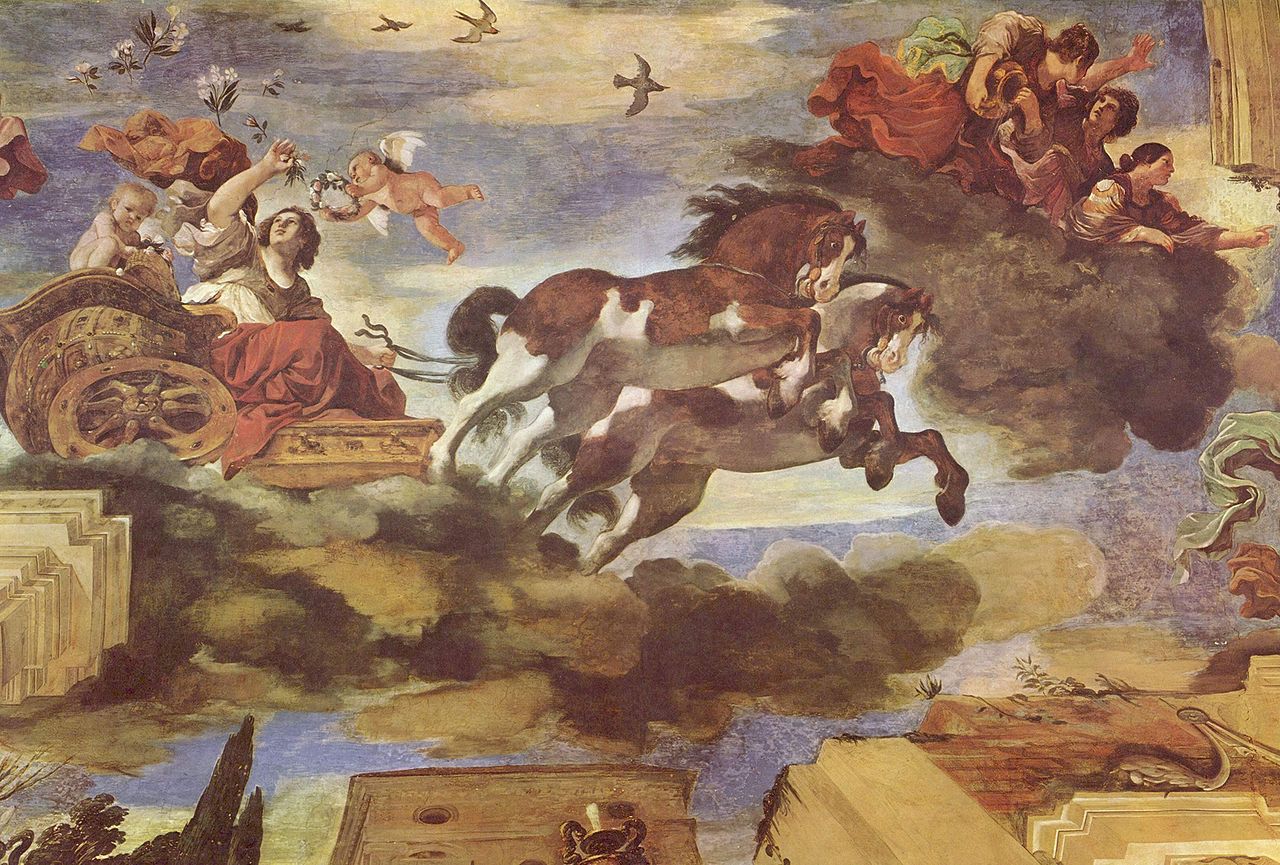


Characteristics and iconography
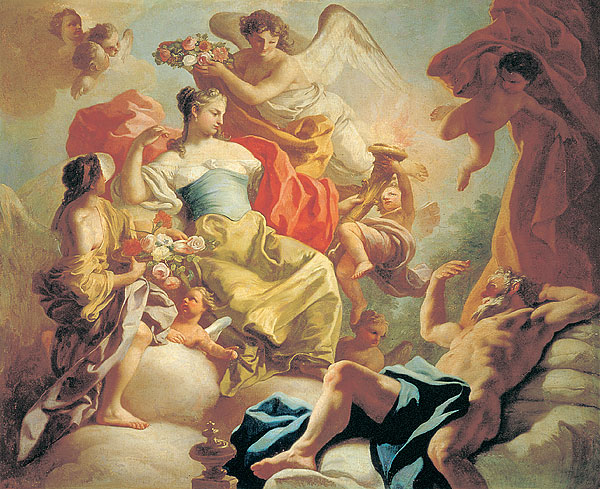
Classical authors portray Aurora as renewing herself every morning and spreading light across the horizon. She is frequently imagined driving a chariot or flying with rosy fingers or saffron robes, imagery that descends from Greek epithets applied to dawn. Artists and sculptors represent her as a youthful, winged figure, sometimes accompanied by dew, birds, or the horses that draw the sun's vehicle. The Latin term itself is simply Aurora, used both as a common noun for dawn and as the goddess's name.
Myths and notable stories
Aurora appears in a number of well known classical tales. Among the most famous is her love for the mortal Tithonus. According to Roman retellings of the older Greek tradition, Aurora begged the chief god—traditionally rendered as Zeus in Greek contexts—for Tithonus's life. She obtained immortality for him but neglected to secure eternal youth; versions of the story say he withered without dying and in some accounts was turned into a grasshopper or cicada. Other poems and episodes in Roman literature mention Aurora's daily passage and her role as a herald of time.
Historical development and literary presence
Aurora belongs to a long-running dawn-goddess tradition that includes the Greek Eos and the Vedic Ushas. Roman writers such as Ovid and Virgil invoke her to mark the break of day, using her appearance to set scenes or signal transitions. Her presence in later European literature is also notable: playwrights and poets reference her to evoke morning or longing. For example, Shakespeare alludes to dawn in Romeo and Juliet, and the Victorian poet Alfred Tennyson wrote a meditation entitled "Tithonus" that explores the consequences of the myth.
Cultural legacy and distinctions
- Aurora functions as both a literal and symbolic sign of renewal, hope, and the cycle of day and night.
- She is the Roman counterpart to the Greek dawn goddess and part of a broader Indo-European motif of a dawn deity—see parallels like ancient Greek and Vedic figures.
- The name endures in modern culture: beyond poetic allusion, the name Aurora has been applied to natural phenomena, works of art, and objects such as the asteroid 94 Aurora. The goddess figure also appears in numerous paintings and operatic or musical settings.
Examples and further notes
References to Aurora may be found across Roman poetry and later European texts. As a mythological figure she is associated with rebirth and the passage of time rather than the sun itself, though classical tradition links her closely with other celestial siblings. When reading classical sources or later adaptations, distinguishing between the Roman Aurora and the Greek Eos helps clarify cultural nuance: the characters are analogous but reflect different literary contexts and linguistic traditions. For more on the goddess in comparative myth and in modern reception, see general surveys of ancient religion and classical literature treating Aurora.
Additional references to Aurora in cultural memory and scientific terminology show how a simple natural event—the coming of morning—has inspired recurring personification and artistic expression from antiquity to the present day (auroral displays, poetic dawn imagery and more).
Questions and answers
Q: Who is Aurora in Roman mythology?
A: Aurora is the ancient Roman equivalent of Eos, who was the ancient Greek goddess of the dawn.
Q: What does Aurora do every morning?
A: Every morning at dawn, Aurora renews herself and flies across the sky to announce its arrival.
Q: Who are some of her family members?
A: Her brother is the sun and her sister is the moon. She also has many husbands and four sons, one for each cardinal direction (North, East, South, and West).
Q: What did Aurora ask Zeus to grant Tithonus?
A: Aurora asked Zeus to grant immortality to Tithonus. However, she failed to ask him for eternal youth so he ended up aging eternally.
Q: How was Aurora described in Lord Alfred Tennyson's poem "Tithonus"?
A: In Lord Alfred Tennyson's poem "Tithonus", Aurora was described as having pure brows and shoulders with a heart renewed; her cheeks began to redden through the gloom while her sweet eyes brightened slowly close to his; before they blinded the stars a wild team that loved her yearned for her yoke and shook darkness from their loosened manes while beating twilight into flakes of fire.
Q: How does Montague describe Romeo in Shakespeare's play Romeo & Juliet?
A: In Shakespeare's play Romeo & Juliet (i.i), Montague describes Romeo as heavy son who steals away from light when all-cheering sun begins drawing shady curtains from Aurora's bed in farthest east.
Q: What asteroid was named after Aurora?
A: The asteroid 94 Aurora was named after her.
Related articles
Author
AlegsaOnline.com Aurora (Roman goddess of the dawn) Leandro Alegsa
URL: https://en.alegsaonline.com/art/7416