
Palate (anatomy): structure, function, development and clinical notes
The palate is the roof of the mouth separating oral and nasal cavities. This article explains hard and soft palates, development, functions in speech and swallowing, comparative anatomy, and culinary usage.
Overview
The palate forms the roof of the mouth and serves as the partition between the oral cavity and the nasal cavity. In humans and other mammals it creates a distinct separation that supports breathing while feeding and helps produce articulated speech. For a basic definition, see the roof of the mouth and its relation to the nasal cavity.
Image gallery
2 Images
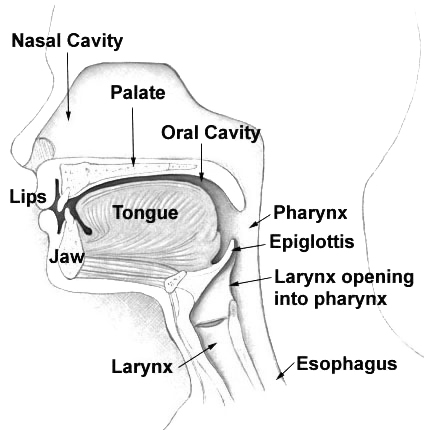
Anatomy and parts
Structurally, the palate is divided into two main regions. The anterior portion is the hard palate: a bony plate covered by mucous membrane that forms a firm surface against which the tongue can press. Posteriorly lies the soft palate or velum, a muscular and flexible continuation that ends in the uvula and helps seal the airway during swallowing. For more detail on the soft region see soft palate.
Development and clinical significance
The bones of the hard palate develop before birth by fusion of facial processes. When fusion is incomplete, the result is a cleft palate, a congenital malformation that can affect feeding, speech, and middle-ear function. Treatment commonly involves surgical repair and multidisciplinary care. Awareness of developmental timing explains why clefting is a frequent focus of prenatal and pediatric medicine.
Functions: speech, swallowing and breathing
The palate contributes to several essential functions. It separates the upper respiratory tract from the mouth to allow simultaneous breathing and eating; the soft palate elevates during swallowing to close the nasopharynx; and both hard and soft palates act as a resonating chamber for speech sounds. A short list of primary roles:
- Separation of oral and nasal cavities during swallowing and breathing
- Providing a rigid surface for articulation of consonants
- Participating in oral resonance that shapes voice quality
- Supporting mucosal sensory roles that aid in oral function
Comparative anatomy and evolution
Not all vertebrates have a fully separated palate. A similar secondary palate occurs in crocodilians, which allows breathing while the mouth is otherwise occupied. In many other tetrapods the oral and nasal passages remain incompletely separated. See comparative notes on mammals, crocodilia, and other groups: mammals, crocodilia, other tetrapods. The evolution of a complete palate is linked to shifts in feeding mechanics and respiratory control.
Cultural and figurative senses
Historically, the roof of the mouth was once regarded as the seat of taste; this usage survives in figurative language. "Palate" can mean the sense of taste itself or a refined ability to distinguish flavors — commonly applied to wine, beer and cuisine. For this semantic sense see references to the sense of taste. In culinary and sensory contexts, describing a food or beverage's "palate" often refers to its overall flavor profile and mouthfeel rather than the anatomical structure.
Notable facts
- The hard palate is important in surgical approaches to oral and nasal disease.
- Disorders of the soft palate can cause nasal speech or swallowing difficulties.
- Comparative anatomy reveals how a secondary palate supports simultaneous breathing and chewing in several lineages.
For introductory diagrams and clinical overviews consult general anatomy and otolaryngology resources: anatomy overview, nasal and oral relations, and specialist literature on congenital palate anomalies. Additional educational links: crocodilian palate, tetrapod comparisons, and taste-related discussions at soft palate resources and taste and flavor.
Questions and answers
Q: What is the palate?
A: The palate is the roof of the mouth in humans and other mammals.
Q: What separates the oral cavity from the nasal cavity in mammals?
A: The palate separates the oral cavity (mouth) from the nasal cavity in mammals.
Q: Are the oral and nasal cavities separate in most tetrapods?
A: No, in most other tetrapods, the oral and nasal cavities are not truly separate.
Q: How is the palate divided in humans and other mammals?
A: The palate is divided into two parts, the anterior bony hard palate, and the posterior fleshy soft palate or velum.
Q: What is a cleft palate?
A: If the fusion of the hard palate is not complete before birth, it is called a cleft palate. This is a birth or congenital defect.
Q: Can palate refer to the sense of taste?
A: Yes, as the roof of the mouth was once considered the seat of the sense of taste, palate can also refer to this sense itself, as in the phrase "a discriminating palate".
Q: How can the flavour of a food be referred to as palate?
A: By further extension, the flavour of a food (particularly beer or wine) may be called its palate.
Related articles
Author
AlegsaOnline.com Palate (anatomy): structure, function, development and clinical notes Leandro Alegsa
URL: https://en.alegsaonline.com/art/74139