
Palaeogene: early Cenozoic period of mammal diversification and climate change
The Palaeogene (also Paleogene) spans about 66–23 million years ago; it follows the Cretaceous, precedes the Neogene, and includes the Paleocene, Eocene and Oligocene epochs.
Overview
The Palaeogene (often spelled Paleogene) is the earliest period of the Cenozoic Era and a major interval in the Phanerozoic Eon. It is conventionally treated as a geologic period and as the first system of the Cainozoic (Cenozoic) Era. The Palaeogene began around 66 million years ago after the mass extinction at the end of the Cretaceous and extends to about 23 million years ago, where it is succeeded by the Neogene. It is one of the principal divisions of the Phanerozoic eon.
Image gallery
6 Images


Subdivisions and timeline
The Palaeogene comprises three standard epochs: the Paleocene, the Eocene and the Oligocene. These epochs are commonly recognized in global chronostratigraphy and are further divided into ages used by geologists and paleontologists. Key boundaries are tied to changes in fossil assemblages, isotopic excursions and abrupt shifts in climate.
Climate, environments and life
The Palaeogene saw dramatic climatic shifts. The early Paleocene remained relatively warm following the end-Cretaceous extinction. The middle of the period experienced one of the best-known transient warming events, the Paleocene–Eocene Thermal Maximum, which led to rapid global temperature rise and profound effects on marine and terrestrial life. Later, through the Oligocene, global temperatures cooled and the Antarctic ice sheet began to form, altering ocean circulation and habitats.
Biological and ecological significance
With non-avian dinosaurs gone, mammals underwent a major adaptive radiation: many modern groups — such as primates, rodents, ungulates and carnivores — first appear or diversify significantly in Palaeogene deposits. Birds and flowering plants also expanded into new niches. Marine ecosystems saw turnover among plankton, foraminifera and early modern groups of fish and marine mammals.
Geology, plate movements and resources
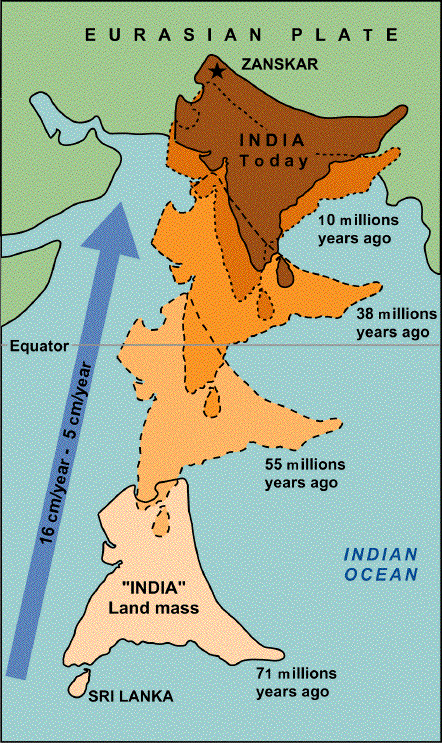
Tectonic reorganization continued during the Palaeogene as continents moved toward their present positions; orogenic activity (mountain building) accelerated in some regions and ocean gateways changed, influencing climate. Sedimentary rocks of Palaeogene age are important reservoirs for fossil fuels and host many fossil sites that preserve the transition to modern ecosystems.
Terminology and historical usage
Historically the Palaeogene together with the following Neogene were grouped under the older name Tertiary, a term still used informally. Modern stratigraphic practice treats the Palaeogene as a distinct period to reflect its unique biological and climatic developments. For further introductory information see general period guides, regional stratigraphic charts (Cainozoic overviews), epoch summaries (Paleocene, Eocene, Oligocene) and sources on the end-Cretaceous extinction and early Cenozoic evolution (Cainozoic, Phanerozoic, eon). Additional background is available in palaeoclimate and stratigraphy summaries (66 Ma studies).
Questions and answers
Q: What does the word "Palaeogene" mean?
A: The word "Palaeogene" means "old generation" in Greek.
Q: What is the Palaeogene?
A: The Palaeogene is the first geological period of the Cainozoic and the tenth period in the Phanerozoic eon.
Q: When did the Palaeogene begin and end?
A: The Palaeogene began 65 million years ago and ended 23 million years ago.
Q: What period came before the Palaeogene?
A: Before the Palaeogene was the Cretaceous.
Q: What period followed the Palaeogene?
A: The Palaeogene was followed by the Neogene.
Q: How many stages did the Palaeogene have?
A: The Palaeogene had three stages: Palaeocene, Eocene, and Oligocene.
Q: What were the Palaeogene and the Neogene originally considered to be?
A: The Palaeogene and the succeeding Neogene were originally considered to be one period, the Tertiary, until it was split recently.
Related articles
Author
AlegsaOnline.com Palaeogene: early Cenozoic period of mammal diversification and climate change Leandro Alegsa
URL: https://en.alegsaonline.com/art/74118
Sources
- stratigraphy.org : stratigraphy.org/ICSchart/ChronostratChart2013-01.pdf