
Pacific giant salamander
Large salamanders of the genus Dicamptodon native to the Pacific Northwest of North America; notable for size, aquatic larvae, occasional paedomorphosis, and loud vocalizations.
The Pacific giant salamanders are a small group of large salamanders belonging to the genus Dicamptodon and traditionally placed in the family Dicamptodontidae (sometimes treated alongside the mole salamanders). They are endemic to the cool, moist forests and streams of the Pacific Northwest in North America and are commonly referred to by the collective name "Pacific giant salamander." These animals are among the largest terrestrial salamanders in their range and are easily distinguished by their robust bodies and striking mottled coloration.
Image gallery
8 Images


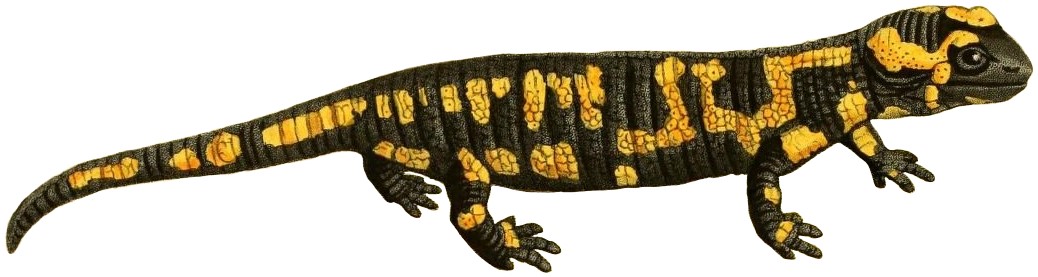

Appearance and distinguishing features
Adults commonly reach lengths of around 20–30 cm (8–12 in) from snout to tail tip, with bulky bodies, broad heads and large mouths. Larval stages are aquatic and bear feathery external gills; some populations or individuals retain larval traits into adulthood (a condition called paedomorphosis). Unlike most salamanders, Pacific giant salamanders can produce audible sounds — a harsh chirp, bark or croak — when handled or disturbed. They are also known for a powerful bite when threatened. For general context about amphibians, see salamanders.
Life history and behavior
Reproduction typically occurs in or beside streams. Eggs are laid in water or under submerged objects; hatchlings develop as aquatic larvae and later metamorphose into terrestrial or semiterrestrial adults in many populations. Diets are carnivorous and opportunistic: juveniles and adults feed on invertebrates and small vertebrates, including insects, worms, small fish and other amphibians. Some populations remain fully aquatic and reproductively mature without metamorphosing, which influences local ecology and conservation considerations.
Species
- Dicamptodon copei — Cope's giant salamander
- Dicamptodon aterrimus — Idaho giant salamander
- Dicamptodon tenebrosus — Coastal giant salamander
- Dicamptodon ensatus — California giant salamander
Taxonomic treatments have varied over time; some authorities have split or lumped populations based on genetic and morphological studies. The four-name arrangement listed above is widely used in field guides and regional checklists.
Habitat, conservation and human interactions
Pacific giant salamanders inhabit cold, clear streams, seeps and adjacent moist forest floors. They use cover such as logs, rocks and root tangles, and they are sensitive to changes in water quality, stream temperature and habitat fragmentation. Threats include logging, urban development, sedimentation and invasive fish that prey on larvae. While not all species are currently listed as threatened, localized declines have prompted conservation attention; habitat protection and maintaining stream integrity are key measures. When encountered in the wild, these salamanders should be left undisturbed — they play an important role as nocturnal predators and indicators of watershed health.
Notable distinctions include their large size and vocal behavior compared with many other North American salamanders. Their ecological role, distinctive life histories (including paedomorphosis in some populations) and sensitivity to environmental change make them important species for study and conservation in the Pacific Northwest of North America. Additional resources and regional accounts are available through natural history organizations and specialist literature (family-level summaries, genus treatments, and species pages such as the California giant salamander overview).
Questions and answers
Q: What is a Pacific giant salamander?
A: A Pacific giant salamander is a type of large salamander found in the Pacific Northwest of North America.
Q: How big can Pacific giant salamanders grow to be?
A: Pacific giant salamanders can grow up to 30 cm (12 in) long.
Q: Are Pacific giant salamanders like other types of salamanders?
A: Pacific giant salamanders are similar to the mole salamander family (Ambystomatidae) but differ in their large size.
Q: Can Pacific giant salamanders make noise?
A: Yes, while most salamanders are silent, the Pacific giant salamander can make noise.
Q: Can Pacific giant salamanders live on land and in water?
A: Yes, adult Pacific giant salamanders can live on both land and in water.
Q: How many species are included in the genus of Pacific giant salamanders?
A: The genus of Pacific giant salamanders includes four species: Cope's giant salamander (D. copei), the Idaho giant salamander (D. aterrimus), the coastal giant salamander (D. tenebrosus), and the California giant salamander (D. ensatus).
Q: Where are Pacific giant salamanders found?
A: Pacific giant salamanders are found in the Pacific Northwest of North America.
Related articles
Author
AlegsaOnline.com Pacific giant salamander Leandro Alegsa
URL: https://en.alegsaonline.com/art/73915
Sources
- digitallibrary.amnh.org : digitallibrary.amnh.org/dspace/bitstream/2246/5781/1/B297.pdf
- doi.org : 10.2307/2409302
- jstor.org : 2409302