
Oxpecker (Buphagidae): African birds that cling to large mammals
Two species of African savanna birds that feed on ticks and other parasites from large mammals; overview of biology, behavior, taxonomy, and their complex relationship with hosts.
The oxpeckers are a small family of passerine birds (family Buphagidae) represented by two closely related species. Endemic to the open grasslands and savannas of sub‑Saharan Africa, these birds are best known for perching on large mammals — such as cattle, antelopes and rhinos — and removing ticks, larval flies and other ectoparasites. Their conspicuous behaviour and frequent association with ungulates make oxpeckers a familiar component of African wildlife and livestock systems.
Image gallery
9 Images


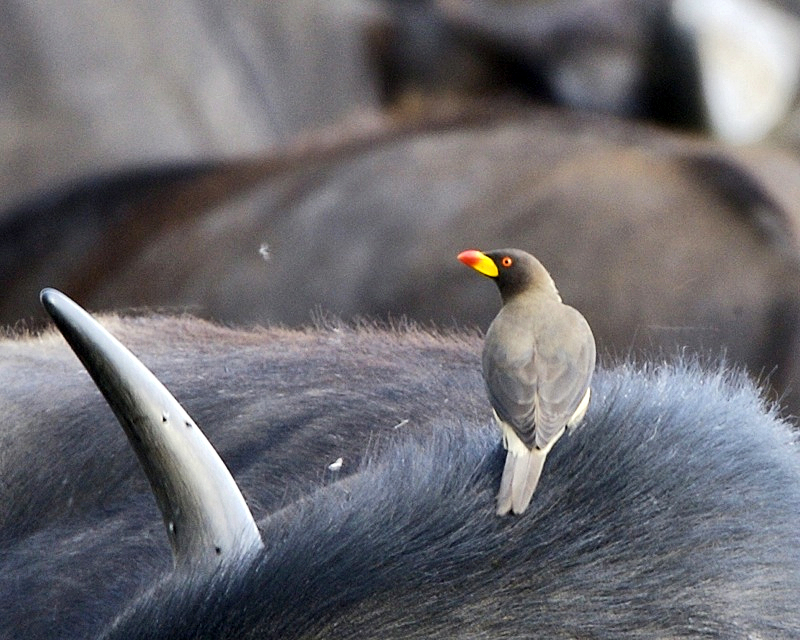

Appearance and behaviour
Oxpeckers are medium‑sized, stout birds with strong feet adapted for clinging to fur and skin. They have pointed bills suited to probing and picking, and their plumage is generally muted brown and grey. Typical behaviour includes walking along a host's body, pausing to pluck parasites, and occasionally pecking at wounds or blood. They often call loudly and will fly short distances between hosts or perches. Breeding pairs defend small territories and nest in tree cavities or similar sheltered sites.
Diet and ecological role
Although commonly described as mutualists that remove harmful parasites from hosts, the relationship between oxpeckers and their mammal hosts is complex. Their diet is dominated by blood‑feeding ticks and fly larvae, but oxpeckers also feed on fresh blood from wounds and may keep wounds open to access food. This can increase blood loss or infection risk in some hosts, so interactions range from beneficial to parasitic depending on context, host species and parasite load.
Taxonomy and evolutionary background
Oxpeckers form the family Buphagidae and are placed among the passerines. Modern genetic studies indicate they are an old lineage related to starling and mockingbird groups, though not closely affiliated with any single living family. Biogeographic evidence suggests the group's deep ancestors may have originated outside Africa, with later colonization and radiation on the African continent. The two extant species are usually listed under the genus Buphagus.
Relationship with humans and conservation
Oxpeckers are frequently seen on domestic stock as well as wild herbivores, bringing them into contact with pastoralists and conservation efforts. In some traditional farming systems they are tolerated or welcomed for apparent pest control, but their tendency to feed on wounds complicates perceptions. Habitat loss, changes in host populations, and veterinary treatments that reduce tick numbers can all affect oxpecker populations. Conservation assessments consider host availability and landscape change when evaluating their status.
Notable facts and distinctions
- There are only two species of oxpecker, both confined to sub‑Saharan savannas.
- The nature of their interaction with mammals spans mutualism to parasitism.
- Genetic evidence places them near starlings and mockingbirds, making them an ancient passerine lineage.
For further reading and source summaries, see these resources:
- Overview of oxpecker species
- Buphagidae family profile
- Savanna ecosystems and distribution
- Sub‑Saharan Africa biogeography
- African avifauna summaries
- Host associations with large mammals
- Domestic cattle interactions
- Associations with rhinoceroses and other wildlife
- Botfly and other ectoparasites
- Life cycle of parasitic larvae
- Phylogenetic studies and genetic evidence
- Mocks and thrashers: related passerines
- Starlings and evolutionary relatives
- Biogeography of passerine lineages
- Discussion of ancient lineages and "living fossils"
Readers seeking visual identification or regional reports should consult local field guides and up‑to‑date conservation listings. Observations of oxpecker behaviour can vary with host species, local parasite burdens and environmental conditions.
Questions and answers
Q: What are oxpeckers?
A: Oxpeckers are two species of bird belonging to the family Buphagidae that are endemic to the savanna of Sub-Saharan Africa.
Q: What do oxpeckers eat?
A: Oxpeckers feed on ticks, botfly larvae, and other parasites by perching on large mammals like cattle or rhinoceroses.
Q: What is the origin of the oxpecker lineage?
A: The origins of the oxpecker lineage are not entirely clear, but recent studies suggest that they are an ancient line related to mockingbirds, thrashers, and starlings that likely originated in Eastern or Southeastern Asia.
Q: What is the biogeography of the oxpecker lineage?
A: The biogeography of the oxpecker lineage and related groups suggest that they likely originated in Eastern or Southeastern Asia before migrating to Sub-Saharan Africa.
Q: Are the oxpeckers closely related to mockingbirds or starlings?
A: While the oxpeckers are related to mockingbirds, thrashers, and starlings, they are not particularly close to either group.
Q: How do oxpeckers interact with large mammals?
A: Oxpeckers perch on large mammals like cattle or rhinoceroses and eat ticks, botfly larvae, and other parasites.
Q: What is the unique aspect of the oxpecker lineage?
A: The two species of oxpeckers that make up the family Buphagidae are considered to be living fossils, as they likely originated in Eastern or Southeastern Asia and have since remained endemic to the savanna of Sub-Saharan Africa.
Related articles
Author
AlegsaOnline.com Oxpecker (Buphagidae): African birds that cling to large mammals Leandro Alegsa
URL: https://en.alegsaonline.com/art/73824
Sources
- doi.org : 10.1016/j.ympev.2006.05.007
- pubmed.ncbi.nlm.nih.gov : 16806992
- doi.org : 10.1016/j.ympev.2003.12.002
- pubmed.ncbi.nlm.nih.gov : 15186812
- lynxeds.com : Handbook of the Birds of the World. Volume 14, Bush-shrikes to Old World Sparrows
- beheco.oxfordjournals.org : Red-billed oxpeckers: vampires or tickbirds?
- doi.org : 10.1002/zoo.20013
- eurekalert.org : "Black rhinos eavesdrop on the alarm calls of hitchhiking oxpeckers to avoid humans"
- linkinghub.elsevier.com : "Oxpeckers Help Rhinos Evade Humans"
- doi.org : 10.1016/j.cub.2020.03.015