
Oxford English Dictionary
A historical dictionary published by Oxford University Press that records the development, meanings, and usage of English words over time.
The Oxford English Dictionary (OED) is a major historical dictionary of the English language published by Oxford University Press. Unlike a small desk dictionary, it aims to document the history of words: when they first appeared, how their meanings changed, and how they have been used in written English across different periods. For that reason, it is often consulted by scholars, editors, translators, and writers.
Image gallery
10 Images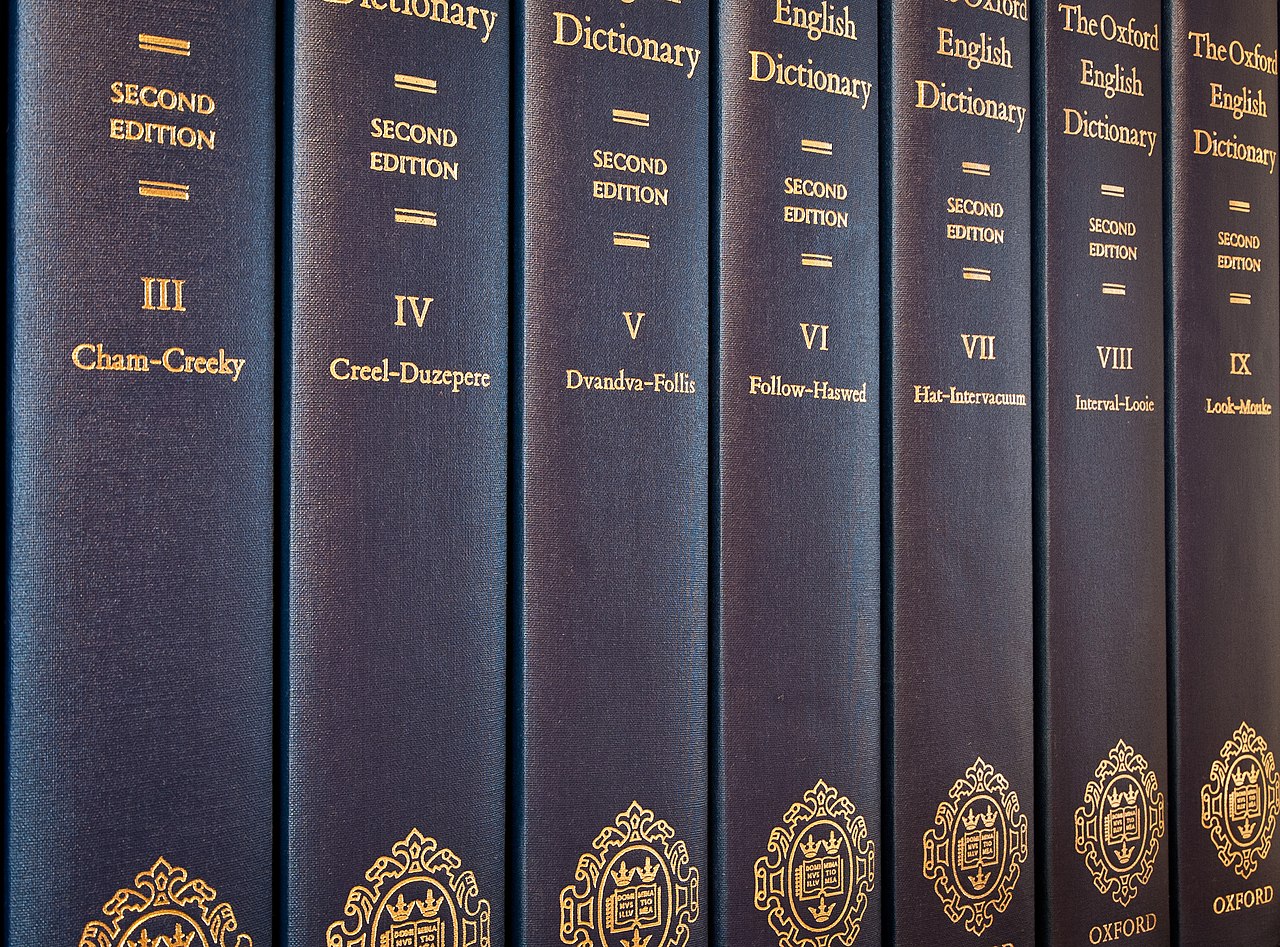


Purpose and method
The OED is best known for its historical approach. Entries are built from evidence, especially dated quotations taken from books, journals, newspapers, and other sources. These quotations show words in context and help explain shifts in spelling, meaning, pronunciation, and sense development. The dictionary does not simply state a modern definition; it traces a word’s life over time, including older or obsolete meanings as well as current ones.
This makes the OED different from many general dictionaries. It is less concerned with telling users the “correct” form of a word than with recording how English has actually been written and spoken. As a result, it is widely regarded as an important source for the study of historical linguistics, literature, and cultural history.
History and development
Work on the dictionary began in 1857, when scholars recognized the need for a more complete record of English vocabulary. Publication started in 1884 under the title A New English Dictionary on Historical Principles, based largely on materials gathered by the Philological Society. The name Oxford English Dictionary came into informal use later, and the first complete edition was eventually published in bound volumes in the 20th century.
The second edition appeared in 1989 and became the standard reference for many years. Since 2000, a third edition has been in progress and is being revised continuously as new evidence and new words are added. Because English keeps changing, the OED is not a finished monument but an ongoing editorial project.
Scale, structure, and digital form
The OED is one of the largest reference works devoted to a single language. Its entries typically include definitions, etymologies, dated quotations, and notes on usage. That structure allows readers to see both the earliest recorded form of a word and the later senses it acquired. Older and less common words are especially important in the OED, because they help explain the broader history of the language.
- Historical coverage: records word meanings across time.
- Evidence-based editing: uses quotations to illustrate usage.
- Etymological detail: explains origins and borrowings where known.
- Ongoing revision: updates entries as scholarship advances.
The dictionary was also adapted to electronic form, and the online version has become the main way many readers access it. Digital publication made searching faster and allowed editors to expand and revise entries more easily than in print. While earlier print editions remain historically significant, the modern OED is increasingly a living digital resource.
As a result, the OED is valued not only as a dictionary but also as a long-term record of the English language. It helps readers understand where words came from, how meanings changed, and how language reflects social and cultural history. Its influence on lexicography has been immense, and it remains one of the most respected works in reference publishing in England.
Questions and answers
Q: What is the Oxford English Dictionary?
A: The Oxford English Dictionary (or OED) is a dictionary published by the Oxford University Press in England. It traces the historical development of the English language and describes how it has been used.
Q: How many pages does the second edition have?
A: The second edition of the Oxford English Dictionary came to 21,728 pages in 20 volumes, published in 1989.
Q: How many main entries are there?
A: There are 231,100 main entries and 47,100 main entries for out-of-date words.
Q: When did work begin on the dictionary?
A: Work began on the dictionary in 1857.
Q: What was it called when it first started to be published?
A: When it first started to be published, it was called A New English Dictionary on historical principles; founded mainly on the materials collected by the Philological Society.
Q: When was The Oxford English Dictionary first used unofficially on its covers?
A: The title The Oxford English Dictionary (OED) was first used unofficially on its covers in 1895.
Q: When did an electronic version become available?
A: An electronic version of the dictionary became available in 1988 and an online version has been available since 2000.
Related articles
Author
AlegsaOnline.com Oxford English Dictionary Leandro Alegsa
URL: https://en.alegsaonline.com/art/73802
Sources
- public.oed.com : "Guide to the Third Edition of the OED"
- public.oed.com : public.oed.com/about/
- telegraph.co.uk : "Oxford English Dictionary 'will not be printed again'"
- telegraph.co.uk : "RIP for OED as world's finest dictionary goes out of print"