
Ovum (egg) — the female reproductive cell
An ovum (plural ova) is the haploid female reproductive cell or gamete produced by animals and land plants; it is formed by meiosis and, when fertilized, gives rise to a zygote.
Overview
An ovum (Latin: "egg") is the haploid cell that functions as the female reproductive unit in sexually reproducing organisms. In general usage the terms egg and ovum refer to the single large gamete that can be fertilized by a male gamete. The ovum carries one set of chromosomes, so it is described as haploid, and it serves the role of the female partner in sexual reproduction. As a reproductive cell, the ovum combines genetic material with a sperm to begin development of a new organism.
Image gallery
3 Images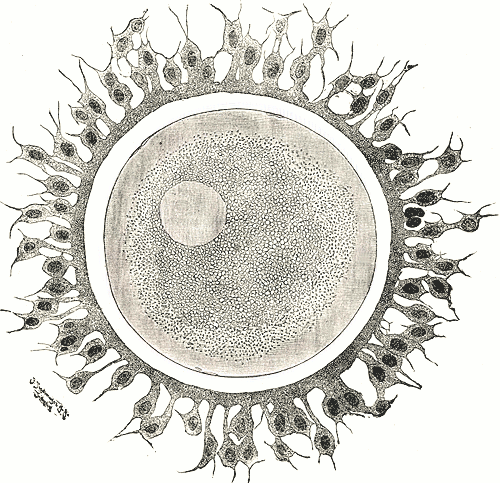


Structure and development
Ova vary widely among species but share some common features: a large cytoplasm rich in nutrients, a surrounding membrane or envelopes, and organelles needed for early embryonic development. They are produced through meiotic divisions of precursor cells; the process ensures the reduction to a single chromosome set. In many animals the mature ovum is released by ovulation and awaits fertilization, while in plants the functional egg cell is produced within the female gametophyte.
- Size: typically larger than sperm, sometimes containing yolk or stored reserves.
- Genetic status: haploid, carrying maternal chromosomes.
- Protective layers: membranes and, in some species, thick shells or extra envelopes.
Occurrence and importance
Both animals and many land plants produce ova or functionally equivalent egg cells. In flowering plants the egg develops inside the ovule within the ovary; in animals the ovum is a free cell released into a reproductive tract or enclosed in an egg. The fusion of an ovum with a sperm, the male gamete, produces a diploid zygote that begins embryogenesis. Understanding ova is central to developmental biology, agriculture, conservation, and assisted reproductive technologies.
Terminology and notes
The plural of ovum is ova. Closely related terms include "oocyte" (a developing egg cell) and "ovule" (in seed plants, the structure that contains the female gametophyte and egg). Historical and anatomical descriptions sometimes use different words depending on context, but the core concept remains: the ovum is the maternal gamete essential for sexual reproduction.
For further reading on basic reproductive cell biology and comparative descriptions across groups, see entries and resources indexed under egg cell, gamete formation, and fertilization: egg overview, haploid concept, female gametes, reproductive biology, cell biology, gamete interaction, plant reproduction.
Questions and answers
Q: What is an ovum?
A: An ovum is a haploid female reproductive cell or gamete.
Q: What is the origin of the word "ovum"?
A: The word "ovum" has a Latin origin and means "egg".
Q: Do only animals produce ova?
A: No, both animals and land plants produce ova.
Q: What is the purpose of the ovum?
A: The ovum's purpose is to unite with a sperm cell during fertilization to create a zygote.
Q: What is the ploidy level of an ovum?
A: The ploidy level of an ovum is haploid.
Q: What happens to the ovum if fertilization does not occur?
A: If fertilization does not occur, the ovum will be shed during menstruation in females.
Q: Is there any difference between the ova produced by animals and land plants?
A: No, ova produced by animals and land plants are essentially the same.
Related articles
Author
AlegsaOnline.com Ovum (egg) — the female reproductive cell Leandro Alegsa
URL: https://en.alegsaonline.com/art/73758
Sources
- education.yahoo.com : The Ovum, Gray's Anatomy of the Human Body, Yahoo! Education
- cancerweb.ncl.ac.uk : Ovum, Online Medical Dictionary, CancerWEB, Newcastle University
- rci.rutgers.edu : Oogenesis, Dr. Uzwiak, New Jersey State University
- biology-online.org : Definition of Ovum, Biology-Online.org