
Ouija board: history, use, and scientific explanation
A flat board used as a 'talking board' in games and spiritualist practice. This article explains its design, history, cultural impact, and the scientific explanation (ideomotor effect) behind reported messages.
Overview
The Ouija board, often called a spirit board or talking board, is a flat surface printed with the letters of the alphabet, the numbers 0–9, and simple words such as "yes", "no" and "goodbye". Players lightly rest their fingers on a small movable indicator — the planchette — and pose questions. The planchette appears to move under the players' fingers to spell out answers. The device is marketed both as an amusement game and used in various forms of amateur spirit communication.
Image gallery
9 Images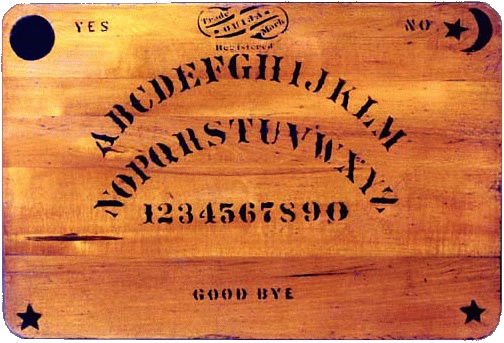


Typical design and use
Most commercially produced boards are printed on cardboard or wood and include a heart-shaped or triangular planchette with a window or pointer. Typical steps in use are:
- One or more participants place fingertips lightly on the planchette.
- One participant asks a question aloud.
- The group waits while the planchette moves toward letters or letters and numbers to form a response.
- Games vary in rituals, from casual party play to more elaborate spiritualist sessions.
History and cultural impact
The Ouija entered popular culture in the late 19th century, during a period when spiritualism was widespread in the United States and Europe. Commercial versions were produced and trademarked in the 1890s, and the board became a mass-market novelty thereafter. Over the 20th and 21st centuries it has appeared in literature, film, and folklore as both a playful toy and a symbol of contact with the beyond. Its name is often said to combine the French "oui" and the German "ja" (both meaning "yes"), though that etymology is traditional rather than definitively documented.
Scientific explanation and testing
Researchers and skeptics explain Ouija movements primarily by the ideomotor effect, a psychological phenomenon in which small, unconscious muscle movements produce motion without the participant feeling deliberate intent. Controlled experiments — for example, in which participants are blindfolded or the board is hidden — typically show that coherent responses disappear and movements become random. Formal scientific studies and numerous informal trials support this interpretation. Simple demonstrations involve asking questions while participants cannot see the board or the planchette; such blindfold tests usually result in nonsensical outcomes.
Uses, controversies, and precautions
People use Ouija boards in different ways: as a parlor game, for creative inspiration, or as part of spiritualist practice. Some religious and cultural groups warn against using the board, viewing it as inviting malevolent ghosts or spirits, while mental health professionals caution that highly suggestible or distressed individuals may experience anxiety after sessions. For safety, many recommend avoiding use with vulnerable participants and treating the board as entertainment rather than a definitive source of information.
Notable facts and distinctions
- The planchette and the board together create a simple tool that amplifies unconscious motion into apparently meaningful output.
- Modern variations include electronic devices, smartphone apps and novelty designs, but the underlying mechanism is the same.
- Testing under controlled conditions is the most reliable way to distinguish between chance, unconscious movement and deliberate fraud.
The Ouija board remains a persistent element of popular culture: evocative, controversial, and instructive about human suggestion and perception. For practical demonstrations or further reading, consider looking up controlled experiments and psychological reviews of the ideomotor effect to see how apparent messages can arise without any supernatural agency.
More on the game · Board elements · Letter layout · Research summaries · Claims about ghosts · Spirit beliefs · Blindfold experiments
Questions and answers
Q: What is a Ouija board?
A: A Ouija board is a game board that is supposedly used to communicate with the dead. It consists of a flat board with numbers 0-9 and all the letters of the alphabet, as well as words like "yes" and "no" at the top and "goodbye" on the bottom. The player uses a planchette, which is a small wooden plank in the shape of an upside down heart, to guide it over these letters or numbers to spell out messages.
Q: How does it work?
A: The Ouija board works by using something called the ideomotor effect. This means that one or more players believe they are not controlling the message, but rather that it comes from ghosts or spirits. However, scientists know this isn't true and anyone can test this by blindfolding or hiding the board from those who are moving the planchette - usually what results is gibberish and no message.
Q: What does 'planchette' mean?
A: A planchette is a small wooden plank in the shape of an upside down heart that has either a glass circle (or plain hole) in its top. It's used when playing with an Ouija board to guide it over letters or numbers to spell out messages.
Q: Is there any scientific evidence for using an Ouija Board?
A: No, there isn't any scientific evidence for using an Ouija Board - scientists know that it's based on self-deception and anyone can test this by blindfolding or hiding the board from those who are moving the planchette - usually what results is gibberish and no message.
Q: What do you need to play with an Ouija Board?
A: To play with an Ouija Board you need a flat gameboard with numbers 0-9 and all letters ofthe alphabet, as well as words like "yes" and "no" at its top and "goodbye" at its bottom; plus one or more players guiding their own individual planchettes over these letters/numbers/words in order to spell out messages.
Q: Is playing with an Ouija Board dangerous?
A: While some people may believe playing with an Ouija Board can be dangerous due to potential contact with spirits/ghosts etc., most experts agree that there isn't any real danger associated with playing this game since it's based on self-deception rather than actual communication between living beings and supernatural entities.
Related articles
Author
AlegsaOnline.com Ouija board: history, use, and scientific explanation Leandro Alegsa
URL: https://en.alegsaonline.com/art/73598
Sources
- mentalfloss.com : "A Brief History of the Ouija Board"
- livescience.com : "Ouija Board: Demystifying the 'Mystifying Oracle'"
- smithsonianmag.com : "The Strange and Mysterious History of the Ouija Board"