
Aularches (Aularches miliaris): foam‑squirting, brightly colored grasshopper
Aularches miliaris is a conspicuously colored grasshopper from South and Southeast Asia noted for its rasping alarm and a bitter, foamy defensive secretion that deters predators.
Overview
Aularches miliaris is a conspicuously patterned grasshopper frequently mentioned in accounts of insect defence because of its dramatic combination of warning colouration and an unusual chemical spray. It is a member of the short‑horned grasshoppers and is commonly treated alongside other brightly coloured, day‑active species that use visual signals to warn predators. For general context on grasshopper biology see grasshopper resources.
Image gallery
4 Images

Distribution and habitat
This species occurs in parts of South Asia and Southeast Asia. It is most often encountered in grassy clearings, roadside vegetation, shrubby margins and other lowland, disturbed habitats where herbaceous host plants are available. Aularches is adaptable to human‑altered landscapes and may be seen near agricultural edges and village gardens.
Identification and appearance
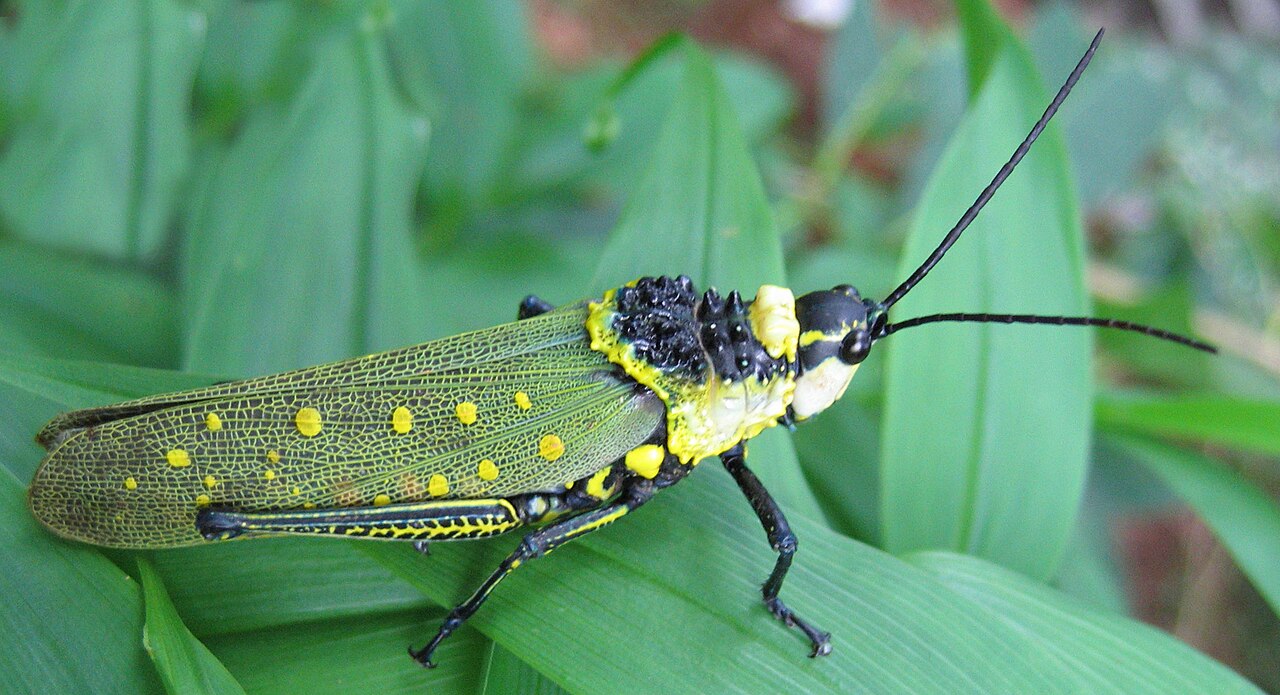
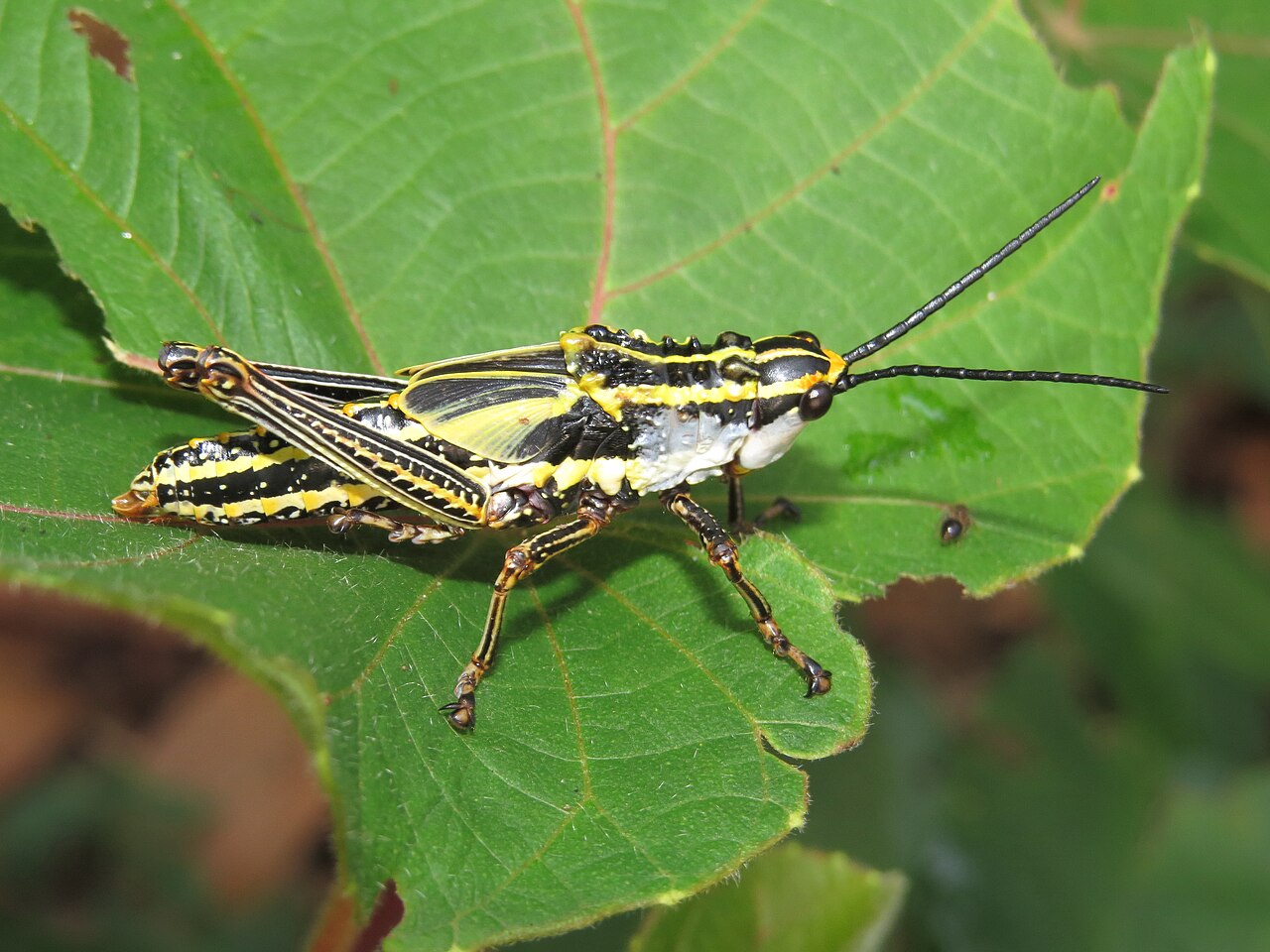
Adults are robust and conspicuously patterned, making them readily visible when at rest or in flight. The species shows bright, contrasting colours that function as aposematic (warning) signals to potential predators. The thorax and abdomen carry distinctive markings and the legs and wings may also display contrasting hues. The thoracic anatomy includes surfaces that can be rubbed together to produce a sharp rasping sound; see general notes on thoracic segments and sound‑producing structures.
Life cycle and diet
Like other short‑horned grasshoppers, Aularches undergoes hemimetabolous development: eggs hatch into nymphs which resemble reduced, wingless adults and pass through several moults before reaching maturity. The species is herbivorous and feeds on a variety of grasses and herbaceous plants in its range. It is not generally regarded as a major agricultural pest, although local feeding on foliage can occur where populations are dense.
Defensive behaviour
When disturbed Aularches commonly produces a sharp rasping or crackling noise generated by movements of thoracic surfaces; this behaviour can startle or warn off predators and is comparable to other orthopteran sound mechanisms (sound production). If seized or firmly pinched on the thorax, the insect can eject a clear, viscous foam as a defensive secretion.
Defensive secretion: properties and delivery
The foam has been described in field observations as mucous‑like, foul‑smelling and bitter to taste. It is faintly alkaline and contains many bubbles, producing a foamy texture that can heap around the insect. The material can be projected as a strong jet from openings in the thorax and may ooze more slowly from other body openings; older descriptions report about ten exudation points in total. This combination of a noisy alarm and a chemically unpleasant spray reduces the likelihood that a predator will continue to attack. For further reading on defensive secretions and insect chemical ecology see toxic foam and mucus summaries.
- Alarm sound: rapid rasping from thoracic rubbing.
- Primary defence: powerful jets from thoracic apertures.
- Secondary defence: gradual oozing from additional openings, reported as around ten in some accounts (exudation points).
Ecology and interactions
The visual and chemical defences of Aularches make it an undesirable target for many predators, contributing to survival following encounters. Birds, reptiles and small mammals that sample the insect are likely to find it unpalatable and learn to avoid similarly coloured prey. The species is therefore of interest to ecologists studying aposematism, predator–prey learning and the evolution of chemical defences; comparative material and methods are discussed in general sources on defensive odours.
Human interactions and cautions
While the secretion is primarily a deterrent rather than a severe toxin to humans, it can soil clothing and may irritate skin or mucous membranes; handling is not recommended. Naturalists and students observing Aularches should take care when collecting or examining specimens and follow standard precautions for handling chemically defended insects. Additional context on handling and safety is available in field guides and entomological resources (sound production, grasshopper references).
Research and cultural notes
Aularches continues to attract attention for its conspicuous defence strategy, and it is cited in popular and scientific literature as an example of how aposematic colouration can be combined with active chemical defence. Research interest includes the composition of the secretion, the biomechanics of jetting, and the behavioural responses of predators that encounter the foam.
For further general reading and species accounts consult regional insect guides and entomological surveys that cover the grasshopper fauna of South and Southeast Asia (South Asia, Southeast Asia).
Questions and answers
Q: What is Aularches miliaris?
A: Aularches miliaris is a grasshopper found in south and southeast Asia.
Q: How is Aularches miliaris protected?
A: Aularches miliaris is protected by powerful chemical defences and its warning colour signals its foul taste.
Q: What does Aularches miliaris do when it is disturbed?
A: When Aularches miliaris is disturbed, it makes a sharp rasping noise with its thoracic segments.
Q: What does Aularches miliaris release when its thorax is pinched?
A: When Aularches miliaris's thorax is pinched, it gives off a toxic foam.
Q: What does the foam released by Aularches miliaris smell like?
A: The foam released by Aularches miliaris has an unpleasant smell and a bitter taste, faintly alkaline, with many bubbles.
Q: Where does the foam come out from in Aularches miliaris?
A: The foam comes out as a strong jet from openings in the thorax and more gently from other openings in the body (ten in total).
Q: What happens to the foam released by Aularches miliaris after it is released?
A: The foam heaps up around the insect and partly covers it.
Related articles
Author
AlegsaOnline.com Aularches (Aularches miliaris): foam‑squirting, brightly colored grasshopper Leandro Alegsa
URL: https://en.alegsaonline.com/art/7355
Sources
- doi.org : 10.1111/j.1365-2311.1927.tb00060.x
- orthoptera.speciesfile.org : Aularches miliaris miliaris (Linnaeus, 1758)