
Ostrich (Struthio camelus) — large flightless bird of Africa
The ostrich is the tallest and heaviest living bird native to Africa, notable for exceptional running speed, very large eyes, and the largest eggs of any living bird.
Overview
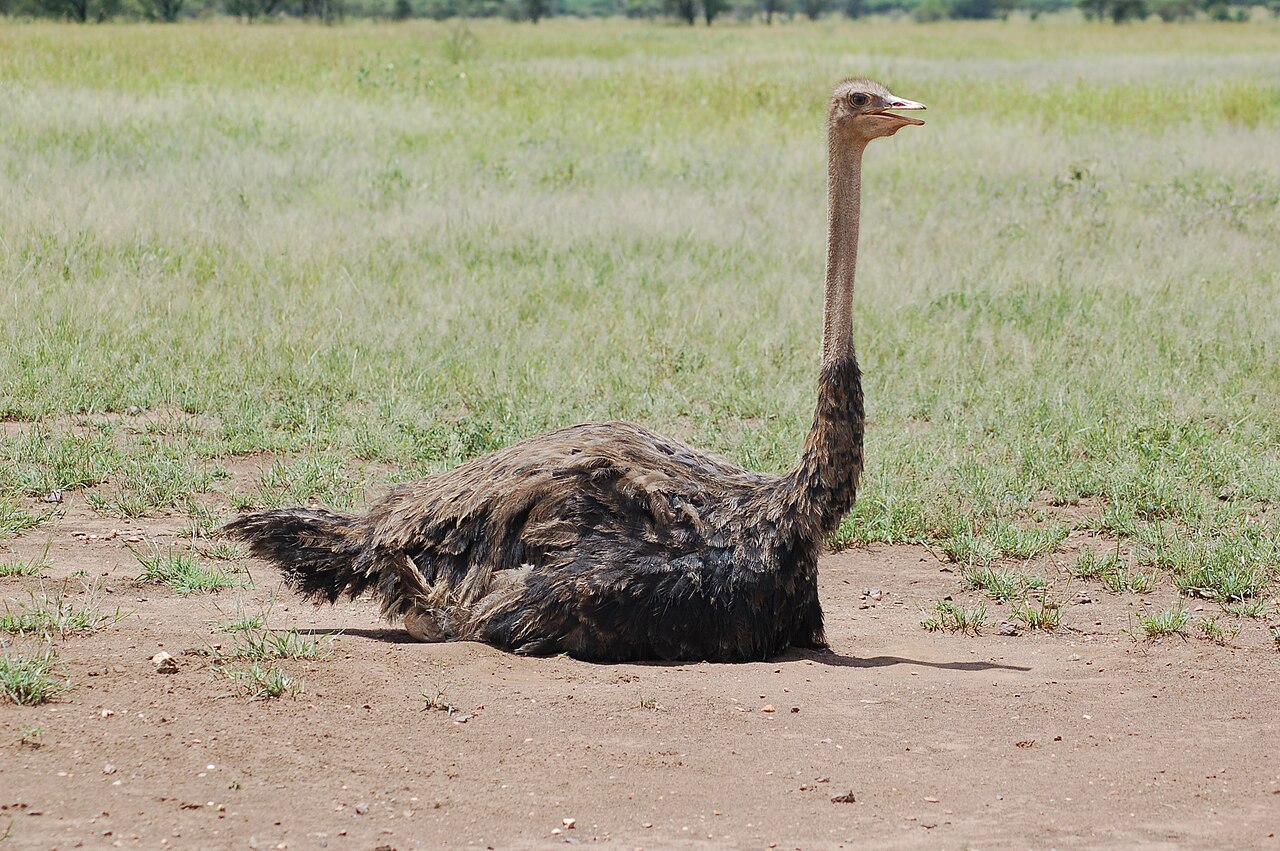
The ostrich (Struthio camelus) is a distinctive flightless bird native to open regions of Africa. It is the tallest and heaviest living bird and is well known for its long neck, long legs and ability to run rapidly. The species lays the largest eggs of any living bird and occupies an important ecological niche across grassland and semi-arid habitats. The ostrich is commonly cited as the largest living bird species by height and mass.
Image gallery
10 Images




Anatomy and adaptations
Ostriches belong to the group of flightless birds called ratites, which share a flat breastbone and other skeletal traits associated with loss of flight. Their wings are reduced and used mainly for balance, courtship displays and shading chicks rather than sustained flight. Each foot has two toes, one of which bears a large, hoof-like nail that helps during fast running. Ostriches have exceptionally large eyes and are often noted as having the biggest eyes of any land animals, an adaptation that benefits daytime vision across open terrain.
Behavior and life cycle
These birds are social and commonly form groups that help detect predators. Ostriches are omnivorous: they eat plant matter, seeds, insects and small vertebrates. Reproduction often involves communal nests in which several females may deposit eggs into a single scrape; the eggs are incubated and tended by adults. Males and females can share parental duties, with males frequently taking a prominent role in nocturnal incubation and defense.
History, conservation and human uses
Ostriches have been known to humans for millennia and were prized in ancient cultures for their feathers and eggshells; today they are farmed for meat, leather and feather products. Wild populations have been affected regionally by habitat change and hunting pressure, and conservation measures vary by country. Farming and regulated harvest have reduced some pressures on wild stocks while creating modern economic uses.
Notable facts and distinctions
- Fastest running bird on land, using long strides and powerful legs for sustained speed.
- Eggs are many times larger than a typical chicken egg and have been used as food and decorative objects.
- Belonging to the ratites links them to emus, rheas and cassowaries in evolutionary discussions.
- Large eyes and height provide excellent detection of predators across open landscapes.
For additional reading on classification, anatomy and conservation, see authoritative resources linked below and specialized literature on ratite evolution and African savanna ecosystems. Flightless bird overview, Africa habitats, size comparisons, egg records, ratite group, ocular adaptations and land vertebrate comparisons provide entry points for further study.
Questions and answers
Q: What is an ostrich?
A: An ostrich is a large flightless bird that lives in Africa.
Q: How big is an ostrich?
A: Ostriches are the largest living bird species.
Q: What is unique about ostrich eggs?
A: Ostriches have the biggest eggs of all living birds.
Q: Can ostriches fly?
A: Ostriches do not fly.
Q: What is a ratite?
A: A ratite is a useful grouping of medium to large flightless birds.
Q: How fast can an ostrich run?
A: Ostriches can run faster than any other bird.
Q: What is unique about an ostrich's eyes?
A: Ostriches have the biggest eyes of all land animals.
Author
AlegsaOnline.com Ostrich (Struthio camelus) — large flightless bird of Africa Leandro Alegsa
URL: https://en.alegsaonline.com/art/73453
Sources
- species.wikimedia.org : Struthio camelus
- commons.wikimedia.org : Struthio camelus
- iucnredlist.org : "Struthio camelus"
- doi.org : 10.2305/IUCN.UK.2016-3.RLTS.T45020636A95139620.en
- taxonomy.nl : "Systema Naturae 2000 / Classification, Genus Struthio"
- animals.nationalgeographic.com : "Ostrich - National Geographic"
- sandiegozoo.org : "San Diego Zoo's Animal Bytes: Ostrich"
- animaldiversity.ummz.umich.edu : "Struthio camelus"
- desertusa.com : "Ostrich"
- books.google.com : The New international encyclopædia
- trails.com : trails.com
- books.google.com : The Garden Route and Little Karoo
- theanimalfiles.com : theanimalfiles.com
- wildwatch.com : wildwatch.com
- pnas.org : "Phylogenetic evidence for multiple losses of flight in ratite birds"