
Osnabrück (district)
Osnabrück is a Landkreis in Lower Saxony, Germany, surrounding but administratively separate from the City of Osnabrück. The district mixes lowland agriculture, wooded hills and medium-sized towns.
Overview: The district is an administrative district (Landkreis) in the state of Lower Saxony within Germany. It forms a ring of rural and urbanized territory around the independent City of Osnabrück, which serves as the regional centre but is not part of the Landkreis itself. The district combines agricultural plains, forested elevations and a network of towns that provide services and light industry for the surrounding countryside.
Image gallery
1 Image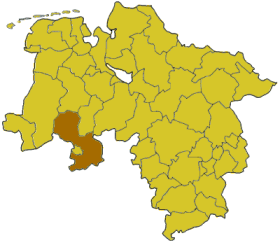
Geography and landscape
The territory includes varied terrain: low river valleys, rolling farmland and the western reaches of forested uplands. Parts of the landscape are influenced by the nearby Teutoburg Forest and by local river systems that have shaped settlement and transport routes. The mixture of open fields and wooded slopes makes the district distinct within Lower Saxony and contributes to a diverse local economy and recreational opportunities.
Neighbours
The district borders several other districts and a neighbouring state. Immediate neighbours include Emsland, Cloppenburg, Vechta and Diepholz to the north and west. To the south and southwest it meets the state of North Rhine-Westphalia, where neighbouring districts include Minden-Lübbecke, Herford, Gütersloh and Warendorf, as well as other adjacent counties. The City of Osnabrück lies at the district's heart but maintains independent municipal status.
History and administration
The district's identity is tied to the long-settled Osnabrück region, which has been an important crossroads between northern and western parts of modern Germany. While the nearby city is historically notable — for example, as one of the locations associated with the Peace of Westphalia negotiations in the 17th century — the district developed as a predominantly rural administrative unit in support of regional commerce and agriculture. Today the Landkreis is governed by an elected council and an administrative head responsible for regional planning, schools, roads and social services within its boundaries.
Economy, transport and settlements
Economic activity in the district is mixed: agriculture and food production are significant in rural areas, while towns host manufacturing, trade and service sectors. A network of regional roads and rail links connects settlements within the district to the city and to long-distance routes toward North Rhine-Westphalia and beyond, facilitating commuting and freight movement. Local tourism benefits from natural areas, walking trails and cultural sites around towns and villages.
Distinctive features
- The district surrounds an independent city that acts as the practical centre for administration, education and commerce.
- Its landscape blends agricultural lowlands with wooded uplands, creating varied land use and leisure opportunities.
- Good transport links tie the district into regional economies across state borders.
For readers seeking administrative or visitor information, local government pages and regional tourism guides provide current details on municipalities, services and events within the district.
Questions and answers
Q: What is Osnabrück?
A: Osnabrück is a district in Lower Saxony, Germany.
Q: How is Osnabrück situated with respect to other districts and states in Germany?
A: Osnabrück is located near the districts of Emsland, Cloppenburg, Vechta, and Diepholz, as well as the state of North Rhine-Westphalia including the districts of Minden-Lübbecke, Herford, Gütersloh, Warendorf, and Steinfurt.
Q: What is the capital city of Osnabrück?
A: The city of Osnabrück is the capital of Osnabrück district.
Q: What is the population of Osnabrück?
A: The text does not mention the population of Osnabrück district.
Q: What is the abbreviation of Landkreis in English?
A: Landkreis is the German word for district. There is no specific abbreviation for Landkreis in English.
Q: How do you pronounce Osnabrück?
A: Osnabrück is pronounced as [ɔsnaˈbʁʏk] in the International Phonetic Alphabet.
Q: Is Osnabrück a city or a district?
A: Osnabrück is a district. However, there is also a city named Osnabrück that is located within the district.
Related articles
Author
AlegsaOnline.com Osnabrück (district) Leandro Alegsa
URL: https://en.alegsaonline.com/art/73394