
Orpiment (As2S3) — yellow arsenic sulfide mineral
Yellow-orange arsenic sulfide mineral (As2S3). Soft and toxic; historically a pigment and arsenic ore. Forms in hydrothermal and geothermal deposits and oxidizes to arsenic trioxide on exposure.
Overview
Orpiment is a naturally occurring arsenic sulfide mineral with the formula As2S3. It is easily recognized by its saturated yellow to orange color and resinous to pearly luster. Because it contains arsenic it is toxic and must be handled with care. For basic mineralogical data see mineral reference and for chemical notation see chemical reference.
Image gallery
10 Images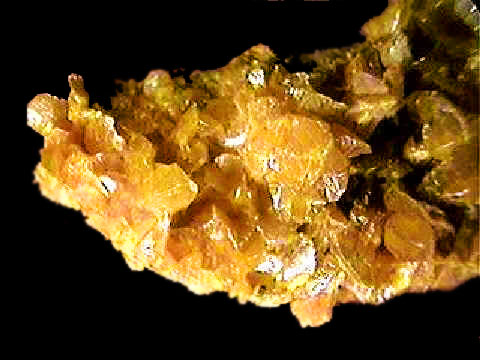


Physical and chemical properties
Orpiment is a very soft, brittle mineral with a Mohs hardness of approximately 1.5–2, and a relatively high specific gravity of about 3.4. It commonly forms foliated, scaly or columnar aggregates and yields a yellow streak. When heated it melts near 300°C and at higher temperatures oxidizes to more toxic arsenic oxides; detailed density and related data are available at density source and its oxidation behavior is summarized at chemical oxidation notes.
Occurrence and formation
Orpiment typically forms in low-temperature hydrothermal veins, hot spring deposits, and in volcanic fumaroles. It is frequently found together with the related mineral realgar (arsenic sulfide with different stoichiometry), and with other sulfides and native arsenic. As a secondary mineral it may appear where arsenic-bearing fluids interact with sulfur-rich environments.
History and uses
Historically orpiment was prized as one of the few bright yellow pigments available to artists before synthetic yellows existed. It was used in illuminated manuscripts, wall paintings and traditional Asian painting. Because of its arsenic content it has largely been replaced by safer organic and inorganic pigments. Orpiment has also been exploited as an ore of arsenic and used in small-scale applications such as leather processing or in traditional remedies, though these uses declined due to toxicity concerns; an overview of historical pigment use is at pigment history and industrial applications are discussed at industrial use notes.
Safety and notable facts
- Orpiment can form a surface coating of arsenic trioxide when it oxidizes; this contributes to its toxicity and requires careful handling.
- Because it is soft and chemically unstable in air and light, orpiment-based paints can darken or deteriorate over time, creating conservation challenges for artworks.
- Modern collectors and researchers treat orpiment specimens with caution, using gloves and avoiding inhalation or ingestion of dust.
While visually striking, orpiment is chiefly of interest today to mineral collectors, historians of art, and industrial chemists studying arsenic compounds. Its combination of vivid color, distinctive physical traits, and hazardous chemistry makes it a mineral of both cultural importance and scientific concern.
Questions and answers
Q: What is orpiment?
A: Orpiment is a mineral.
Q: What is the chemical formula for orpiment?
A: The chemical formula for orpiment is As2S3.
Q: What color is orpiment?
A: Orpiment is orange to yellow in color.
Q: What is the hardness of orpiment?
A: Orpiment has a Mohs hardness of 1.5 to 2.
Q: What is the specific gravity of orpiment?
A: Orpiment has a specific gravity of 3.46.
Q: Why is orpiment toxic?
A: Orpiment is toxic because it gets a layer of arsenic trioxide on it by oxidation in the air.
Q: What was orpiment used for in the past?
A: Orpiment was used as a pigment because it was one of the only yellow pigments that they could find, and it was also used to remove hair from hides.
Related articles
Author
AlegsaOnline.com Orpiment (As2S3) — yellow arsenic sulfide mineral Leandro Alegsa
URL: https://en.alegsaonline.com/art/73244